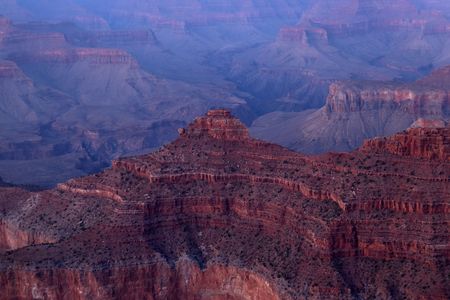

New research has unveiled fascinating details about how one of America’s most iconic natural wonders came to be. Scientists have traced the ancient path of the Colorado River to explain when and how it carved Arizona’s magnificent Grand Canyon.
Using advanced analysis of microscopic zircon crystals found in sandstone and volcanic ash deposits, researchers have mapped the river’s prehistoric journey. Their findings reveal a dramatic geological story spanning millions of years.
According to the study, approximately 6.6 million years ago, the Colorado River began flowing into a massive basin in northeastern Arizona. This created an enormous shallow lake stretching more than 90 miles across, located east of where the Grand Canyon exists today.
The ancient lake, which scientists have nicknamed Bidahochi Lake after a local rock formation, gradually filled with water over roughly one million years. Around 5.6 million years ago, the lake reached capacity and began overflowing at its lowest point, sending water rushing through what would become the Grand Canyon corridor.
The river continued its journey, filling and overflowing through additional downstream basins before finally reaching the Gulf of California about 4.8 million years ago, where it emptied into the sea near northwestern Mexico.
“Scientists have long debated when the Grand Canyon was carved, and our study contributes to that conversation,” explained UCLA geologist John He, who co-led the research published in the journal Science.
He described their innovative research method: “Imagine you go out to a river bank and scoop up a handful of sand. In that handful, there are hundreds of thousands of sand grains that look like any other sand grain. But within that handful there will be a couple of hundred or even thousands of microscopic grains of zircon crystal, each of which is a vault of information about where it comes from.”
The team used volcanic ash dating to determine when the river deposited the sand layers containing these informative zircon crystals.
Ryan Crow, a research geologist with the U.S. Geological Survey in Flagstaff, Arizona, and study co-leader, addressed a long-standing geological puzzle: “A longstanding question has been: where did the Colorado River go before it flowed through Grand Canyon?”
“We have long known that the river existed in western Colorado 11 million years ago, and that it did not (run through) Grand Canyon until after 5.6 million years ago. But until now we knew almost nothing about where it was during the intervening time,” Crow explained.
The Colorado River begins its 1,450-mile journey at La Poudre Pass in Colorado’s Rocky Mountain National Park. The Grand Canyon itself stretches approximately 280 miles long, reaches up to 18 miles wide, and plunges more than a mile deep in some areas.
The canyon’s walls display rock layers formed up to 1.8 billion years ago, creating a visible timeline of Earth’s geological history.
“Past work shows that over the last million years the Colorado River has been carving into rock at an average rate of about 100 meters to 160 meters (330 to 525 feet) per million years, so the process of canyon carving continues. The canyon we see today is the result of about five million years of river incision and erosion,” Crow noted.
The researchers emphasized that the Grand Canyon continues to captivate visitors and scientists alike.
“Grand Canyon, a natural wonder of the world, captures the attention and curiosity of almost everyone that sees it. People relate to it in different ways. But I think many, even those who rarely think about geology, have similar questions when they see Grand Canyon. How did the canyon form? When did the canyon form? Those are questions we strive to answer,” Crow said.
He reflected on the canyon’s profound impact: “The architecture of the planet is so exposed, laid bare in front of us. There is something disquieting about this, being challenged to envision the millions of years of geologic time by the solidity of a towering wall of rock.”