
NEW ORLEANS — Carnival season has arrived in New Orleans, bringing with it countless strands of traditional green, gold and purple Mardi Gras necklaces.
While parade-goers once treasured glass beads that were difficult to obtain, today’s celebrations feature mass-produced plastic necklaces from foreign manufacturers that float riders distribute freely. Though spectators often collect multiple strands during parades, many end up discarded on streets or thrown away. Following severe flooding several years ago, city workers discovered over 46 tons of these plastic trinkets blocking municipal storm drainage systems.
These necklaces have become an environmental concern, yet imagining Mardi Gras celebrations without them seems impossible. This challenge led the Krewe of Freret to take a bold stance last year by prohibiting plastic beads entirely from their parade route.
“Our riders loved it because the spectators don’t value this anymore,” said Greg Rhoades, who co-founded Freret. “It’s become so prolific that they dodge out of the way when they see cheap plastic beads coming at them.”
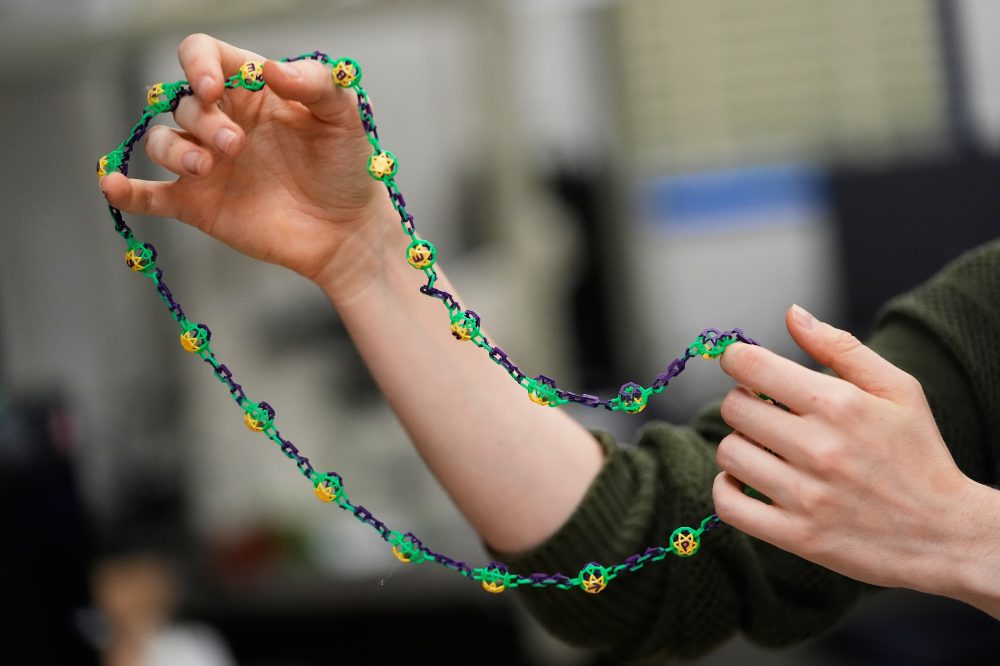
For this year’s festivities, the krewe has returned to distributing beads, but not the traditional plastic variety. Freret joins two other parade organizations in testing environmentally-friendly alternatives created by Louisiana State University researchers.
Graduate student Alexis Strain explained that these “PlantMe Beads” are manufactured using 3D printing technology with polylactic acid, a starch-derived material known as PLA. Each individual bead consists of a large hollow sphere filled with okra seeds, allowing the entire necklace to be planted in soil where the okra helps attract decomposition-promoting bacteria.
According to Kristi Trail, who serves as executive director of the Pontchartrain Conservancy, plastic beads create dual environmental hazards. Initially, they obstruct storm drainage systems and contribute to urban flooding. Subsequently, those that escape the drains flow directly into Lake Pontchartrain, potentially endangering aquatic ecosystems. Her organization currently plans to research microplastic contamination in the lake.
Environmental consciousness during Mardi Gras has expanded over recent years, with parade organizers increasingly choosing meaningful alternatives like food items, soap products, and sunglasses instead of disposable trinkets. Trail noted that while comprehensive data on these efforts’ effectiveness remains unavailable, recent grant funding should enable future impact assessments.
“Beads are obviously a problem, but we generate about 2.5 million pounds of trash from Mardi Gras,” Trail stated.
Strain conducts her research under Professor Naohiro Kato, an associate biology professor at LSU who conceived biodegradable bead development in 2013 following conversations with environmentally-concerned community members. Drawing on his plant biology expertise, Kato recognized that vegetation could serve as bioplastic source material and began exploring potential applications.
The laboratory’s initial biodegradable prototypes emerged in 2018 using bioplastic derived from microalgae. However, manufacturing expenses for algae-based beads proved too costly to compete with petroleum-based alternatives. Strain’s subsequent experimentation with 3D printing technology led to the PlantMe Bead innovation.
For the 2026 Carnival season, LSU students have manufactured 3,000 PlantMe Bead necklaces that they’re distributing to three parade organizations in exchange for design feedback and spectator response data.
Kato mentioned an amusing development: people have expressed appreciation for the PlantMe Beads’ uniqueness and desire to preserve them as keepsakes.
“So wait a minute, if you want to keep it, the petroleum-plastic Mardi Gras bead is the best, because this won’t last,” he observed.
The research team continues developing additional sustainable Mardi Gras solutions. Strain experiments with different 3D printing materials that decompose rapidly without requiring soil planting. Kato discusses partnerships with local educational institutions to transform bead production into community engagement projects, envisioning students creating necklaces while learning about bioplastics and plant science. He also continues investigating methods to make algae-based bioplastic economically feasible.
Nevertheless, Kato emphasized that replacing one plastic type with a less harmful alternative shouldn’t be the ultimate objective. He advocates for Mardi Gras celebrations to embrace waste reduction principles.
Rhoades confirmed that Freret shares this philosophy.
“In 2025, we were the first krewe — major parading organization — to say, ‘No more. No more cheap beads. Let’s throw things that people value, that people appreciate, that can be used year-round,’” Rhoades explained.
Among their most popular distribution items are baseball caps featuring the Freret logo. Rhoades regularly notices people wearing these hats throughout the city and reports that other parade organizations have taken notice.
“I really believe that we, and other krewes, are able to inspire your larger krewes,” he said. “They want people to like their stuff. They want people take their stuff home, and use it, and talk about it, and post it on social media, and say, ‘Look what I just caught!’”
Source: https://srnnews.com/biodegradable-mardi-gras-beads-help-make-carnival-season-more-sustainable/