
The latest “Masters of the Universe” film appears confused about its target demographic. While contemporary blockbusters typically aim for broad appeal to justify massive production budgets for movies based on vintage toys, He-Man will never achieve the cultural impact that Barbie has accomplished.
The character and visual style — featuring muscular physiques and distinctive hairstyles — remains firmly anchored in 1980s culture. The toy line debuted in 1982 as competition for Star Wars merchandise. An animated television show followed in 1983, leading to a 1987 film starring Dolph Lundgren that failed both critically and commercially during the franchise’s peak years.
While some fans have embraced that original “Masters of the Universe” movie as an entertaining cult favorite, and several animated shows have appeared over recent decades, He-Man appears culturally frozen in that era. The property became a nostalgic artifact alongside Saturday morning cartoons — except for an internet meme featuring “What’s Up?” by 4 Non Blondes, which gets a nod in this new film. However, even that viral video dates back to 2005.
Travis Knight directed this version after successfully creating something appealing from “Transformers” with “Bumblebee.” However, this production seems uncertain about its identity. It functions as an expensive B-movie that’s simultaneously cartoonish and campy while constantly making excuses for those qualities. The violence level likely excludes children under ten years old. The filmmakers attempt something similar to Taika Waititi’s “Thor” films or “Guardians of the Galaxy,” but fail to fully embrace what that HEYYEYAAEYAAAEYAEYAA internet video understood perfectly: He-Man is fundamentally absurd. Not just the character, but everything — the appearance, the character names, even the catchphrase “by the power of Greyskull, I have the power.”
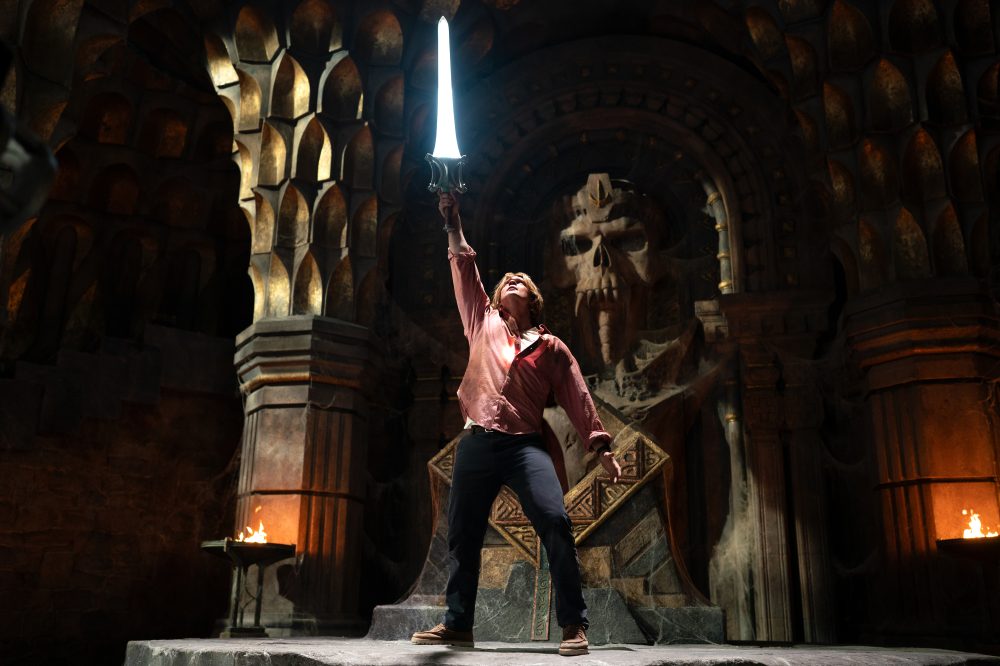
The screenplay, credited to numerous writers, tries to make much of this material into repetitive humor. The story explains awkward character names like Fisto and Ram Man as products of a child’s creativity. The plot establishes a scenario where Prince Adam (portrayed as a child by Artie Wilkinson-Hunt) gets evacuated from Eternia for safety when Skeletor (Jared Leto) conquers the realm. After fifteen years stranded on Earth, he works a mundane human resources position, shares an apartment with a roommate, and desperately searches for the Power Sword that represents his only chance to return home. Though he’s developed into an attractive adult (Nicholas Galitzine), he remains extremely socially awkward and openly discusses his background. Predictably, everyone considers him mentally unstable.
Fortunately, his Earth-based scenes are brief (though perhaps not brief enough in a film that stretches to an excessive 142 minutes, including a Lundgren appearance) before he returns to Eternia attempting to restore the kingdom. Initially, everyone dismisses him, including his childhood friend Teela, who has become a warrior with model-like features (played with detached coolness by Camila Mendes), until he learns to wield the sword that immediately grants him superhuman abilities. It’s challenging to convey how unexciting and undramatic this simple solution feels.
The extensive cast performs admirably given the material. Galitzine displays charm and sweetness in his awkwardness, but his character lacks development. Idris Elba contributes amusing seriousness to a defeated warrior struggling with lost confidence. As Skeletor, Leto embraces theatrical excess with a dramatic British accent that evokes Paul F. Tompkins’ Andrew Lloyd Webber impression more than Bane. This isn’t necessarily negative — Leto and Alison Brie, playing his mistreated assistant, appear to enjoy themselves most, resembling refugees from “Power Rangers” — but it raises questions about why they didn’t simply hire an English character actor initially. Other performers fare worse: Morena Baccarin serves mainly atmospheric purposes as The Sorceress, while Kristen Wiig delivers a forgettable performance as a robotic warrior.
The film attempts to explore themes about masculine expectations and authority, but these elements remain disorganized and unclear while failing to meaningfully include female characters in the conversation.
The movie might have succeeded better by fully embracing Saturday morning cartoon sensibilities with fewer self-mocking jokes. However, that approach would have demanded greater certainty about the project’s fundamental purpose.
“Masters of the Universe,” distributed by Amazon MGM Studios and opening in theaters Friday, receives a PG-13 rating from the Motion Picture Association for “sequences of violence and action, some suggestive material and language.” The runtime is 142 minutes. Rating: Two stars out of four.