
Palestinian families in the West Bank are expressing deep anxiety about the safety of their imprisoned loved ones following Israel’s passage of new legislation that establishes capital punishment as the standard sentence for Palestinians found guilty of fatal attacks.
The legislation, approved by Israeli lawmakers late Monday evening, technically applies to all citizens but specifically targets attacks described as those “negating Israel’s existence” – language that critics argue makes it highly unlikely to affect Jewish Israelis.
Legal scholars anticipate Israel’s Supreme Court will overturn the measure after civil rights organizations file their expected challenge, noting the law conflicts with international agreements. The U.N. human rights chief stated Tuesday that the legislation breaches international humanitarian law.
Under the new statute, condemned individuals would face execution specifically through hanging within 90 days of sentencing, with no opportunity for clemency. Legal experts suggest the hanging provision was included due to concerns that Israeli physicians would decline to participate in lethal injection procedures.
While judges retain discretion to impose life imprisonment instead of execution in undefined “special circumstances,” the law otherwise mandates capital punishment.
The Israeli human rights organization B’Tselem reports that West Bank military tribunals, which exclusively handle Palestinian cases, achieve conviction rates of 96% and have documented histories of coercing confessions through pressure or torture – allegations Israel disputes.
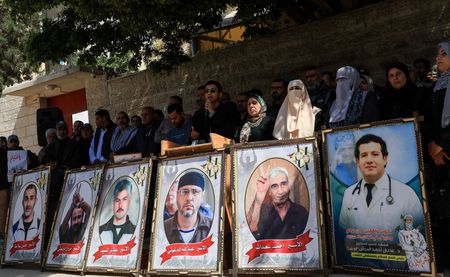
Family members of Palestinian detainees gathered for a demonstration in Ramallah Tuesday, demanding the death penalty statute be rescinded.
“I am afraid for my son and for all the prisoners. The news came down like a thunderbolt on the prisoners’ families,” said Maysoun Shawamreh, whose 29-year-old son Mansour faces attempted murder charges.
Abdel Fattah al-Himouni’s son Ahmed awaits trial for his alleged role in an October 2024 combined shooting and stabbing incident at a light-rail station near Tel Aviv that claimed seven lives, including a woman holding her infant.
Al-Himouni expressed concern his son could now face execution if convicted and questioned whether a fair trial would be possible. “I appeal to human rights organizations to pressure the Israeli government so this law does not come into effect,” said al-Himouni.
The 1949 Fourth Geneva Convention, which Israel has signed, requires that death row inmates retain petition rights for pardons and mandates at least six months between sentencing and execution.
Mordechai Kremnitzer, a legal scholar with the Israel Democracy Institute, characterized the law as “a clear case that invites the Supreme Court to strike it down.”
“The likelihood of executions in the near future is not very high,” Kremnitzer explained, noting that judges typically oppose capital punishment as it conflicts with both universal and Jewish moral principles.
The measure has generated international condemnation of Israel, which already faces criticism for escalating settler violence against Palestinians in the West Bank and its military operations against Hamas in Gaza.
Israeli settler attacks on Palestinians in the West Bank seldom result in military court charges. The monitoring group Yesh Din reports the most recent case of an Israeli citizen being indicted for killing a Palestinian involved a 2018 incident.
In Israel’s civilian court system, where Palestinians may also face trial, the law similarly mandates death or life imprisonment for homicides intended to “negate Israel’s existence” – terminology unlikely to apply to Jewish defendants.
“That’s how the law will only apply to Palestinians,” explained attorney Debbie Gild-Hayo of The Association for Civil Rights in Israel, which has petitioned the Supreme Court challenging the measure.
Suhad Bishara, whose organization Adalah jointly filed the appeal with ACRI, argued that “military courts have no basic guarantees for a fair trial” and questioned whether Israel’s parliament has authority to create laws for occupied territories.
Palestinian Authority prisoners’ minister Raed Abu al-Hummus estimates 45 to 47 Palestinian detainees currently awaiting murder sentencing could face execution if the law takes effect.
ACRI clarified the statute would only apply to future killings, not past cases, and would not affect the hundreds of Hamas fighters involved in the October 7, 2023 attack that killed 1,200 people in southern Israel, since parliament continues developing the legal framework for their trials.
Israel’s far-right politicians celebrated the legislation as fulfilling a key 2022 campaign promise by National Security Minister Itamar Ben-Gvir. His Jewish Power party contends capital punishment will discourage Palestinians from conducting deadly attacks against Israelis or attempting kidnappings to secure prisoner exchanges.
However, Amnesty International, which monitors global death penalty implementation, states “there is no evidence that the death penalty is any more effective in reducing crime than life imprisonment.”