
Weather conversations are commonplace, particularly across Britain.
Yet it’s difficult to envision a gentle discussion about meteorological conditions serving as an emotionally powerful moment in a motion picture. This becomes even more surprising when the movie centers on World War II, among the most dramatically compelling topics in cinema history.
However, this changes once you experience Andrew Scott’s performance, an actor capable of making even mundane material sound captivating — or at minimum, touching and complex.
Individuals frequently discuss precipitation, his character, Capt. James Stagg, contends during “Pressure,” which chronicles how weather science influenced the success of D-Day. Yet do they contemplate the reasons behind rainfall? Or what creates wind patterns? How, he wonders, could such phenomena be considered dull?
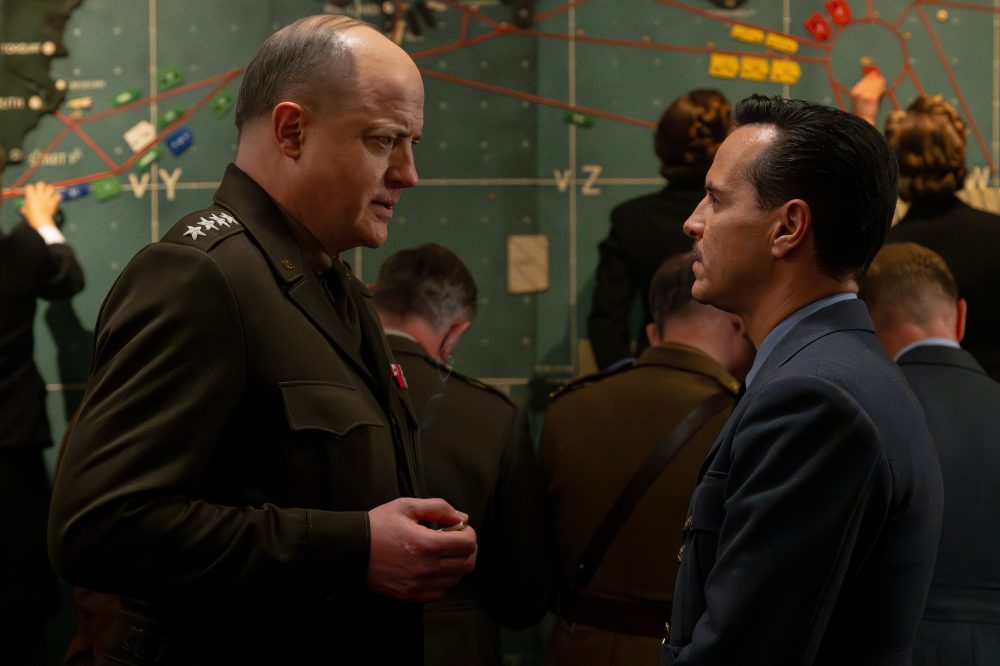
At moments, “Pressure,” helmed and co-authored by Anthony Maras, resembles a sequence of similarly refined monologues. This approach makes sense given its theatrical origins — the 2014 stage production by David Haig. Chronicling the lesser-known account of how weather experts determined the optimal timing for the Normandy beach assault, the movie creates tension between two figures: Scott’s contemplative, obstinate, even bitter weather scientist, and the legendary Dwight D. Eisenhower, distinguished military leader and eventual president, portrayed by Brendan Fraser.
Fraser’s interpretation of Eisenhower appears physically commanding — significantly more so than the historical figure — and equally headstrong, though more vocally so. However, he proves less compelling than Scott’s complex Stagg, a role and portrayal that transforms an otherwise competent, well-crafted military film into something more captivating.
The movie opens with fallen soldiers scattered across a shoreline beside bloodied waters — evoking the disastrous D-Day preparation known as Exercise Tiger, which claimed hundreds of American military lives. This serves as Maras’s method of emphasizing both the human cost and the potential for additional tragedy.
Several months afterward, in June, Stagg arrives for assignment at Allied command. The Scottish weather expert, reluctant to leave his expectant wife behind, has been recruited to assist with Eisenhower’s planned assault, which depends on surprising the enemy. Additionally, and critically, on meteorological conditions.
Stagg receives orders to meet Eisenhower, through his reliable assistant Kay Summersby (an outstanding Kerry Condon, injecting energy into a part that avoids further speculation about her connection with the general). Eisenhower explains that the entire war’s outcome depends on this mission. “We invade France Monday,” he declares.
However, the commander requires an accurate weather prediction. The mission demands a full moon and cloudless skies for aerial support, plus tranquil seas. Eisenhower seeks approval — which his own reliable forecaster, Irving P. Krick (Chris Messina), readily provides. Using historical data, Krick maintains that June 5, 1944, will bring peaceful and bright conditions.
Krick represents everything Stagg isn’t — sociable, bold, self-assured. He even performs songs and dances. Stagg, however, disagrees with the American’s evaluation. “Get me the data,” he demands. Historical trends hold no value in this volatile area, he maintains.
Requesting information from every weather monitoring post or balloon within 2,000 miles of Normandy, Stagg contends two storm systems approach. A June 5 launch will result in massive casualties, he warns. Actually, suitable weather might not appear until June 18. This message finds no welcome audience — not from Eisenhower, not from Krick and certainly not from Field Marshal Bernard Montgomery (Damian Lewis, embracing the theatrical nature). “My men are ready and primed,” Montgomery declares. “Get them onto the beaches, and leave the rest to me.”
As historical records confirm, D-Day did not occur on June 5. Eisenhower eventually decides to delay based on Stagg’s prediction, proven correct when Sunday’s clear weather suddenly becomes stormy during morning worship. Yet just as the chance seems lost, Stagg identifies a temporary weather improvement. He suggests — spoiler alert — that the invasion move forward one day later, on June 6.
For beach combat sequences, Maras utilized archival material — he has stated inspiration from Peter Jackson’s remarkable World War I documentary “They Shall Not Grow Old” — adding color and combining it with his own footage of frightened soldiers. Somehow, genuine tension emerges when Eisenhower and others assemble in the operations room.
Close by, silently, Stagg remains. Like his role, Scott accomplishes more with minimal resources. While the performer may be recognized for praised performances in “Fleabag,” “Ripley” and “Sherlock,” he’s also an accomplished theater artist, and his contribution here echoes the nuanced work he delivered in “Vanya,” the Chekhov adaptation where he portrayed all eight characters. Among Scott’s most powerful moments: when he receives heartbreaking news via telephone during a crucial war planning period. His suffering is evident, yet somehow he shows minimal external reaction.
“The weather feeds us,” Stagg states earlier, making his argument that weather is far from tedious. Indeed, meteorology itself becomes the central character in “Pressure.” The movie relates a story in which John F. Kennedy, traveling to his inauguration, questioned his predecessor about what advantage the Allies possessed.
“We had better meteorologists than the Germans,” Eisenhower responded.
“Pressure,” a Focus Features release arriving in theaters Friday, has received a PG-13 rating from the Motion Picture Association for “war violence, bloody images, some strong language, and smoking.” Runtime: 100 minutes. Two and a half stars out of four.