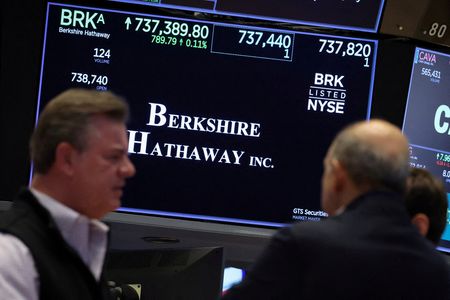

Berkshire Hathaway announced Thursday that the investment giant has started purchasing its own shares again after nearly two years without buybacks, marking a significant move by new CEO Greg Abel who took over from Warren Buffett in January.
The company initiated the share repurchases on Wednesday, ending a drought that lasted since May 2024.
These buybacks could help the Omaha-based conglomerate deploy some of its massive $373.3 billion cash reserve that accumulated while Buffett had difficulty finding attractive investment opportunities.
In a show of personal confidence, Abel revealed he purchased 21 Class A shares on Wednesday for approximately $14.6 million, using the after-tax proceeds from his $25 million annual salary. The 63-year-old executive now holds 249 Class A shares valued at roughly $182 million and indicated he intends to make similar investments going forward.
During his inaugural television interview as CEO on CNBC from New York, Abel confirmed he discussed both the corporate buybacks and his personal stock purchases with Buffett beforehand.
These announcements could help address investor worries that Berkshire has been overly conservative with its capital allocation, while demonstrating Abel’s deeper financial commitment to the trillion-dollar enterprise.
Buffett, now 95, continues as chairman and maintains virtually his entire wealth in Berkshire shares. Abel previously received $870 million in 2022 when he sold his 1% ownership in Berkshire Hathaway Energy back to the parent company.
Berkshire stock climbed 1.5% during morning trading Thursday. However, through Wednesday’s close, the shares had underperformed the S&P 500 by more than 30 percentage points over the 10 months since Buffett’s surprise announcement of stepping down as CEO.
The conglomerate’s vast holdings encompass Geico insurance, BNSF railway, numerous industrial and manufacturing operations, consumer brands like Duracell and Fruit of the Loom, plus a $297.8 billion stock portfolio dominated by Apple shares.
Abel explained to CNBC that the company repurchases stock when management believes the true worth of shares surpasses their trading price, generating long-term shareholder value.
“With the transition of leadership,” Abel noted, it was crucial to announce the resumption of buybacks. While Berkshire typically reports repurchases quarterly, Abel characterized this disclosure as a special one-time communication.
CFRA Research analyst Cathy Seifert called the buybacks a “positive signal” following Monday’s sharp stock decline – the worst single-day drop since Buffett’s departure announcement.
“For that near-term positive to be sustained, we’ll have to see improvement in Berkshire’s underlying fundamentals,” she said.
Abel emphasized that increasing his personal stake helps synchronize his interests with shareholders for the long haul. He expressed his intention to serve as CEO for two decades.
Berkshire stands apart from most major corporations by not offering equity compensation or stock option programs.
“The whole idea is: our shareholders are owners, use their after-tax dollars to buy Berkshire, I’ll do the same,” Abel said. “No one else in corporate America does this.”
The company maintains its policy of not paying dividends, with Abel stating none are planned for the foreseeable future.
Abel also addressed escalating legal battles involving Berkshire subsidiary PacifiCorp over September 2020 Oregon wildfires, where plaintiffs allege the utility failed to deactivate power lines.
PacifiCorp confronts $50 billion in potential liability beyond already settled cases, prompting S&P Global to warn Monday of a possible downgrade to junk bond status.
Abel stated that “any time we’re responsible for something, we’re willing to take absolute responsibility,” but emphasized PacifiCorp must resist covering damages from lightning-caused fires.
“We’re sorry, absolutely, that these people’s lives have been impacted,” Abel said. “We feel for them. But that’s not the utility’s responsibility to take on those costs and obligations. So that’s where we’re drawing the line.”