
The Transportation Security Administration faces a staffing crisis as nearly 500 officers have resigned during the 41-day government shutdown, according to the latest Department of Homeland Security figures.
Republican senators have presented what they call their final funding proposal for most DHS operations, excluding immigration enforcement activities. Senate Majority Leader John Thune characterized the offer as Democrats’ “last and final” opportunity from Republicans. The proposal includes new restrictions on immigration officers such as mandatory body cameras, but omits Democratic priorities like agent identification requirements and protections for raids near schools and churches.
TSA officials warn they may need to close some airport operations if the budget crisis continues. Beyond the workforce exodus, massive sick-out rates are crippling major airports nationwide. Atlanta’s primary airport saw 41% of TSA staff call out sick, while Houston’s George Bush Intercontinental Airport experienced a 39% absence rate. Department of Homeland Security data shows more than 11% of scheduled TSA employees missed work Wednesday across the country.
“This reckless shutdown has driven nearly 500 TSA officers to quit, while thousands more are forced to call out because they can’t afford gas, childcare, food, or rent,” stated DHS spokesperson Lauren Bis.
The crisis has created chaos at airports nationwide, with callout rates reaching extreme levels at multiple locations. New Orleans’ Louis Armstrong International Airport recorded 36% absences, Houston’s William P. Hobby Airport hit nearly 32%, and both New York’s JFK and Baltimore-Washington International airports saw roughly 29% of staff call out.
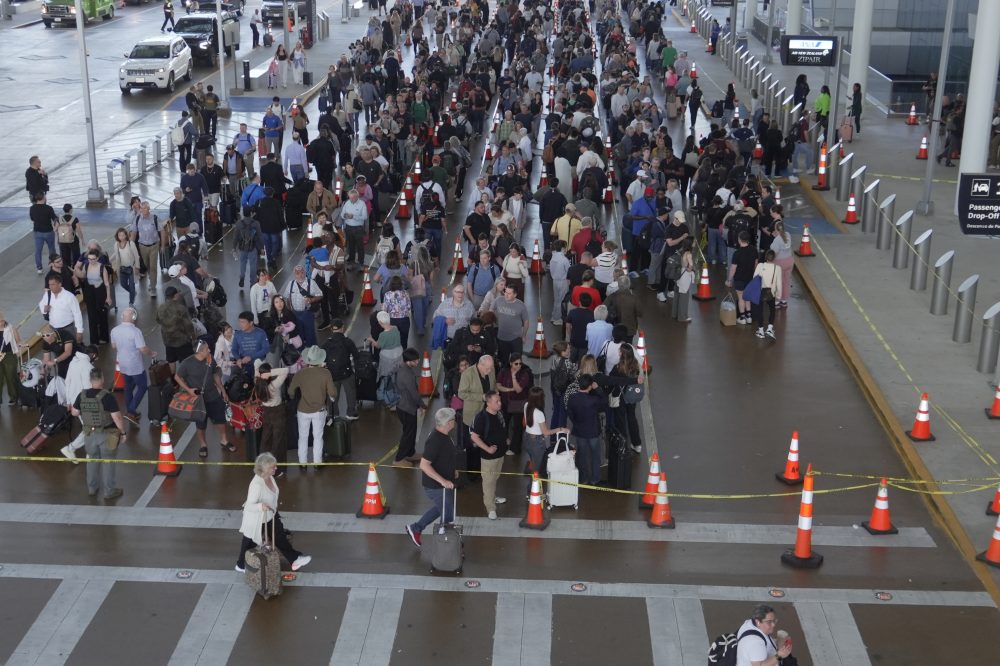
Travelers at Houston’s George Bush Intercontinental Airport endured hours-long security delays, with some passengers expressing frustration about the political deadlock leaving TSA agents unpaid. Eche Emole, attempting to catch a flight to Cancun, Mexico, waited three hours in security lines Thursday.
“You don’t experience this in a lot of other countries, and I just feel like it’s unacceptable,” Emole commented. “This should not be happening.”
James Person, traveling to Knoxville, Tennessee, praised airport personnel and immigration officers brought in to assist with security operations.
“I’m just really upset with Congress for not doing their job to fund DHS so we can get rid of this mess,” Person said.
Multiple travelers reported missing flights due to extended security wait times. Melissa Gates said she wouldn’t make her Baton Rouge, Louisiana flight after waiting over two and a half hours without reaching the checkpoint. With no alternative flights until Friday, she planned to spend the night at the airport.
“I should have just driven, right?” Gates said about her 260-mile journey. “Five hours would have been hilarious next to this.”
Jimmy Hidalgo managed to reschedule his Fort Lauderdale flight to a later departure after nearly three hours in line, though he noted having to accept a middle seat.
During a White House meeting, President Trump acknowledged the presence of newly sworn-in DHS Secretary Markwayne Mullin and noted they were “now on Day 41” of the shutdown. Trump blamed Democrats for the impasse and threatened “very drastic measures” if the shutdown doesn’t end immediately. He has already deployed ICE officers to airports as TSA backup.
Atlanta’s Hartsfield-Jackson International Airport experienced particularly severe disruptions Thursday, with security lines extending outside the main terminal. Social media posts showed queues winding through baggage claim areas and onto exterior sidewalks. The airport advised travelers to allow four hours for security processing.
Houston’s George Bush Intercontinental Airport warned passengers of four-hour security waits Thursday morning, with different terminals showing varying delay times. Officials attributed increased congestion to higher passenger volumes and major Houston events, including a global energy conference and NCAA Tournament Sweet 16 games.
Airport and union representatives cited several factors making Houston’s situation particularly severe: one of the nation’s highest TSA callout rates, heavy passenger traffic due to United Airlines’ major hub operations, and peak tourism season.
ICE officers assisting at struggling airports handle crowd control and identity verification using TSA equipment, according to DHS spokeswoman Lauren Bis.
“After receiving standard TSA training curriculum, ICE officers are guarding entrances and exits, assisting with logistics, doing crowd control, and verifying identification using TSA equipment and standard operating procedures,” Bis explained.
Acting TSA Administrator Ha Nguyen McNeill testified before lawmakers that multiple airports face callout rates exceeding 40%, with more than 480 transportation security officers resigning during the shutdown. She described the severe financial hardship affecting TSA workers.
“Some are sleeping in their cars, selling their blood and plasma, and taking on second jobs to make ends meet, all while being expected to perform at the highest level when in uniform to protect the traveling public,” McNeill stated.
McNeill also revealed that TSA officers have experienced a more than 500% increase in assault frequency since the shutdown began.
“This is unacceptable and it will not be tolerated,” she declared.
President Trump suggested on social media Wednesday that he might deploy National Guard units to assist at airports experiencing extended security delays. Legal expert Joseph Nunn from the Brennan Center for Justice explained Trump could potentially utilize state troops for law enforcement duties like operating X-ray machines and checking identification, provided governors cooperate and troops remain under state rather than federal control.
The Federal Emergency Management Agency’s Disaster Relief Fund faces rapid depletion, according to FEMA external affairs official Victoria Barton. The agency continues disaster response operations and pays approximately 10,000 disaster workers through remaining fund resources.
Senate Democratic leader Chuck Schumer of New York emphasized the need for substantive reforms. “We’ve been talking about ICE reforms from day one,” he said.
House Speaker Mike Johnson criticized Democrats’ stance, stating “They know this is crazy.”
Conservative Republicans also opposed the latest proposal, demanding complete immigration operations funding and expressing skepticism about leadership promises to address Trump’s proof-of-citizenship voting legislation later.
Senate Majority Leader Thune indicated late Wednesday that Democrats needed to present “a more realistic offer on the table” to resume productive negotiations.
Democrats continue demanding changes to immigration enforcement and mass deportation operations following incidents in Minneapolis where federal officers killed two U.S. citizens during protests.
The Republican funding proposal covers most DHS operations except ICE enforcement and removal activities central to the ongoing dispute. While including some new officer restrictions like body cameras, it excludes Democratic demands for agent identification requirements and raid restrictions near sensitive locations like schools and churches.
TSA Acting Administrator McNeill warned lawmakers about potential airport closures if the budget impasse continues, describing the situation as “dire.”
“At this point, we have to look at all options on the table. And that does require us to, at some point, make very difficult choices as to which airports we might try to keep open and which ones we might have to shut down as our callout rates increase,” she testified.