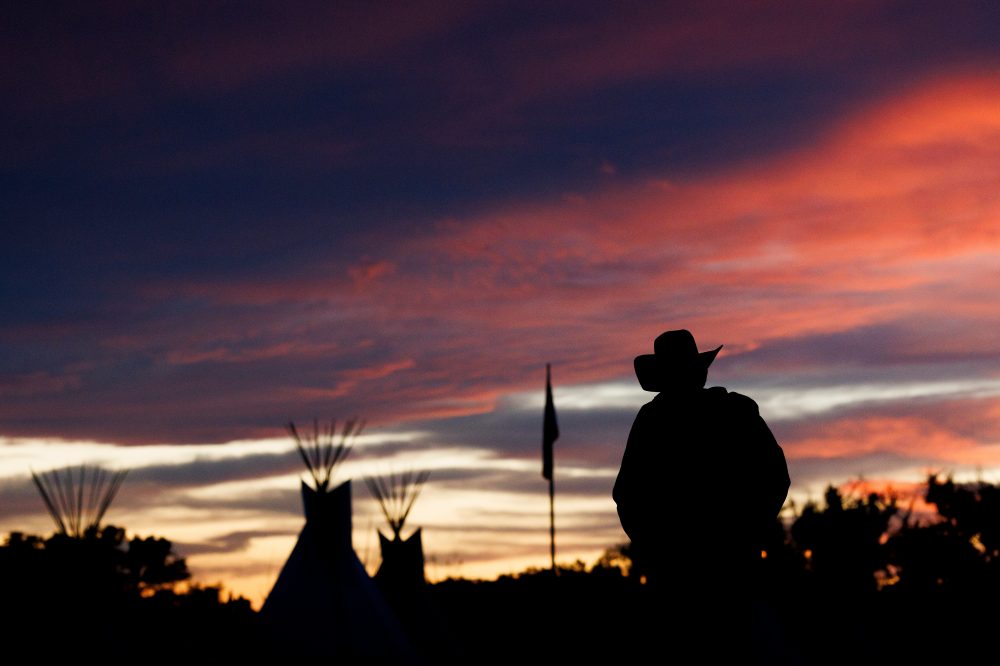

Thursday marks 150 years since the Battle of Greasy Grass — a momentous clash that most Americans know as the Battle of Little Bighorn. For Native American tribes across the country, the anniversary is an occasion to honor one of the most historically significant and emotionally powerful events in the story of this nation.
On a sweltering day in June 1876, allied tribes united along the banks of the Little Bighorn River in what is now Montana and handed the U.S. Army a stunning defeat. They were fighting to protect their way of life against the relentless push of westward expansion. Lt. Col. George Armstrong Custer and more than 200 of his soldiers lost their lives in the engagement.
This week, the normally quiet, wind-swept prairie of rolling hills and grassy ridges is buzzing with activity as the battle is being reenacted. Horse riders from the Cheyenne River Reservation in South Dakota and other locations have traveled hundreds of miles to the Crow Agency area in Montana for the occasion. A sunrise pipe ceremony was held Thursday morning, and families are being encouraged to pass along their oral histories. Over at the Standing Rock Sioux Reservation in North Dakota, horse races and traditional songs and dances are also taking place.
Coming together at the battlefield means “we’re still here,” said William Good Bird, a traditional singer from the Spirit Lake Dakota Nation in North Dakota, who greeted a camp of hundreds of people gathered from many different tribes with a song and drumming at sunrise.
“Today I am celebrating the victory of our people, celebrating my life as a human being and my spot on this earth,” he said.
According to historian Dakota Goodhouse, the discovery of gold in the Black Hills — located in what is now South Dakota — by a Custer-led expedition just a few years earlier set off a military campaign aimed at forcing Great Plains tribes onto reservations, then called agencies.
Goodhouse noted that while there were larger and longer battles, and other Native victories, between March 1876 and June 1877, only the Battle of Greasy Grass — a name given by Native Americans referring to the slippery grass along the riverbank — achieved widespread national recognition, largely because the commanding officer died in the fight.
At the time, the Lakota were among the largest and most powerful tribal nations, led by figures such as Sitting Bull and warriors including Crazy Horse. U.S. forces were stretched out over miles of hilly terrain, and Native warriors overwhelmed them rapidly.
Word of Custer’s defeat came as a shock to Americans who were in the middle of celebrating their country’s 100th birthday.
In the aftermath, the federal government intensified its efforts to crush Native resistance, ushering in years of suffering and displacement. Crazy Horse was killed in 1877, and starvation forced others to surrender in 1881.
The story of Sitting Bull’s surrender is more complicated than history books suggest, according to Jon Eagle Sr., a former Standing Rock tribal historic preservation officer from the Hunkpapa band of the Oceti Sakowin.
“Our people say that he looked at his son Crow Foot and said, ‘My boy, if you live, you can never be a man in this world because you can never own a gun or a pony,’” Eagle recalled. “I think that he understood that things were going to change for his children, his grandchildren and those not yet born.”
Sitting Bull was ultimately killed along with roughly a dozen others when Indian agency police moved to arrest him in 1890.
Biographer T.J. Stiles described Custer as one of the Army’s most distinguished combat officers coming out of the Civil War. However, Stiles said the so-called “Boy General” — known for his long hair and eye-catching battlefield attire — frequently clashed with the chain of command and struggled with the administrative demands of leadership.
“Custer was someone who whenever he got into the frying pan, he immediately started looking for the fire,” Stiles said.
In 1873, Custer was given command of the Seventh Cavalry at Fort Abraham Lincoln, near what is now Bismarck, North Dakota. He led several military expeditions from that post, including the one that confirmed the presence of gold in the Black Hills, a place sacred to the Lakota people.
While Custer has long been viewed in American culture as a tragic hero and celebrated for his military record, historian Goodhouse pointed out that he could also be considered surprisingly open-minded for his era, even as the government worked to displace Native peoples and erase Native languages through boarding schools. Custer learned to speak Arikara and Lakota and became fluent in Plains Indian sign language.
Even so, as many Americans celebrate the 250th anniversary of the signing of the Declaration of Independence, the milestone carries a very different meaning for many Native Americans.
“It’s just a mark to me of 250 years of injustice to the Native people,” said Jim Real Bird, a Crow tribal member and reenactment coordinator.
Eagle shared that sentiment: “That’s one of the things that we always tell our people when we come together, is they failed at their attempts to rub us out. We’re still here as ancient people deeply connected to our environment.”
For more than three decades, reenactments involving hundreds of warriors have taken place near the battlefield each year to mark the anniversary. The performances are rooted in Northern Cheyenne oral history and place a strong emphasis on horsemanship and keeping the Native language alive.
“All the other things that are Native American don’t mean nothing if you don’t know your language,” Real Bird said.
Thousands of visitors are expected to camp at the site over several days, taking part in prayer gatherings, relay races, horse rides, and parades. The National Park Service is also hosting anniversary events at the battlefield national monument.
At Standing Rock, Eagle said races are being held to pay tribute to the horses that carried their ancestors to victory 150 years ago. The commemoration also features oskáte — a traditional celebration involving oral histories, victory songs, and tribal dancing.
“It’s just an opportunity for us to share with the generations coming behind us that they’re descendants of a very powerful nation and ancient people that are still here despite everything that was done to us,” said Eagle, whose great-great-grandfather Sunka fought in the battle, as did his great-great-great-grandfather Charging Thunder.
Goodhouse shared stories passed down from his grandfather about their ancestors who were in the Hunkpapa camp when the troops attacked. His grandfather’s great-grandfather, Striped Face, was shot during the battle but climbed onto his horse and kept fighting.
“There’s this kind of energy there that still lives on because we have this direct narrative that was handed down,” Goodhouse said.