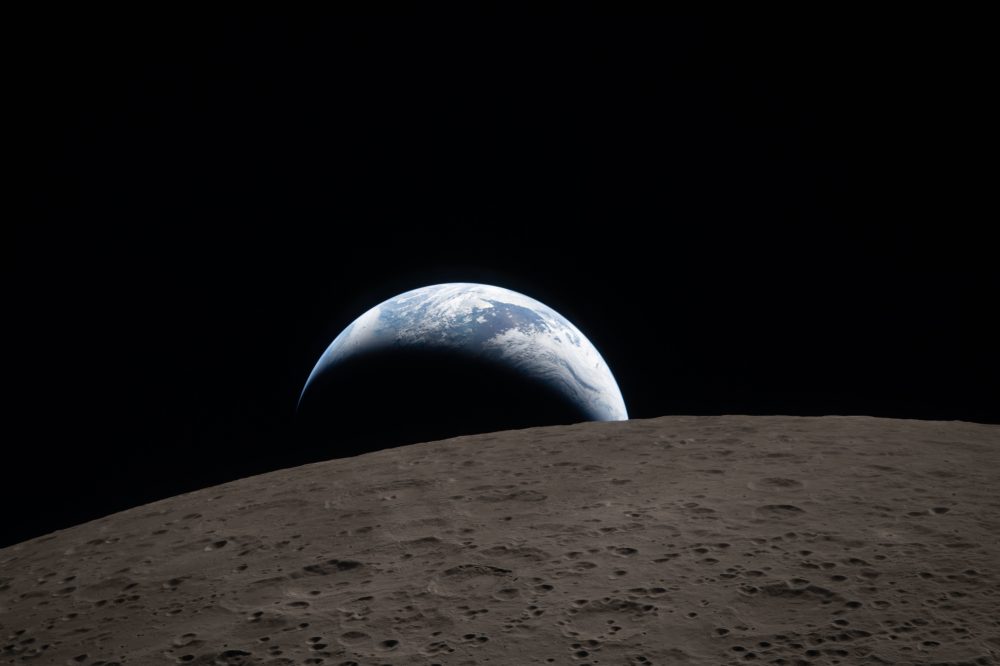

HOUSTON (AP) — Unprecedented footage of the moon’s hidden side. Accomplished. A total solar eclipse witnessed from lunar orbit. Accomplished. A new record for human space travel distance. Accomplished.
Following NASA’s spectacular lunar return mission with Artemis II, people worldwide are asking: What comes next? How does the space agency surpass such an achievement?
“To people all around the world who look up and dream about what is possible, the long wait is over,” NASA Administrator Jared Isaacman declared while presenting Artemis II commander Reid Wiseman, pilot Victor Glover, Christina Koch and Canada’s Jeremy Hansen during Saturday’s celebratory homecoming event.
Following the safe return of the first lunar voyagers in over fifty years to Houston and their families, NASA is focusing on Artemis III preparations.
“The next mission’s right around the corner,” entry flight director Rick Henfling remarked after the crew’s Pacific ocean landing on Friday.
During a recently scheduled mission for next year, Artemis III’s astronauts—not yet announced—will rehearse connecting their Orion spacecraft with lunar landing vehicles while orbiting Earth. Companies led by Elon Musk’s SpaceX and Jeff Bezos’ Blue Origin are competing to complete their landing systems first.
Musk’s Starship and Bezos’ Blue Moon are competing for the crucial Artemis IV moon landing scheduled for 2028. Two crew members will target the south polar region, the chosen site for Isaacman’s proposed $20 billion to $30 billion lunar base. Enormous quantities of ice likely exist within permanently dark craters in that area—ice that could supply water and spacecraft fuel.
The connecting equipment for Artemis III’s Earth-orbit practice mission is already positioned at Florida’s Kennedy Space Center. The newest Starship model is preparing for a test launch from South Texas, while a smaller Blue Moon prototype will attempt a lunar touchdown later this year.
NASA pledges to reveal the Artemis III crew “soon.” Similar to 1969’s Apollo 9, Artemis III seeks to minimize risks for subsequent moon landings.
Apollo 9 astronaut Rusty Schweickart enjoyed piloting the lunar module in low-Earth orbit—”a test pilot’s dream.” However, he acknowledged that “the real astronauts” in public perception were those who actually stepped onto the moon.
Wiseman and his teammates displayed remarkable emotion and authenticity during their lunar journey, becoming emotional while remembering deceased loved ones and those remaining on Earth.
Throughout their nearly 10-day expedition, they emotionally requested naming a fresh, brilliant lunar crater after Wiseman’s deceased wife, Carroll, who lost her battle with cancer in 2020. They also openly expressed their affection for each other and Planet Earth, describing it as a beautiful yet fragile sanctuary in the dark emptiness that requires better stewardship.
Artemis II featured the first woman, the first person of color and the first non-American to journey to the moon.
“Wonderful communicators, almost poets,” Isaacman commented from the recovery vessel while awaiting their return.
Apollo’s stoic, strictly professional moon crews from the 1960s and 1970s certainly never embraced as a group.
For those who remember Apollo, Artemis—Apollo’s twin sister in Greek mythology—couldn’t arrive soon enough.
Writer Andy Chaikin said he felt like Rip Van Winkle waking from a nearly 54-year sleep. His 1994 book “A Man on the Moon” inspired the HBO series “From the Earth to the Moon.”
“It’s amazing how far we’ve come and how different this experience is from back then,” Chaikin commented from Johnson Space Center late last week.
The most challenging aspect, according to NASA Associate Administrator Amit Kshatriya, is developing close relationships with the crews and their families before launching them to the moon. He nervously watched Friday’s reentry alongside the astronauts’ spouses and children.
“You know what’s at stake,” Kshatriya revealed afterward. “It’s going to take risk to explore, but you have to make sure you find the right line between being paralyzed by it and being able to manage it.”
Declaring “mission complete” only after reuniting with his two daughters, Wiseman delivered an inspiring message to the rows of blue-flight-suited astronauts at Saturday’s celebration.
“It is time to go and be ready,” he said, pointing at them, “because it takes courage. It takes determination, and you all are freaking going and we are going to be standing there supporting you every single step of the way in every possible way possible.”