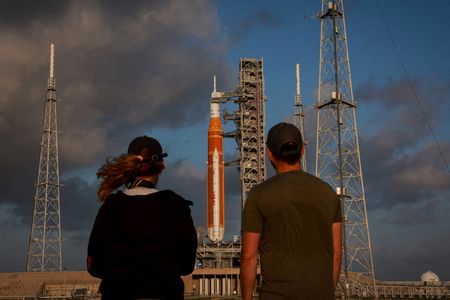

NASA stands ready to make history by sending astronauts toward the moon for the first time in more than 53 years through its Artemis II mission, marking a pivotal moment in America’s space exploration efforts as the nation works to maintain its leadership position amid increasing competition from China.
Four astronauts – three from the United States and one from Canada – are scheduled to launch Wednesday aboard NASA’s Orion spacecraft atop the Space Launch System rocket for a 10-day journey that will take them around the moon and back. This voyage will carry humans farther into space than anyone has traveled before.
This marks the inaugural crewed flight within NASA’s Artemis program, America’s primary initiative to establish routine lunar missions at an estimated price tag of no less than $93 billion since 2012. Humans haven’t set foot on the moon since the Apollo 17 mission in 1972, an achievement NASA hopes to replicate by 2028 at the challenging lunar south pole region.
The United States remains the sole nation to successfully land people on another world through its six Apollo moon landings, originally motivated by rivalry with the Soviet Union.
China has emerged as a significant technological competitor to the U.S., making consistent advances in its lunar exploration program through recent years with multiple robotic moon missions and plans to land its own astronauts on the surface by 2030. American officials have emphasized the importance of reaching the moon before China.
NASA astronaut Christina Koch, serving as an Artemis II mission specialist, described the moon Sunday as a “witness plate” documenting our solar system’s origins and a pathway to Mars, “where we might have the most likelihood of finding evidence of past life.”
“Many, many countries have recognized the value that there is in exploring further into the solar system, to the moon and on to Mars,” she told reporters. “They recognize that not only can we gain all these extremely tangible benefits, but that we have the opportunity to answer the question that could be the question of our lifetime, which is, are we alone?”
“Answering that question starts at the moon,” she said. “The question is not should we go, but should we lead, or should we follow?”
Using a sequence of progressively sophisticated Artemis missions spanning the coming decade, America seeks to establish guidelines for how nations will function and collaborate on the moon’s surface, where countries and corporations may eventually harvest lunar materials and prepare for far more challenging Mars expeditions.
NASA has partnered with numerous private companies for its lunar program, hoping to foster future commercial moon-based industries whose potential value remains difficult to predict, according to industry experts.
A January PricewaterhouseCoopers analysis projects $127 billion in lunar surface activity revenues by 2050, with investments potentially ranging from $72 billion to $88 billion during that timeframe.
However, government funding will drive corporate lunar strategies and income for the foreseeable future. Commercial moon-based growth independent of government support remains far in the future, according to Akhil Rao, an economist with analysis firm Rational Futures who previously worked as a research economist at NASA.
“NASA did not see a short-run economic value that companies would be able to derive that would allow NASA to be hands-off,” said Rao, who was among a team of economists and space policy staff laid off last year amid the Trump administration’s sweeping federal workforce cuts.
The Artemis II mission will provide a more rigorous evaluation of NASA’s Orion spacecraft and SLS rocket, which completed a comparable uncrewed mission in 2022. The crew will evaluate essential life-support equipment, crew controls, navigation systems, and communications before NASA advances to more complicated missions in subsequent years.
Launch is planned for April 1, though it may occur any day through April 6, depending on Florida weather conditions and potential last-minute technical issues. Following that, another launch opportunity opens April 30, determined primarily by Earth-moon orbital dynamics.
Artemis III, the subsequent mission scheduled for 2027, will feature the Orion capsule connecting in Earth orbit with NASA’s two lunar landing vehicles – Blue Origin’s Blue Moon system from Jeff Bezos and SpaceX’s Starship from Elon Musk. This complex rendezvous will test how the landers will collect astronauts before traveling to the moon’s surface.
NASA’s new administrator, Jared Isaacman, a billionaire private astronaut who has significantly restructured the program with new goals, added this mission to the program in February. His choice delayed the program’s first crewed lunar landing to Artemis IV.
The system is more intricate than the Apollo missions, incorporating multiple NASA-funded companies with the goal of encouraging private competition and commercial activity around the moon. Boeing and Northrop Grumman lead SLS development while Lockheed Martin constructs Orion for NASA.
SpaceX and Blue Origin are creating their own landing vehicles with NASA funding through different contract structures that permit them to market the spacecraft to additional clients.