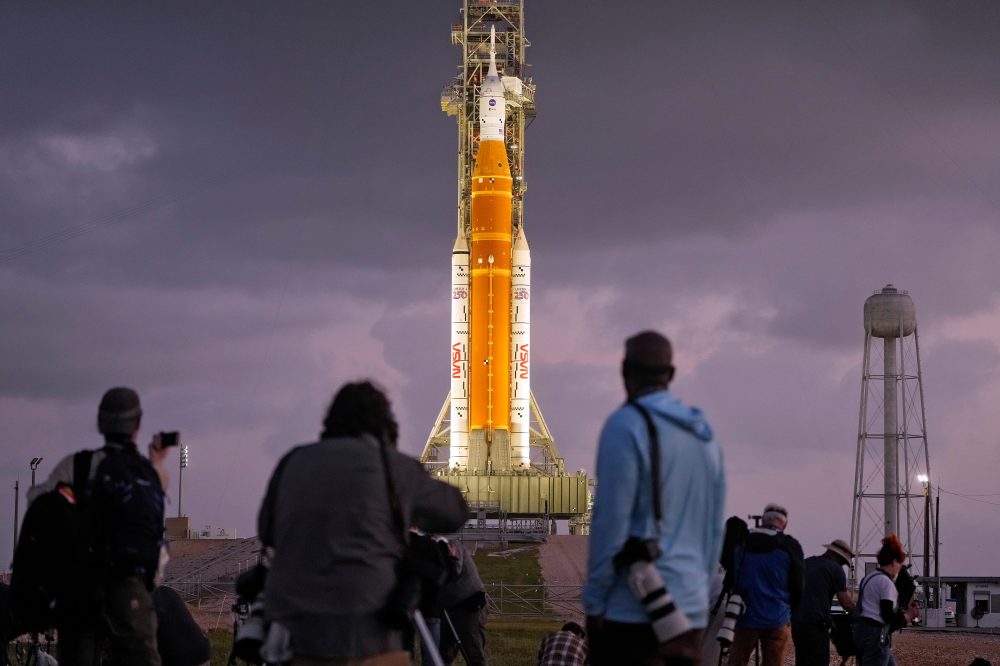

NASA has commenced fueling operations for the Artemis II mission, marking the beginning of what will be humanity’s return to lunar exploration after more than half a century.
Anxiety filled the air as liquid hydrogen began flowing into the massive rocket just hours before the scheduled departure. Previous hydrogen leaks during earlier countdown testing had caused significant mission delays, making today’s fueling process particularly crucial.
Ground crews must pump over 700,000 gallons (2.6 million liters) of fuel into the towering 32-story Space Launch System rocket before the four-person crew can climb aboard at Kennedy Space Center in Florida.
The enormous rocket is scheduled to lift off Wednesday evening during a two-hour window that opens at 6:24 p.m. EDT from Kennedy Space Center.
Four astronauts will make the journey: Reid Wiseman, Victor Glover, Christina Koch, and Jeremy Hansen. Their mission will take them thousands of miles past the moon before making a U-turn back to Earth. The crew won’t orbit the moon or conduct any lunar surface activities — instead completing a direct round-trip lasting under 10 days. NASA has promised future missions will include lunar landings, but only after these initial test flights.
This mission differs significantly from the Apollo program that carried astronauts to the moon between 1968 and 1972, as Artemis II’s crew features a woman, a Black astronaut, and a Canadian citizen.
Artemis II represents the first step in NASA’s ambitious goal of establishing a permanent lunar base, with plans for a moon landing near the south pole targeted for 2028.
The crew members began their day early Wednesday morning when alarms sounded in Kennedy Space Center’s crew quarters, waking the three Americans and one Canadian who will soon become the first lunar travelers in more than 53 years.
Following breakfast, the astronauts will begin putting on their spacesuits. NASA’s launch opportunity starts at 6:24 p.m. and extends for two full hours.
Launch director Charlie Blackwell-Thompson and many mission controllers are dressed in green clothing in the firing room. At NASA, green symbolizes “go” and represents good fortune.
Mission personnel are closely watching the fueling process of the 322-foot lunar rocket scheduled for Wednesday evening’s launch.
A stuffed toy called Rise will accompany the Artemis II crew on their lunar journey, carrying the names of more than 5.6 million people who registered with NASA.
Rise serves as a zero gravity indicator, providing crew members with a visual sign when they enter weightlessness in space.
The toy’s concept draws inspiration from the famous “Earthrise” photograph captured during Apollo 8, which showed Earth appearing as a blue marble against the darkness of space in 1968.
Rise emerged as the winner from over 2,600 design submissions and was created by Lucas Ye from California.
Commander Reid Wiseman and his teammates placed a small memory card inside Rise before the toy was secured in the Orion spacecraft. The card contains the names of everyone who registered to symbolically join the nearly 10-day mission.
“Zipping that little pocket on the bottom of Rise was kind of the moment that put it all together for me,” Wiseman said. “We are going for all and by all. It’s time to fly.”
NASA has started the fuel loading process for the new rocket that will carry four astronauts on their lunar mission.
Launch teams have initiated pumping more than 700,000 gallons (2.6 million liters) of liquid hydrogen and liquid oxygen into the Space Launch System rocket at Kennedy Space Center.
This represents a major step in the two-day countdown process that began Monday when launch control teams arrived for duty.
The complete fueling process will require at least four hours before the astronauts board for humanity’s first moon flight since Apollo 17 departed in 1972.
The launch window spans two hours beginning at 6:24 p.m. EDT.
The original American moon explorers from over 50 years ago were all white males selected based on their military test pilot backgrounds.
The Artemis II crew represents a more diverse astronaut program, including a woman, a person of color, and a Canadian citizen.