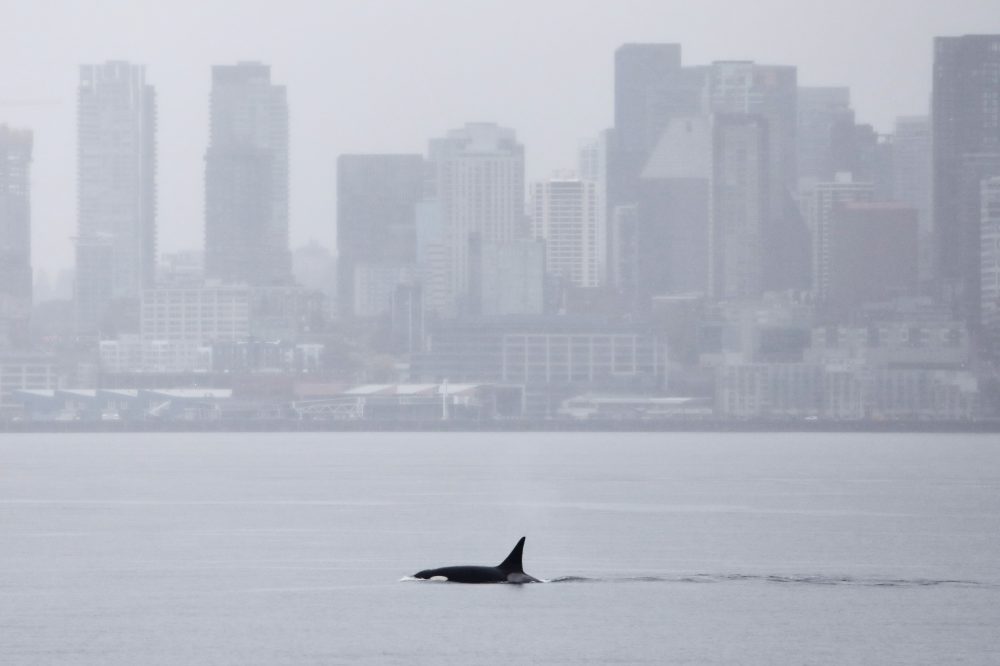

When visitors come to Seattle, they typically expect to see iconic landmarks like the Space Needle and downtown views from Puget Sound waters.
A family of three killer whales seems to have adopted the same sightseeing approach.
This trio of orcas, completely unknown to the Seattle marine area until now, has been captivating whale enthusiasts with multiple appearances near the city’s downtown waterfront over the past month. The whales have also been spotted along various other coastlines throughout the region.
“People … are all very happy to see this,” said Hongming Zheng, an amateur whale photographer who spent 10 hours driving to locate the enigmatic pod. “It was epic.”
Marine biologists maintain comprehensive documentation of killer whales that regularly visit the Salish Sea — the waterway separating Washington state from Canada — by cataloging their distinctive dorsal fins and saddle patches, which are gray-colored markings along their bodies.
The appearance of these three orcas in Vancouver, British Columbia, during March caught scientists off guard. None of the whales matched any existing records in regional databases.
Following investigation, researchers discovered photographs of the same pod in Alaskan waters from the previous year, according to Shari Tarantino from the Washington-based Orca Conservancy. The group consists of an adult female accompanied by what scientists believe are her two young, including one large juvenile male.
The whales have received official designations as T419, T420 and T421 — with the “T” indicating “transient” status rather than “tourist.”
These visiting orcas display distinctive markings absent from local whale populations: round scars created by cookie-cutter sharks, which attach themselves to larger marine animals and remove chunks of flesh. These marks prove the whales have lived in open ocean environments, where such sharks are commonly found.
“We don’t know their exact origin with 100% certainty yet, but the leading hypothesis is that they’re from Alaska, possibly the Aleutian region, given their appearance and the fact that some Alaskan populations range widely across the North Pacific,” Tarantino wrote in an email.
Regarding why this family has traveled thousands of miles from their typical habitat, Tarantino suggests they may be pursuing dining opportunities. Unlike the region’s endangered resident orcas that consume salmon, this pod hunts marine mammals — and the Salish Sea offers abundant harbor seals, sea lions and porpoises.
“They have quickly become a crowd favorite,” Tarantino wrote. “People spend a lifetime hoping to see a killer whale from shore, and these three have more than delivered.”