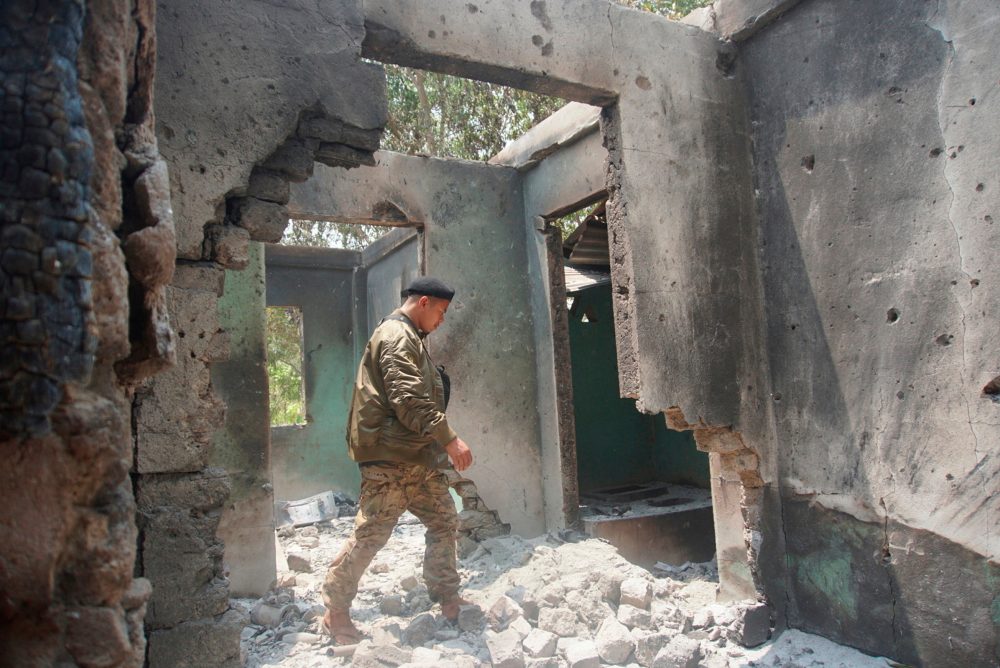

BANGKOK (AP) — Just over twelve months ago, Myanmar’s armed forces found themselves retreating across multiple fronts in the nation’s devastating civil conflict, losing control of vast territories in the northern regions to experienced militia coalitions while facing pressure from established resistance groups and newly-formed democracy fighters throughout the country.
The situation has dramatically shifted since then.
After recruiting tens of thousands of additional soldiers through conscription, Myanmar’s military forces, called the Tatmadaw, have regained some lost territory and seem prepared to launch new attacks, even as certain opposition factions have withdrawn from combat and others face internal conflicts and equipment shortages.
“I think we’re nearing a crescendo here where the Tatmadaw is going to reassert itself and the resistance movement is going to peter out,” said Morgan Michaels, a Singapore-based analyst with the International Institute of Strategic Studies who runs its Myanmar Conflict Map project.
“That doesn’t mean armed resistance will peter out — armed resistance will always continue in Myanmar until there’s a comprehensive, negotiated political solution, but the Tatmadaw has retaken the strategic initiative and everything is in the Tatmadaw’s favor.”
Meanwhile, following five years of warfare that has resulted in tens of thousands of deaths, including approximately 8,000 civilians, and displaced millions from their communities, exhaustion has set in among both military opponents and ordinary citizens, according to Aung Thu Nyein, a Myanmar political expert now based in Thailand.
“There are many saying that the local population doesn’t care much who will win the war, but (just want) to stop fighting,” he said in a text message.
Beijing is also applying considerable pressure for peace in Myanmar, also called Burma, which serves as a vital supplier of rare earth minerals and other natural resources needed to protect Chinese mining operations and business interests, he explained.
China has poured billions into Myanmar’s mining sector, petroleum pipelines, and infrastructure projects while serving as a primary weapons provider to the Tatmadaw alongside Russia.
Beijing also wields substantial influence over paramilitary organizations operating near the Chinese border, many composed of ethnically Chinese fighters.
China initially backed the October 27, 2023, military campaign launched against the Tatmadaw by the Three Brotherhood Alliance, primarily because Beijing was frustrated that the military government had permitted criminal organizations to flourish in border territories. However, China has since cut off weapons and ammunition to these militias while demanding they cease hostilities.
Among the Three Brotherhood Alliance groups, both the Myanmar National Democratic Alliance Army and the Ta’ang National Liberation Army accepted ceasefires in 2023 following Chinese-brokered negotiations, leaving only the Arakan Army actively engaged in combat with the Tatmadaw in western Rakhine state.
The Brotherhood Alliance consists entirely of established paramilitary organizations based on ethnic minority communities known as Ethnic Armed Organizations, or EAOs. The removal of Suu Kyi from power has also sparked the creation of pro-democracy fighting forces called People’s Defense Forces, or PDFs, many connected to the shadow National Unity Government formed by former members of Suu Kyi’s political party and allies.
Facing an expected escalation of Tatmadaw attacks, coordination at the highest levels between established EAOs and the NUG is essential for resistance operations, the Burma Liberation Democratic Front, a pro-democracy organization active in the Sagaing and Mandalay regions, informed The Associated Press.
“Although there is a shared understanding of the need to overthrow the military dictatorship and move toward a future federal union, there are still gaps and differences in overall grand strategy and tactics,” the group told the AP in a written response to questions.
“There are still differences in positions, perspectives, and approaches. Many continue to hold onto ethnic, regional, and organizational interests and attachments.”
The organization, which belongs to a coalition of 20 PDFs, noted that the Tatmadaw was actively “attempting to divide and weaken the situation by creating divisions between the public and revolutionary forces, among different ethnic groups, and even among revolutionary groups.”
The military commanders who removed Aung San Suu Kyi’s civilian administration in 2021 also recently conducted elections, despite criticism from United Nations experts who called them neither free nor fair due to suppressed opposition. Min Aung Hlaing, the senior general who ruled the nation with strict control after deposing Suu Kyi, took the presidential oath this month.
From a political standpoint, the elections seemed designed to create an appearance of legitimacy for his leadership to improve relationships with Southeast Asian nations and other countries as Myanmar faces international sanctions.
China, which had advocated for the election, immediately offered congratulations to Min Aung Hlaing and promptly dispatched its foreign minister for a face-to-face meeting. The TNLA militia organization also sent congratulatory messages, promising to maintain the China-mediated ceasefire.
Completing the elections also releases additional troops who had been assigned to provide extensive polling site security, Michaels noted.
Among his initial presidential actions, Min Aung Hlaing extended an invitation to the nation’s armed opposition forces for fresh peace negotiations, including both EAOs and PDFs. The National Unity Government was notably excluded from the invitation, and they immediately rejected the proposal as “aimed at prolonging people’s subjugation under military rule.”
The unclear proposal, published in the state-controlled Global New Light of Myanmar, established a July 31 deadline for groups to participate in discussions, with the condition that they should avoid presenting “unrealistic demands.”
No details were provided about potential consequences for groups declining to participate, and government officials did not respond to email requests for comment.
During this period, the Tatmadaw has maintained its military campaigns, including advancing a major operation in Sagaing to recapture the northern city of Indaw, which PDF groups seized with Kachin Independence Army EAO assistance in 2023.
Simultaneously, military forces have defended against an eastern offensive as they attempt to prevent the Karen National Liberation Army from advancing toward a Tatmadaw stronghold near the Thai border.
Through the peace talks offer, Min Aung Hlaing likely hopes to revive the Nationwide Ceasefire Agreements established with approximately half of Myanmar’s EAOs by former governments roughly ten years ago, which helped create relative stability.
However, given the apparent lack of current interest, more limited ceasefires may be the immediate objective, Michaels suggested.
“In the short term if you can agree to ceasefires with some groups, then you can redirect your resources toward other groups that are either unwilling to agree to a ceasefire or that the Tatmadaw is unwilling to agree to a ceasefire with,” he said.
“The Tatmadaw can always accept some degree of opposition and, in fact needs some level of active armed resistance to justify its rule and justify its behavior. But the current level of armed resistance across the country is not tenable.”