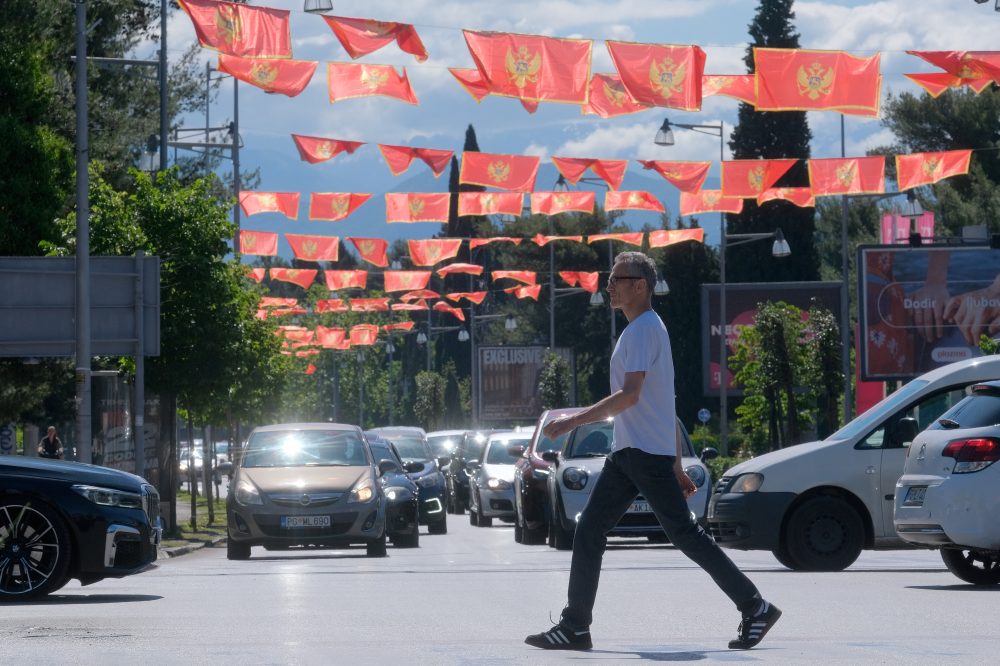

PODGORICA, Montenegro (AP) — This week, Montenegro commemorates two decades since gaining independence from its partnership with Serbia, marking a significant transformation period that has led the Balkan nation into NATO membership. The country now sets its sights on achieving complete European Union integration.
In an interview with The Associated Press during national celebrations, President Jakov Milatovic highlighted NATO membership as a crucial achievement and expressed confidence that the nation of 623,000 residents will accomplish its goal of becoming the EU’s 28th member by 2028.
The slogan “28 by 28” has been painted on aircraft belonging to the country’s national airline.
“We can achieve it,” Milatovic stated from his presidential office in Podgorica, the nation’s capital. “I am optimistic about it.”
Musical performances and various festivities are taking place throughout the capital city of Podgorica and other municipalities across Montenegro, a nation recognized for its breathtaking Adriatic coastline and majestic mountain ranges.
Among the six Western Balkan nations at various stages of the membership process, Montenegro stands as a leading candidate for EU admission. Multiple additional countries, including Ukraine, also aspire to eventual membership.
The European Union has established a working committee to develop an accession agreement for Montenegro — indicating that membership remains achievable.
EU representatives are anticipated to reinforce this message during a gathering in the Montenegrin coastal city of Tivat in early June with Western Balkan candidate nation leaders. The remaining candidates include Albania, Bosnia-Herzegovina, North Macedonia, Serbia and Kosovo.
Milatovic observed that EU support within Montenegro reaches approximately 80%. However, the nation must complete democratic and economic transformations, and the pace of completion “now is entirely up to Montenegro,” he emphasized.
Unity was significantly less evident when the country decided 20 years ago to exit the State Union of Serbia and Montenegro — which was itself among several states that emerged from Yugoslavia’s dissolution.
Divided between independence advocates and those favoring continued union with Serbia, Montenegro conducted a referendum on May 21, 2006, to determine its direction following a decade of conflicts and NATO airstrikes in 1999 designed to end the Kosovo war. The outcome: 55.5% voted for independence.
Separating from the joint state created division due to Montenegro’s deep historical connections with Serbia and because approximately one-third of Montenegrins identify as Serbs. Montenegro and Serbia share Orthodox Christian faith, speak similar languages and maintain centuries-old partnerships.
The independence movement was spearheaded by Montenegro’s former longtime leader Milo Djukanovic, who guided the country toward NATO membership and away from Russia, another traditional Slavic partner.
“Twenty years ago, the citizens of Montenegro took decision-making into their own hands, and that was the basis of our development,” the president stated.
“The major progress probably happened when the country became a part of NATO in 2017,” he continued. “Being a part of NATO for a small country like Montenegro is very important because NATO is indeed a security guarantee for our independence and statehood.”
As a candidate since 2010, Montenegro continues to encounter numerous obstacles on its EU path, according to former European integration minister Jovana Marovic. A primary focus involves reinforcing state institutions.
“What was missing in the last 14 years, we have to provide now just in six months,” she stated. “So it’s really demanding, but the process is going on.”
For Montenegro’s population, economic conditions and living standards represent top concerns. Alongside democratic transformations, Montenegro has implemented the euro as its currency, though the economy remains limited and heavily reliant on tourism.
Zorana Popivoda, 28, praised Montenegro’s independence restoration. However, she noted, “then you go into a store and you see that you can buy absolutely nothing.”
President Milatovic, 39 and trained as an economist, condemned previous Montenegrin leadership for insufficient action during independence’s early years to advance democratic reforms and combat organized crime and corruption.
“I think that over the last 20 years, we can objectively say that the country experienced progress,” he remarked, “but also that Montenegro had a number of missed opportunities.”