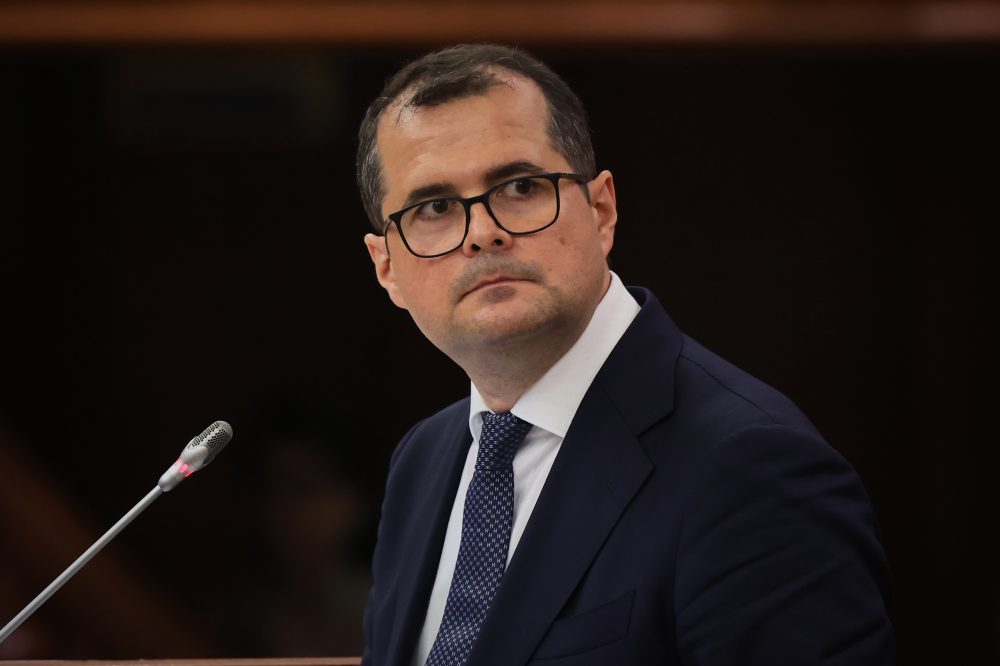

CHISINAU, Moldova — Moldova’s pro-Western parliament has chosen businessman and investor Vasile Tofan to serve as the country’s new prime minister, placing a political outsider in charge of the former Soviet republic’s push to become a member of the European Union.
Tofan, 44, received the backing of President Maia Sandu and her Party of Action and Solidarity. Parliament voted 53 to 21 in favor of his election, with 21 members abstaining, out of a total of 101 seats.
Until recently, Tofan served as a senior partner at Horizon Capital, an investment firm based in Ukraine. He holds a master’s degree in business administration from Harvard Business School, along with bachelor’s and master’s degrees in public administration from Erasmus University in the Netherlands.
His appointment comes three weeks after former Prime Minister Alexandru Munteanu unexpectedly stepped down after serving just eight months in the role. Munteanu’s resignation automatically forced the entire government to step down as well. He offered no clear explanation for leaving, stating only that he could “no longer exercise my mandate in accordance with my principles and beliefs.”
President Sandu, who put forward Tofan’s name for the position, stated that Moldova “must have a united, strong team in the government” in order to achieve its goal of joining the EU. She has directed Tofan to put together a new cabinet following the departure of the previous ministers.
Moldova is a landlocked nation bordered by Ukraine to the east and Romania — a member of both the EU and NATO — to the west. The country declared independence from the Soviet Union in 1991.
Predominantly Romanian-speaking but home to a significant Russian-speaking population, Moldova has increasingly moved toward the West in recent years, making it a focal point in the broader geopolitical rivalry between Russia and Europe.
As part of the formal process of joining the EU, Moldova and Ukraine last month began negotiations on a cluster of five chapters tied to the core values and principles of the EU, including the rule of law, fundamental rights, and the functioning of democratic institutions. Both nations also launched a second round of talks last week covering areas such as foreign relations, security and defense, trade policy, development cooperation, and humanitarian aid.