
Moldovan government officials are strongly condemning Russian President Vladimir Putin’s recent decision to provide expedited citizenship pathways for residents living in the breakaway region of Transdniestria, viewing the action as a direct threat to their sovereignty.
The separatist territory split from Moldova back in 1990 while the country remained part of the Soviet Union, and following a short-lived armed conflict in 1992, both sides have coexisted in relative stability.
Approximately 1,500 Russian military personnel, whom Russia often characterizes as peacekeeping forces, maintain positions between the two territories, while the breakaway region continues to receive significant financial support from Moscow.
Moldova’s administration, which has set a goal of European Union membership by 2030, views both the separatist territory and the Russian military deployment as tools for Moscow to influence their domestic policies. Last month, military leaders from the Russian contingent were prohibited from entering Moldovan territory.
Putin’s Friday directive allows the 350,000 people living in Transdniestria to obtain Russian passports while bypassing standard residency and other typical requirements. Roughly half of the population already possesses Russian citizenship.
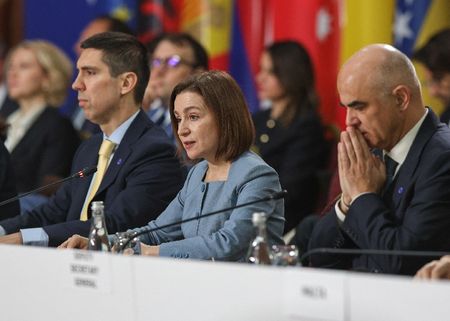
“Probably, they want more people to send to the war in Ukraine,” President Maia Sandu, a frequent critic of Russia’s invasion of its neighbour, told a conference in Estonia on Saturday.
“It’s probably one way to threaten us again, because Russia does not like the actions we have been taking on reintegration on the economic and financial (sectors). The people in the Transdniestria region have to think twice.”
She noted that numerous residents from the territory had already obtained Moldovan passports to “feel safer” following the start of the conflict.
Prime Minister Alexandru Munteanu stated Saturday evening that his administration was weighing concrete responses, noting that diplomatic protests to the Russian ambassador regarding Russian drone incursions into Moldovan airspace had failed to influence Moscow’s behavior.
Ukrainian President Volodymyr Zelenskiy characterized Putin’s citizenship offer as equivalent to “Russia designating the territory of Transdniestria as supposedly its own.” He announced that Ukraine and Moldova would develop “a joint assessment and joint action.”
Russia’s ambassador to Moldova, Oleg Ozerov, defended the policy to the state TASS news agency, claiming it was motivated by humanitarian concerns due to Moldova’s “increasing pressure on Transdniestria.”
He dismissed Moldovan objections to the decree as “hypocrisy,” pointing out that many Moldovans were securing passports from Romania, Moldova’s western neighbor.