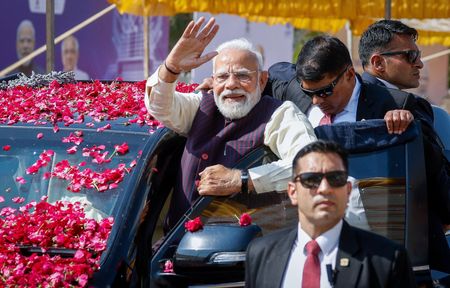

Indian Prime Minister Narendra Modi’s political party appeared positioned for major victories in state elections Monday, results that could speed up implementation of controversial policies including uniform civil laws and large-scale infrastructure projects, according to political experts and party leaders.
The electoral success demonstrates that Modi’s approach of promoting economic development, providing substantial government benefits, and appealing to India’s Hindu majority population has proven highly effective, even in areas traditionally controlled by opposition parties. This strategy is supported by campaign funding that significantly exceeds what opposition groups can raise.
Modi’s Hindu nationalist Bharatiya Janata Party (BJP) has consistently advocated for implementing a Uniform Civil Code to standardize civil laws across the nation, replacing the current system that permits Indians of different religious backgrounds to follow faith-specific laws or choose secular alternatives.
While the BJP cannot advance this policy nationally due to lacking the required two-thirds parliamentary majority needed for constitutional changes, the party can implement such measures in states under its control. Additionally, their signature infrastructure development initiatives will face less opposition resistance with fewer states under opposition leadership.
Rahul Verma, a researcher at the Centre for Policy Research in Delhi, observed that several BJP-controlled states have already begun developing their own versions of uniform civil codes. He suggested the party might also advance other proposals including redrawing electoral districts nationwide and conducting simultaneous state and federal elections, both potentially benefiting the ruling party.
“It is not like they will act on this immediately, in the next six months to a year,” Verma said. “But you may hear these conversations again. It is definite that the party will get stronger and more confident to push these ideas again.”
According to Election Commission voting trend announcements from last month’s state elections, the BJP was positioned to capture the strategically important eastern state of West Bengal while maintaining control in neighboring Assam. The party invested heavily in the Bengal campaign, with Modi and Home Minister Amit Shah conducting over 80 rallies and public events throughout the state.
These victories would grant the party and its coalition partners control of 20 among India’s 28 states plus two of three federally administered territories with legislatures, representing unprecedented dominance since the 1960s. The primary achievement from April’s elections would be securing West Bengal, a major state that controls India’s eastern region where the BJP has long sought power.
Beyond the anticipated Assam victory, a BJP-aligned coalition has gained considerable ground in the crucial southern state of Tamil Nadu, though a new party led by a film star holds the leading position there.
These successes follow the 2024 national election where the BJP lost its parliamentary majority and required coalition partner support to form the federal government in New Delhi.
BJP legislator Praveen Khandelwal indicated the state victories would enhance investor confidence through increased political stability, accelerate infrastructure development, and improve social program delivery. The wins will also enable the party to advance policies replacing religion-based civil laws.
“The Uniform Civil Code has long been part of the BJP’s ideological and policy agenda,” Khandelwal told Reuters. “With more BJP-ruled states, state-level initiatives toward UCC, like drafting committees, consultations, or partial legal harmonisation, become more likely.”
State governments in West Bengal and Tamil Nadu that strongly opposed the BJP face removal based on voting patterns, delivering a devastating blow to anti-Modi political alliances.
“The inability of the opposition to mobilise and build a stable, ideologically driven base has been a major weakness,” said Neelanjan Sircar, associate professor at Ahmedabad University in Gujarat state.
Opposition groups and some analysts attribute the BJP’s success to factors including electoral district manipulation in Assam and voter registration revisions in Bengal that removed millions from voting lists, many of them Muslims.
Opposition parties claim many excluded voters were their supporters. However, the Election Commission stated the process followed established protocols designed to eliminate duplicate, deceased, or relocated voters among other categories.
Analysts also noted that Modi’s personal appeal combined with his platform of economic growth alongside a strong pro-Hindu agenda continues proving unbeatable.
“The BJP have a charismatic national leader, they are a very organised party, they have a resource advantage that many parties lack, and a clear ideological narrative – all of which help mobilise sections of the Hindu population,” Verma said.
During the 2024-25 fiscal year ending March 31, the BJP reported total income of 67.69 billion rupees ($712 million), compared to 9.18 billion rupees for the primary opposition Congress party, according to the Association of Democratic Reforms.
The BJP’s primary campaign promises in Bengal and Assam included deporting individuals they characterized as illegal Muslim immigrants from Bangladesh.
The party also pledged financial assistance including monthly payments of 3,000 rupees for women and unemployed youth in Bengal. Since the 2020 COVID pandemic, Modi’s government has supplied free food rations to over 800 million of India’s 1.42 billion citizens, a program analysts credit with strengthening support among lower-income voters.
“The party’s so-called ‘lost ground’ is a baseless argument built by the opposition,” said BJP spokesperson Nalin Kohli, referring to the 2024 general election result. “There is no challenge to either the BJP or the leadership of Prime Minister Narendra Modi.”