
Dark, curved marks outline where a tree once stood on the brick facade of Mississippi’s biggest synagogue.
A memorial brass plaque survived a deliberately set blaze that struck Beth Israel Congregation’s worship center in northeast Jackson earlier this year. Fire scorched the trunk, limbs and metal leaves that bore inscriptions marking members’ births, marriages and milestone celebrations.
Restoration experts are now working to repair the plaque alongside five Torah scrolls and sacred fabric artwork from the synagogue. Meanwhile, Rachel Myers, a congregation leader who instructs the synagogue’s religious education program, has posted a child’s hand-drawn tree picture in its place.
“He wanted to make sure that we keep that Tree of Life going,” she said.
These artistic creations by young members demonstrate how Myers and fellow congregants have transformed the arson incident into a lesson about perseverance and spiritual strength.
Stephen Spencer Pittman, a Madison County resident, faces trial for what federal prosecutors describe as a hate-motivated assault. Pittman, who typically uses his middle name, has entered not guilty pleas to three federal counts including arson, destruction of religious facilities and using fire to commit a crime.
Authorities apprehended Pittman hours following the blaze at a nearby medical facility where he received treatment for serious burns. He reportedly admitted his actions to police and called Beth Israel the “synagogue of Satan,” according to federal court filings. Security footage from within the synagogue captured a man spreading liquid, and prosecutors claim Pittman contacted his father after igniting the fire and “laughed as he told his father what he did and said he finally got them.”
Myers believes the incident has actually strengthened congregation bonds. She notes it has even simplified her Hebrew instruction with younger students.
“We’re going to keep doing this, because someone wants us to stop,” she stated Sunday when synagogue leadership allowed local reporters inside.
That morning, approximately 60 congregation members toured their synagogue for the first time since flames erupted during early morning hours on January 10. The scene differed dramatically from their familiar worship space, according to Sarah Thomas, the congregation’s first vice president and lifelong member of 37 years.
“It was a good chance to see what it is now and then start to dream and hope for what it will look like when we’re back in here as a community,” she explained.
Rather than walls adorned with tapestries and religious artwork, members encountered bare cinderblock surfaces, broken glass windows, and exposed ceiling beams – damage worsened by asbestos discovery during cleanup.
“All along all of these walls were holy scriptures, prayer books and other works of art you can’t find anywhere else,” stated Zach Shemper, the congregation president, while standing in the now-vacant library where security video showed the perpetrator entering and spreading accelerant.
The attack destroyed numerous irreplaceable items, including two Torah scrolls stored in the library where flames first ignited.
A lingering smoky odor remains detectable throughout the building since the ventilation system awaits remediation, Thomas noted. However, cleanup efforts are 95% finished.
Working alongside a local architect, congregation leaders anticipate construction beginning by late summer, aiming to resume worship services by the Jewish New Year in October 2027. Asbestos removal alone carries a $2 million price tag, though total reconstruction costs remain undetermined pending contractor estimates.
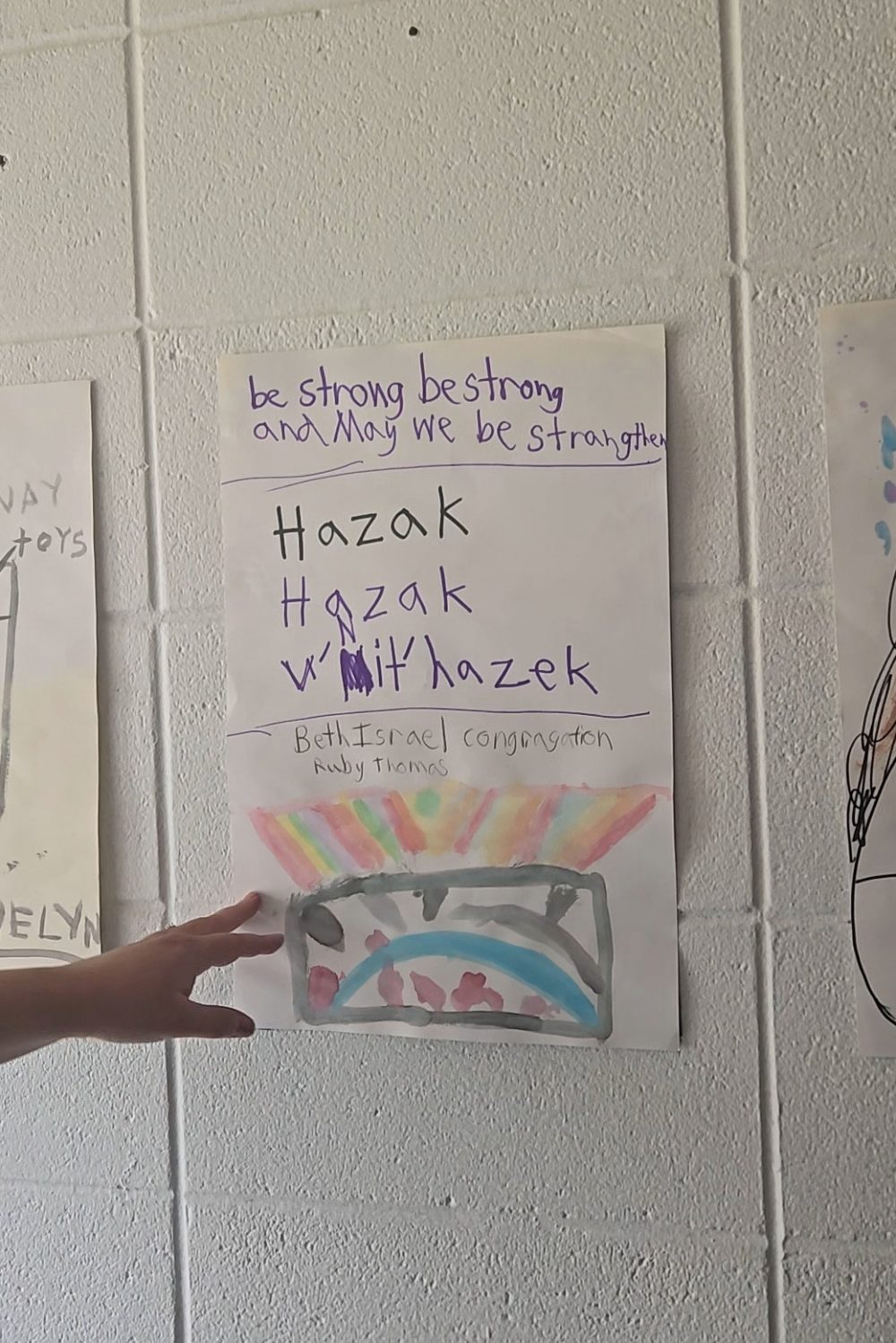
To lift spirits during the walkthrough, Myers displayed student artwork from her classes around the synagogue. Members spontaneously began discussing desired improvements to the facility – particularly additional freezer space in the kitchen, which serves a crucial function during their annual community bazaar featuring traditional Jewish cuisine.
“Our congregation is already thinking about ways to invite the public back here in the space,” Myers said.
Thomas felt especially moved seeing artwork created by her daughter Ruby. Below lyrics to a Hebrew song about strength that Myers taught the children, Ruby depicted bright blue water conquering red flames, creating a victorious rainbow.
“Whatever this one person thought he was going to do,” Myers concluded, “it only made us stronger.”