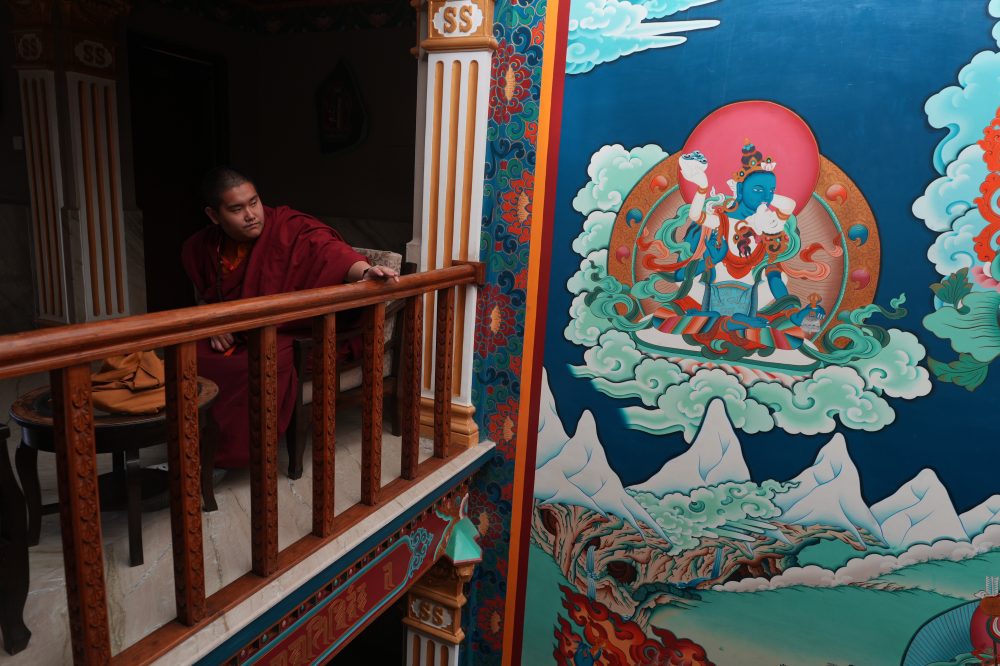

KATHMANDU, Nepal — In a monastery nestled within the Himalayan foothills, a 19-year-old Buddhist monk provides blessings to countless devotees. Using a ceremonial vessel and peacock feather, he touches each bowed head while sprinkling blessed water for spiritual protection, cleansing, and enlightenment. He pauses to acknowledge children who watch him with wonder, respect, and amazement. He works to match the rhythm of fellow spiritual leaders who, like himself, are selected few offering these final benedictions.
Half a year before this moment, thousands of miles distant, this young man was staying up all night playing Madden NFL on his Xbox near Minneapolis. During breaks, he would grab pizza rolls and Diet Coke, or check messages about upcoming visits to TopGolf or Buffalo Wild Wings.
These contrasting environments both represent home for Jalue Dorje.
Living as an ordinary American teenager, he developed a passion for rap music, gaming, and football. He also serves as an emerging spiritual guide who was identified by the Dalai Lama and additional Tibetan Buddhist authorities as a reincarnated lama from childhood.
At 19 years old, he completed high school last year and relocated to northern India to enter the Mindrolling Monastery, approximately 7,200 miles from his Columbia Heights residence. He recently visited Nepal to reunite with his parents, who traveled from Minneapolis, and participated in holy ceremonies and lessons led by the abbot of Shechen Monastery.
Traditional burgundy and gold monastery garments had taken the place of his typical hoodies and sweatpants. Yet he continued referencing both Drake and Shantideva, the 8th-century Indian monk. Under his robes, he sported white Crocs adorned with “The Simpsons” Jibbitz charms. He frequently wore these at Shechen Monastery, located near the 1,500-year-old Boudhanath stupa, among Tibetan Buddhism’s holiest locations.
Every morning brought dawn awakening. Following prayers, he walked from his lodging through busy Kathmandu streets filled with fruit vendors, incense, and spices, avoiding mopeds near the towering white dome and spire of Boudhanath with its vibrant Tibetan prayer flags and painted, watchful Buddha eyes.
On one particular day, he approached the monastery and removed his Crocs before entering a prayer hall designated for doctorate-holding monks and lamas. Incense filled the air. Ancient instruments — cymbals, bells, and drums — accompanied the monastic chanting.
Standing before three massive golden Buddha statues, Dorje bowed to Shechen Rabjam Rinpoche, the monastery’s spiritual leader, and offered him a golden plate representing the entire universe, plus a “khata” — a white Tibetan ceremonial scarf.
This marked Dorje’s first mandala, or offering, since beginning his destined spiritual journey. He describes this as a moment of recognition regarding his progress.
“This is the real one, you know? We’re here and this is really happening,” he says. “I’m doing what the prophecy fulfilled.”
Following the Dalai Lama’s recognition at age 2, Dorje dedicated much of his childhood to monastic preparation, memorizing holy texts, practicing calligraphy, and studying Buddha’s teachings.
Lama identification relies on spiritual indicators and visions. Dorje was four months old when Kyabje Trulshik Rinpoche, a respected Tibetan Buddhism master, identified him. Multiple lamas later confirmed him as the eighth Terchen Taksham Rinpoche — the original was born in 1655.
Jalue Dorje’s parents brought him to meet the Dalai Lama in 2010 during Tibetan Buddhism’s spiritual leader’s Wisconsin visit. The Dalai Lama performed a hair-cutting ceremony and recommended the parents allow their son to remain in America to master English before monastery enrollment.
“From my parents’ end, educating me was a really big one,” Dorje says. “They followed the words of his holiness; he laid the foundation, and they took that gamble.”
During childhood, he questioned why he couldn’t sleep late on weekends and watch cartoons like other children. His father assured him this would eventually benefit him, “like planting a seed that one day would sprout.”
He recalled early morning recitation and memorization sessions. He remembered online critics questioning his status as a reincarnated lama, which upset his parents. He also remembered both parents working diligently cleaning hotel rooms and hospital laundry while raising him.
“It wasn’t all rainbows and unicorns every day,” Dorje says. “We overcame a lot.”
Speaking both English and Tibetan fluently, Dorje succeeded in public school. Despite his official lama enthronement during a 2019 India ceremony, his parents allowed him to remain in America until graduation.
During his upbringing, he displayed a Dalai Lama photograph in his bedroom above DVD collections of “The Simpsons,” “South Park,” and “Family Guy,” alongside the “Buddha” manga series.
His bedside table held a journal containing football play diagrams he hoped to execute as left guard for his school team. His living room wall featured a poster showing his senior photo in sunglasses and football uniform, making a meditation gesture with his fingers.
He maintained an arrangement with his father, receiving Pokémon cards for memorizing Buddhist scriptures. He accumulated hundreds, occasionally hiding them in his ceremony robes. “I remember,” he says, “when I first learned my Tibetan ABCs, when I was able to recite it all by memory, my dad was so happy.”
His days were extensive. Each morning began with sacred text recitation. School followed, then football practice. He returned home for Tibetan history and Buddhism tutoring. Evenings involved calligraphy practice or listening to rap music. After getting his license, he drove around enjoying Taylor Swift.
What alternative career might he have pursued? “Sports journalist would have been cool,” he says. He enjoys writing. As an enthusiastic fan, he supports the Atlanta Hawks in basketball, Real Madrid in soccer, and the Atlanta Falcons in football.
His preferred athlete is U.S. figure skater Alysa Liu: “She brings so much swagger, but it doesn’t overshadow the sports.” During high school, he wrote an award-winning Tibet story for the student newspaper.
On the football field, teammates appreciated his optimism; he encouraged them to enjoy themselves and maintain perspective during defeats. However, during his final senior season game, he cried, understanding it would likely be his last game ever.
He frequently assisted with local Tibetan community events. For his 18th birthday, over 1,000 people gathered at the Tibetan American Foundation of Minnesota for his final celebration before joining the India monastery.
During the lengthy flight, his thoughts wandered.
“I was like, ‘Dang! I’m missing the first week of NFL!’” He packed minimally: headphones, laptop, a fantasy football magazine, and a book about Guru Rinpoche, the Indian Buddhist master who introduced Tantric Buddhism to Tibet.
His parents accompanied him to New Delhi, then drove north to Dehradun, near the Himalayan foothills, in a college drop-off equivalent. They purchased him a larger bed. They painted his monastic room and built a shrine for dawn and dusk prayers.
As an only child, his departure brought tears from his parents. His longest previous solo journey from home was a three-day northern Minnesota camping trip.
“Everything leading up to this point in the history of all your lifetimes — the billions and billions of lifetimes you accumulated — leads to your family,” Dorje says. “To have such great parents is a result of a great past life’s merit. But not only past life merit, but the connection of karma — and love.”
Initially, his mother, Dechen Wangmo, worried about her toddler son during extended prayer sessions.
“Would he be hungry? What if he fell asleep?” she recalled thinking. She continued worrying about him as a teenager: “He’s a tulku,” she says, using the Tibetan term for a reincarnated lama, “but he’s my son.”
To her relief, he flourished. While his friends attended history, science, and literature classes at U.S. colleges, he studied Buddhist philosophy and practiced calligraphy and chanting in India.
“He’s kind of found his groove at the monastery,” says Kate Thomas, one of his Minneapolis tutors.
Despite the 10-hour time difference, he maintained contact with home friends through texts and WhatsApp. During free time, he assembled Legos, visited an arcade for FIFA soccer video games, and watched Marvel superhero films plus NBA and NFL games on his laptop. He was particularly excited about the Super Bowl halftime show: “That was an incredible performance by Bad Bunny — I can’t lie!”
This marked his first experience with ascetic living, consuming daily rice and lentil rations and hand-washing his clothing. However, he adapted well, befriending monks from across Asia while discussing spirituality, popular culture, and sports.
“Dudes are dudes!” he says.
This was his first opportunity socializing with other “tulkus” — reincarnated spiritual masters near his age. Among them was Trulshik Yangsi Rinpoche, 13. He’s considered the reincarnation of Kyabje Trulshik Rinpoche — the Tibetan Buddhist master who originally recognized Dorje as a tulku at four months old.
At the monastery, they connected over their shared love of Tintin comics. Dorje became his English instructor.
“I think of him as my spiritual teacher,” Dorje said after sharing a meal with the younger lama. “I’m profoundly grateful that I get to repay my debt to the one who found me and improving his English.”
Yangsi Rinpoche smiled, then reflected: “He’s my best friend.”
Hours after Dorje blessed thousands — including his parents — on the final day of the 12-day ceremonies, the family rose before dawn to visit the ancient Maratika or Halesi Mahadev Caves, 100 miles southwest of Mount Everest. They traveled eight hours on dirt roads, crossing mountains and valleys, for a pilgrimage to caves sacred to both Hindus and Buddhists.
After exploring the caves with wonder, Dorje sat cross-legged on rocky ground beside his father, Dorje Tsegyal. They prayed together, as they had done nearly daily since his childhood.
After several years of contemplation and ascetic practice, Dorje plans to return to the United States to teach Minnesota’s Buddhist community at the Nyingmapa Taksham Buddhist Center. His objective: becoming “a leader of peace,” following examples set by the Dalai Lama, Nelson Mandela, and Gandhi.
This represents a lengthy path that started shortly after his birth. He feels prepared. “This,” he says, “is just the beginning.”