
ST. PAUL, Minn. — Legal representatives for two Minnesota school systems and the state’s primary educators union appeared in federal court Wednesday, requesting a judge halt Trump administration policy modifications that expanded immigration officials’ authority to conduct operations at and around educational facilities.
Last year, the Department of Homeland Security eliminated decades-old national guidelines that restricted immigration enforcement activities at designated “sensitive locations” including educational institutions, bus stops, religious facilities, and medical centers, which had previously made these areas largely protected except under extraordinary conditions.
The Fridley and Duluth school systems, along with Education Minnesota union, filed legal action to challenge this policy shift in February, coinciding with the Department of Homeland Security’s deployment of approximately 3,000 federal agents to the state for Operation Metro Surge. Two citizens were fatally shot by federal agents during the enforcement operation in Minneapolis during January.
The legal petitioners requested the court Wednesday to issue either a temporary stay or preliminary injunction to reinstate the former protective measures.
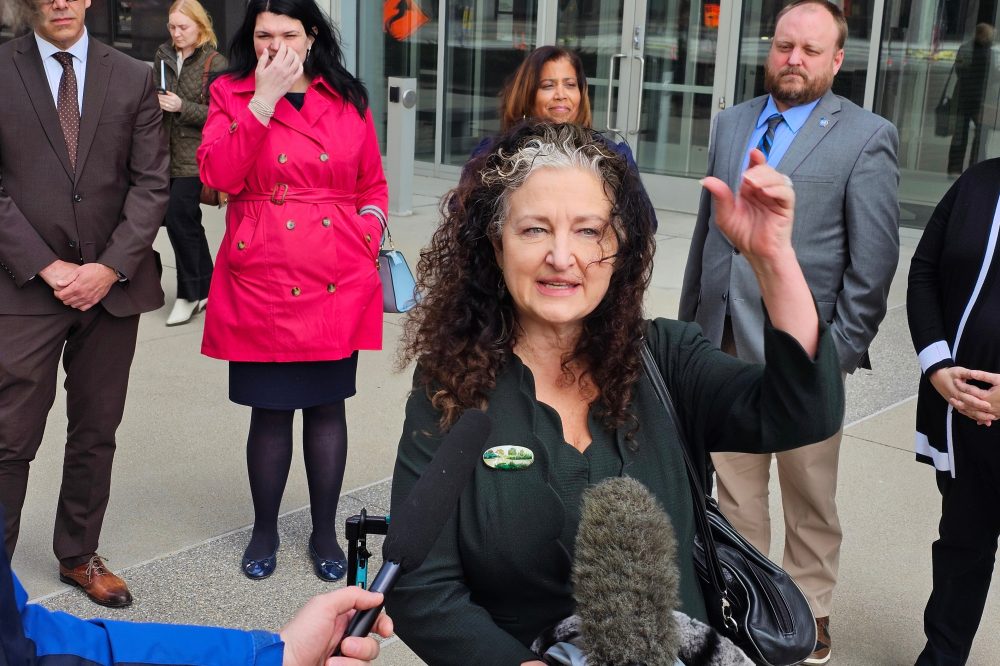
Legal counsel Amanda Cialkowski, representing the districts and union, informed media following the hearing that the potential scope of a favorable decision remained uncertain regarding its application beyond Minnesota’s borders or to other protected sites such as religious institutions and medical facilities.
“We’ll just have to wait and see what the judge does,” she said.
Educators nationwide have documented how Trump’s immigration enforcement efforts have affected their professional duties and student welfare. Court documents from an active lawsuit filed by national teachers organizations in Oregon federal court include accounts from teachers describing raid rumors that frightened students away, immigrant families who completely withdrew their children from school, and incidents of arrests occurring at bus stops involving parents and students.
Congressional Democrats’ insistence that federal agencies avoid enforcement activities around educational institutions, religious centers, and hospitals represents one of several unresolved disagreements in the ongoing legislative battle over Homeland Security funding.
Wednesday’s legal arguments before U.S. District Judge Laura Provinzino centered primarily on complex procedural questions regarding whether the school districts and union possessed proper legal standing to file suit, could demonstrate direct injury from the policy modification, and whether the new directives constituted the type of final administrative action subject to judicial review.
Department of Justice lawyer Jessica Lundberg argued that “swapping out” the current policy guidance for previous guidelines, as requested by plaintiffs, would not produce substantial practical changes. She noted that even under former regulations, enforcement activities near educational facilities remained possible.
Provinzino indicated she would deliver her decision “as quickly as I can … but also making sure I get it right.”
Both superintendents from the Fridley district in suburban Minneapolis and the Duluth district in northern Minnesota attended the courtroom proceedings.
Fridley Superintendent Brenda Lewis testified that the policy change “deeply impacted” student attendance as families felt unsafe sending children to school. She explained her schools needed to transition to remote learning for numerous students, creating additional resource demands.
Lewis also reported her district has lost 72 students since December, damaging funding tied to enrollment numbers and meal service. Some transferred to districts they perceived as safer, while others departed the country or are currently in detention facilities, she stated.
Although Operation Metro Surge officially concluded, meaning Fridley has not observed ICE officers on campus grounds for eight weeks, Lewis emphasized the consequences will persist for years.
Duluth Superintendent John Magas noted his district — located roughly 150 miles north of Minneapolis — lies well beyond the Twin Cities metropolitan region but began experiencing policy change effects long before the surge operation.
School systems throughout the Twin Cities region experienced dramatic absenteeism increases during the enforcement crackdown. St. Paul recorded over 9,000 absent students in mid-January, representing more than 25% of the district, based on attendance records obtained by The Associated Press.
Minneapolis Public Schools had over 8,000 students remain home on January’s final school day, approaching 30% of enrollment. Fridley witnessed attendance decline by nearly one-third, according to legal filings.