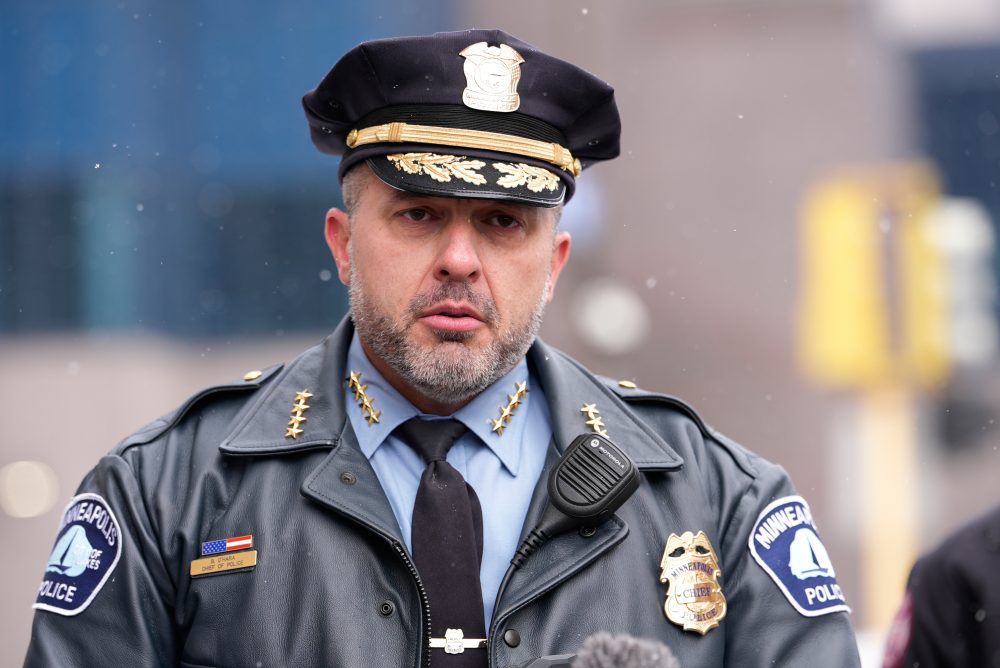

MINNEAPOLIS (AP) — Minneapolis finds itself in familiar territory once more, grappling with uncertainty after Police Chief Brian O’Hara stepped down following findings that he probably meddled in a misconduct inquiry.
O’Hara came to Minneapolis as an outside hire tasked with transforming the police force following George Floyd’s death in 2020, which resulted in federal and state investigations revealing patterns of excessive force and discriminatory policing. His background included extensive experience in Newark, New Jersey, where he implemented reforms after that city’s department operated under federal oversight due to excessive force violations and unconstitutional practices.
The obstacles facing Minneapolis were evident well before O’Hara took the helm in late 2022. The department’s very existence had been questioned, with more than 43% of residents voting in 2021 to eliminate it entirely as the community struggled with Floyd’s death and the subsequent massive demonstrations and widespread unrest.
Law enforcement specialists had recognized the enormous responsibility awaiting Minneapolis’ incoming police leader, who would need to restore public confidence and revitalize a department whose spirits had fallen so dramatically that officers were leaving in droves.
“I don’t think there was a bigger challenge to any American city than what Minneapolis faced when he arrived,” said Chuck Wexler, executive director of a Washington think tank, the Police Executive Research Forum. “They had gone from 850 to 500 officers, violent crime was significantly up, trust with the community was broken, a police station had burned down and a federal consent decree would face the next chief. Then you had the politics of Minneapolis.”
Taking charge of a major department as an outsider presents significant obstacles, particularly when tasked with transformation and reconstruction, according to Renée Hall, president of the National Organization of Black Law Enforcement Executives who relocated from Detroit to oversee the Dallas Police Department from 2017 to 2020.
“It’s extremely challenging to walk into an organization, where you don’t even know where the light switches are, where the bathrooms are. And that’s just the basics,” Hall said. “You have to learn the officers, the community, the politics of that particular city, and try to learn and navigate the existing relationships, like unions or officer associations and who is tied to whom and who is fighting for whom.”
Hall explained that external appointments often encounter hostility from internal staff who favored promoting from within. Building community confidence also requires considerable time, she noted.
Following the defeat of the police elimination proposal, O’Hara entered the administration of a strongly progressive city frequently torn by political conflicts between the mayor and City Council, as well as among council members themselves.
These tensions were clearly visible Wednesday during a City Council press conference regarding O’Hara’s departure, which progressive members used to criticize Mayor Jacob Frey, who describes himself as a “pragmatic progressive.”
The resignation “is a symptom of a much larger problem, which is simply that Mayor Frey continues to be unable to effectively manage the Minneapolis Police Department,” said Council member Robin Wonsley, a cornerstone of the council’s progressive bloc.
Frey, who recently advocated for O’Hara’s reappointment, defended his response to allegations about the chief’s potential wrongdoing.
“I don’t make decisions based on rumors and anonymous complaints,” he said in a statement, adding that he would work with the council to find a replacement. “I took action promptly after receiving the investigative report. … Decisions this serious have to be grounded in facts, evidence and completed investigations. Anything less would be irresponsible.”
O’Hara did not return a message seeking comment Wednesday. His attorney, Doug Kelley, released a statement touting successes during O’Hara’s tenure, including diversifying and increasing the department’s ranks, the decreasing violent crime rate and mitigating violent clashes during the immigration crackdown.
“The circumstances of Chief O’Hara’s departure should not define his service,” Kelley wrote. “He was proud to serve Minneapolis, remains grateful to the officers and community partners who did difficult work under extraordinary pressure, and hopes the city continues moving forward. He understandably looks forward to returning to his young family in New Jersey.”
The departure occurred just months after Minneapolis returned to national attention during a federal immigration surge that resulted in three civilians being shot, two fatally. O’Hara faced criticism he hadn’t done enough to stop the crackdown.
Violence plagued the city in 2025, including deadly attacks on state politicians in the Minneapolis suburbs; gunfire that erupted at a popular city picnic spot; and a shooting during Mass at the Church of the Annunciation that left two children dead and more than a dozen people injured. O’Hara called the church attack a “truly unthinkable tragedy.”
Critics say dozens of complaints were filed against O’Hara, from accusations that he was rude to the public to the recent investigation into an ultimately unproven allegation he had a sexual relationship with a city employee. Most of the complaints have not been made public, and 17 complaints are still being investigated. Investigators closed 17 more without any disciplinary actions.
An independent investigator did not find evidence to substantiate the alleged sexual relationship with a city employee, but a second report released this week said O’Hara likely deleted the employee’s contact from his phone during the investigation and that he talked to another employee about the probe despite being told it was not to be discussed.
That recent report led to a written reprimand; Frey told O’Hara he would be disciplined and that he could be terminated. Frey said O’Hara chose to resign instead.
Frey appointed an interim chief Tuesday from inside the department, and he has 30 days to nominate a successor under the city’s charter.