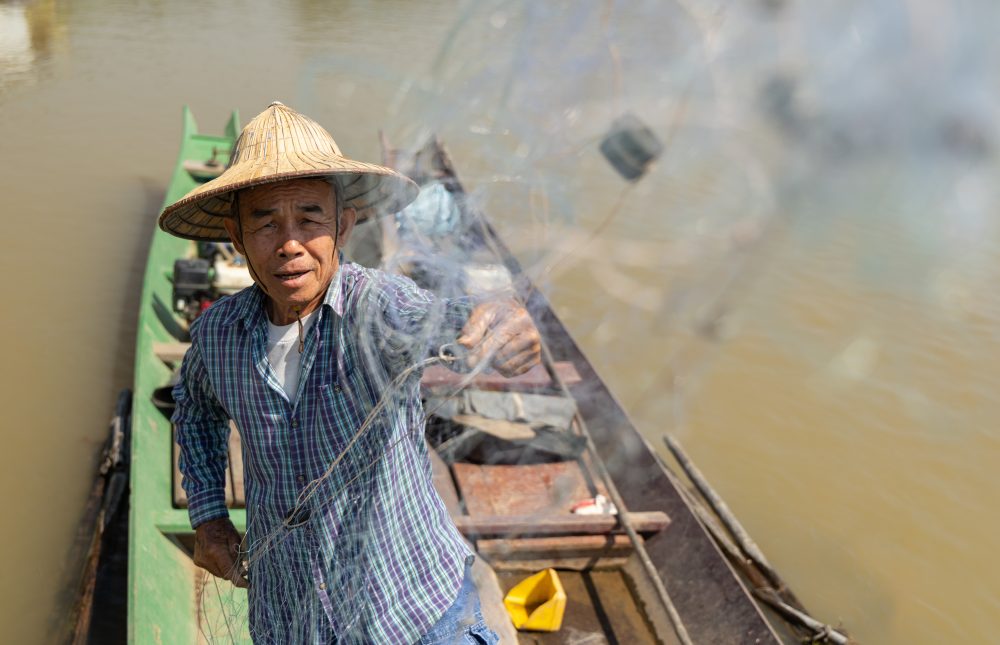

Standing at the front of his traditional fishing vessel in Chiang Saen, Thailand, 75-year-old Sukjai Yana pulled a meager collection of tiny fish from his nets, worried about both the size of his catch and whether anyone would buy what he hauled in.
Many days, Yana returns home empty-handed as customers increasingly avoid purchasing fish due to concerns about contamination in the Mekong River system. Toxic chemicals flowing downstream from rare earth mining operations are endangering the livelihoods of millions who depend on these waterways for agriculture and fishing.
For generations, Yana’s family has called this northern Thai fishing community home. “I don’t know where else I’d go,” he said.
Yana represents just one of 70 million residents across mainland Southeast Asia whose lives depend on the massive Mekong River, which stretches nearly 5,000 kilometers (3,100 miles). Growing global appetite for rare earth minerals has sparked an uncontrolled mining surge primarily in conflict-ridden Myanmar, with operations now expanding into neighboring Laos.
The mighty Mekong has already endured numerous environmental challenges, including plastic waste, upstream hydroelectric projects, and riverbank sand extraction. However, environmental specialists caution that toxic discharge from mining activities represents a potentially catastrophic danger.
Contact with dangerous heavy metals including arsenic, mercury, lead and cadmium increases the likelihood of cancer, organ damage and birth defects, particularly affecting children and expectant mothers.
Thailand faces the most severe impact from this mining expansion as these contaminants threaten its worldwide agricultural exports — affecting everything from rice sold in American grocery stores to edamame consumed in Japan and garlic used throughout Malaysian cooking. Current responses remain localized and insufficient, while smuggling activities and Myanmar’s ongoing civil conflict prevent comprehensive regional solutions, creating additional concerns for downstream nations Cambodia and Vietnam.
Suebsakun Kidnukorn from Mae Fah Luang University in northern Thailand’s Chiang Rai province emphasized that farming forms the economic foundation of Southeast Asia, cautioning that rare earth extraction is destroying “the world’s kitchen.”
While harvesting banana clusters at his farm in the mountainous Thai village of Tha Ton, 63-year-old Lah Boonruang counted on his fingers the contaminated crops he grows — rice, garlic, corn, onion, mangoes and bananas.
Boonruang waters his farmland using the Kok River, a Mekong branch that carries pollutants as it flows from Myanmar into Thailand.
“Everyone is afraid of the toxins,” he said. “If we can’t export, a farmer is the first to die.”
Thailand ranks among the globe’s leading rice exporters alongside India and Vietnam. The country shipped more than $10 billion in rice and fruit products during 2024, with trade data showing the United States as the primary rice purchasing nation.
Niwat Roykaew, who established The Mekong School environmental institute in northern Thailand’s Chiang Khong district, expressed deep concern about the situation. “Our worry is that toxins accumulate in the rice we export. This would make our rice farming industry, which is our culture, collapse,” he said.
Thai researchers have discovered increased heavy metal contamination in additional Mekong tributaries, including the Sai and Ruak rivers.
The Mekong originates in China and travels through five Southeast Asian countries before reaching the ocean. Countless people throughout the Mekong Basin depend on fish as their primary protein source.
Advisories telling ethnic communities in northern Thailand’s hills to stop using river water create particular hardship for the Lahu people, renowned for their fishing traditions, explained Sela Lipo, a 56-year-old Lahu community leader.
“The Lahu’s way of life is always with a river,” he said. “The contaminated river has cut off our lifeline.”
Thai officials acknowledge having minimal influence over mining activities occurring across borders in troubled Myanmar and Laos. Thailand’s ability to respond has been hampered by insufficient technical knowledge, data and financial resources, according to Aweera Pakkamart from Thailand’s Pollution Control Department.
Public universities, municipal authorities and regional groups like the Mekong River Commission have instead concentrated primarily on tracking heavy metal concentrations and informing local populations about potential dangers.
Warakorn Maneechuket, a scientist at Thailand’s Naresuan University, reported that recent testing of water, fish and riverbed samples from Mekong tributaries revealed elevated concentrations of hazardous heavy metals including arsenic, mercury, lead and cadmium linked to rare earth extraction.
In her laboratory, she demonstrated clear indicators of contamination using a surgical blade to highlight abnormal growths resembling tumors, altered scale coloration, and strange eye pigmentation before examining a catfish captured from the Kok River.
Heavy metal buildup occurs gradually and dangerously. Arsenic exposure can trigger organ shutdown. Mercury attacks the nervous system. Lead interferes with brain function while cadmium damages kidney tissue.
Tanapon Phenrat from Naresuan University helped create a mobile application allowing fishers to assess fish safety, teaching Chiang Saen fishermen to use the technology for identifying and photographing questionable catches. Developing a community-based scientific database for northern Thailand can help measure contamination extent and distribution, he explained.
“Each and every sample is very important,” he said.
Because rare earth elements appear everywhere in modern life, market demand continues climbing.
These materials prove essential for contemporary technology, powering everything from mobile phones and electric cars to military weapons and aircraft. Despite their name suggesting scarcity, rare earths exist abundantly. What makes them valuable is the expensive extraction process and complicated refinement procedures, which China dominates.
The Washington-based Stimson Center has employed satellite imagery analysis to locate almost 800 suspected illegal rare earth and other mining locations along Mekong tributaries throughout Laos, Myanmar and Cambodia.
Numerous Myanmar sites sit in active combat zones. The ongoing war has created a “diversification of mines” across different regions, noted Regan Kwan from The Stimson Center, who has documented mining expansion to 26 riverside locations in Laos.
Rare earth extraction involves either excavating rock formations or using chemical solutions to wash minerals from soil, generating poisonous waste products. This process creates distinctive patterns visible in satellite monitoring, Kwan explained.
Myanmar serves as China’s primary heavy rare earth supplier, delivering over $4.2 billion worth of these materials to China from 2017 through 2024, with most exports occurring following the 2021 military coup.
President Donald Trump has prioritized securing America’s critical mineral and rare earth supplies as a central foreign policy goal. These materials power F-35 fighter aircraft, submarines, Tomahawk missiles, radar equipment and precision weapons, according to federal agencies, with demand increasing as the United States restocks and expands military reserves depleted by conflicts in Iran and Ukraine.
This development brings troubling news for the river system supporting mainland Southeast Asia.
Brian Eyler from the Stimson Center compared the situation to previous regional disasters, noting that while 20th-century conflicts including the Vietnam War and Khmer Rouge massacres caused the most devastating damage to the Mekong region, toxic contamination ranks as a close second threat, calling it an “atomic bomb” for the river ecosystem.
The pollution proves far more destructive than other challenges like massive dam construction and “it is not stopping.”