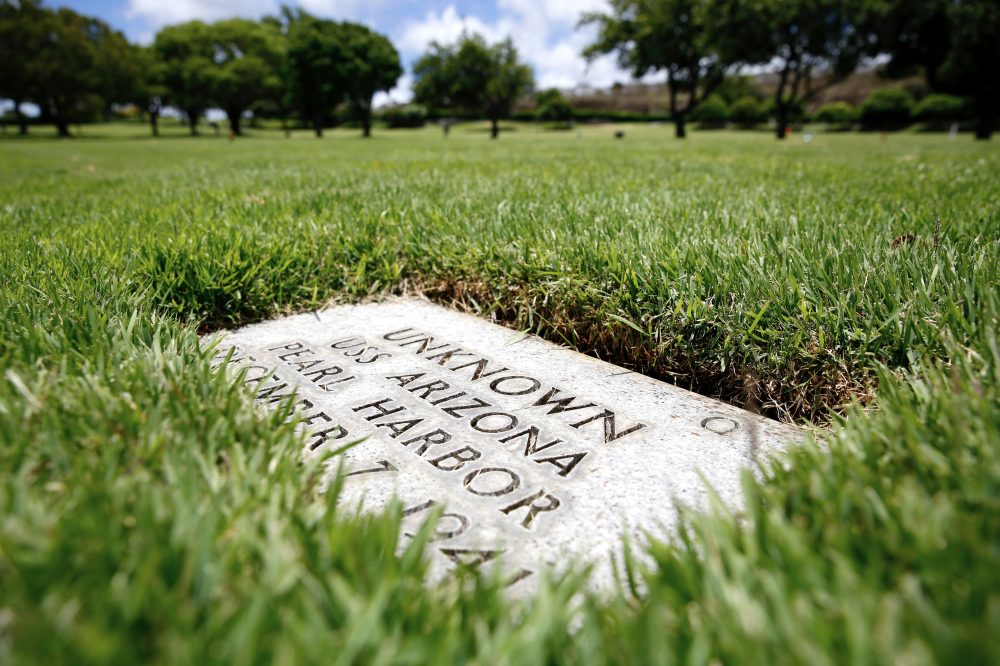

HONOLULU — Military officials will begin digging up the remains of 88 servicemen from the USS Arizona who have been buried without names since the Pearl Harbor attack, hoping to finally identify these heroes using modern DNA science.
The sailors and Marines died when their battleship was bombed during Japan’s surprise attack 85 years ago, but their identities remained unknown despite military efforts at the time. Now, breakthrough advances in genetic testing offer new hope for putting names to these fallen warriors.
Kelly McKeague, who leads the Defense POW/MIA Accounting Agency, announced Thursday that the removals from Honolulu’s National Memorial Cemetery of the Pacific will start in November or December.
The process will move slowly and respectfully, with approximately eight sets of remains being removed every two to three weeks. Scientists will then match DNA from the remains against genetic samples provided by family members of missing troops.
Japan’s December 7, 1941 bombing of the Hawaiian naval installation destroyed or damaged dozens of vessels, ultimately drawing America into World War II.
This latest identification mission builds on a decade of similar DNA projects involving Pearl Harbor casualties. The same agency has successfully identified hundreds of crew members from the USS Oklahoma, USS West Virginia and other vessels using comparable techniques.
The Arizona went down in just nine minutes after taking a direct hit, and 1,177 servicemen died aboard the vessel — accounting for nearly half of all American deaths during the attack. The sunken battleship remains on the harbor floor today, serving as the final resting place for more than 900 sailors and Marines still trapped inside.
Those remains will stay undisturbed in their underwater tomb. Only the servicemen buried in the cemetery will be removed for identification.
Robert Edwin Kline served as a 22-year-old gunner’s mate second class when he perished on the Arizona. His great-nephew Kevin Kline, who works in real estate in northern Virginia, grew up believing his relative’s body remained with the ship. He only learned a few years back that some crew members had been laid to rest as unknowns in the cemetery.
While Kevin Kline doesn’t expect his great-uncle to be among those identified, he thinks families who do receive DNA matches will find peace after decades of what he calls “generational grief.”
He recalled meeting a woman who couldn’t understand her lifelong sadness during Christmas season. She eventually realized the timing connected to her grandmother losing a son on the Arizona and her mother losing a brother — both women avoided holiday celebrations because they came so soon after the attack’s anniversary.
“As she got older, she realized that her grandmother and her mom were still grieving about this loss,” Kline said. “And it fell on her as well.”
For years, the Defense POW/MIA Accounting Agency refused to dig up Arizona remains, arguing it wouldn’t be practical since they had medical records, dental records and family DNA for only a tiny fraction of the men — just 1% of families as recently as 2021.
Kevin Kline responded by creating Operation 85 and spending three years tracking down relatives and convincing them to provide DNA samples. Of the 1,500 people he reached out to, only about 15 refused to help.
Family members of 626 sailors and Marines have now contributed their DNA, Kline reported. That represents nearly 60% of the crew members still unaccounted for, and additional sample kits continue arriving.
Kline admits feeling angry and frustrated by the military’s earlier resistance, but his attitude has shifted.
“I’m happy that we were able to kind of pull this together and turn that hard no,” Kline said.
The recovered remains will be transported to the agency’s laboratory at Joint Base Pearl Harbor-Hickam for initial examination. DNA samples will then be shipped to the Armed Forces DNA Identification Laboratory at Dover Air Force Base in Delaware for final analysis.
The military newspaper Stars and Stripes first broke the story about the Arizona disinterment decision.