
Senior military officials at an American Army training base in Germany defended the strategic importance of U.S. forces stationed in Europe, just one day after President Donald Trump indicated he was considering reducing American troop strength in the region.
Speaking to reporters at the Hohenfels training facility in southern Germany on Thursday, several high-ranking officers outlined key advantages of maintaining the current military presence, including strengthening partnerships with NATO allies, discouraging hostile nations, and incorporating tactical knowledge gained from the ongoing conflict in Ukraine.
The military leaders either avoided discussing Trump’s statements directly or refused to address them when asked. Representatives from U.S. Army Europe and Africa Command, as well as European Command, did not provide immediate responses regarding how potential troop cuts might affect operations.
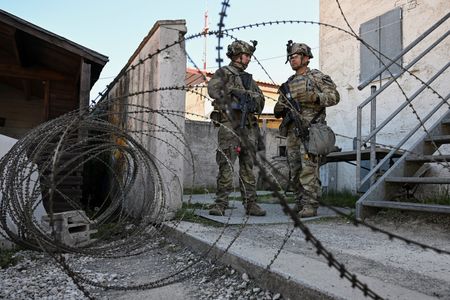
Germany currently hosts America’s most significant military presence in Europe, with approximately 35,000 active-duty service members stationed throughout the country. The nation functions as a crucial training center, particularly the Hohenfels installation, which covers 163 square kilometers of forested terrain and conducts large-scale combat exercises for American forces alongside NATO partners.
During Thursday’s visit, an armored brigade was midway through an intensive 10-day training exercise that included avoiding enemy surveillance and drone attacks. The unit was completing a nine-month assignment in Poland and other Eastern European locations as part of an Army program designed to strengthen NATO partnerships and military readiness.
Colonel Michael Ziegelhofer, the brigade commander, emphasized that the European presence demonstrates to potential enemies that any conflict would involve “the most ready, trained, lethal fighting force, and not just the United States, but the United States and its NATO allies.” He added, “The fact that we’re out here represents, you know, really our country’s support for NATO and our allies.”
Standing near a simulated village used for training scenarios, Ziegelhofer stressed the importance of joint exercises with international partners. “If a crisis were to take place over here, we’d be in the fight together, so training like this helps us to build the interoperability, not just with the equipment that we have, but between the people and the systems and the processes in our unit,” he explained.
The colonel noted that his brigade has gained valuable experience with unmanned aircraft during their European deployment. “We worked all the way from learning how to fly them to getting pretty sophisticated in understanding the systems and processes, both in using them ourselves and how to counter the enemy’s use of those since we’ve been over here,” Ziegelhofer said.
Lieutenant Colonel Michael Cryer, who leads the permanent opposition force at Hohenfels known as the “warrior” battalion, explained how lessons from the Russia-Ukraine war are being integrated into current training programs, particularly regarding drone technology and electronic warfare capabilities.
“It’s been a cat-and-mouse game, as you’ve seen in Ukraine,” Cryer observed. “Where one side develops this capability, another side develops a countermeasure.”
According to Cryer, one of the most significant tactical challenges involves conducting offensive operations while under constant drone surveillance. “It is nearly impossible to hide,” he stated. “Across the army, we haven’t totally come to grips with that.”