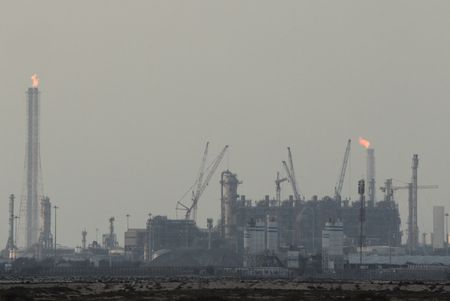

Energy facilities across the Middle East went offline Monday as escalating conflicts between Israel, the United States, and Iran triggered widespread precautionary shutdowns of oil and gas operations.
Qatar suspended its liquefied natural gas production, which accounts for roughly one-fifth of the world’s total supply. The nation ranks as the globe’s second-largest LNG exporter behind the United States and serves as a crucial supplier for balancing energy demands in Asia and Europe. QatarEnergy’s customer base is 82% Asian.
Saudi Arabia’s largest domestic oil refinery ceased operations after being targeted by a drone attack, according to a source familiar with the situation.
The military actions have extended into their third day, also forcing the halt of most oil production in Iraqi Kurdistan and shuttering several significant Israeli gas fields, which has disrupted exports to Egypt.
Energy markets reacted dramatically, with oil prices climbing as much as 13% during trading to exceed $82 per barrel – the highest level since January 2025. The price surge occurred as the conflict brought shipping through the Strait of Hormuz to a virtual standstill. This critical waterway handles one-fifth of the world’s oil supply.
Saudi Aramco’s Ras Tanura refinery, which processes 550,000 barrels daily, was closed as a safety precaution. The facility sits within an energy complex along the kingdom’s Gulf coastline that also functions as a vital export terminal for Saudi crude oil.
Aramco has not yet responded to requests for comment.
QatarEnergy announced it was also stopping production of LNG-related products. Earlier Monday, Qatar’s government reported that two Iranian drones struck a QatarEnergy facility, with officials currently evaluating the extent of damage.
In Iraqi Kurdistan, oil companies including DNO, Gulf Keystone Petroleum, Dana Gas and HKN Energy have suspended operations at their fields as a safety measure, though no damage has been reported. The region exported 200,000 barrels daily through a pipeline to Turkey’s Ceyhan port in February.
Off Israel’s coast, the government ordered Chevron to temporarily close the massive Leviathan gas field, where the company is working to increase capacity to approximately 21 billion cubic metres annually as part of a $35 billion export agreement with Egypt. A Chevron representative confirmed that its facilities, including the Tamar gas field, remain secure.
Energean also shut down its production vessel that services smaller gas fields in the area.
In Iran, explosions were reported Saturday at Kharg Island, which handles 90% of Iran’s crude exports, though the impact on facilities remains unclear.
Iran ranks as the third-largest producer within the Organization of the Petroleum Exporting Countries, contributing about 4.5% of global oil supplies. The country produces approximately 3.3 million barrels per day of crude oil, plus an additional 1.3 million barrels daily of condensate and other liquids.
Regarding the Saudi facility, the source indicated that conditions at Aramco’s Ras Tanura refinery are now stable. The Saudi defense ministry spokesperson told Al Arabiya TV that two drones were intercepted at the site, with debris sparking a contained fire but causing no injuries.
While some refinery units were shut down for safety reasons, an unnamed energy ministry official told Saudi state news agency SPA that petroleum product supplies to domestic markets remained unaffected.
However, the Ras Tanura closure will likely heighten supply concerns as shipping through the Strait of Hormuz has nearly stopped following attacks on vessels in the area Sunday.
“The attack on Saudi Arabia’s Ras Tanura refinery marks a significant escalation, with Gulf energy infrastructure now squarely in Iran’s sights,” said Torbjorn Soltvedt, principal Middle East analyst at risk intelligence firm Verisk Maplecroft.
“The attack is also likely to move Saudi Arabia and neighbouring Gulf states closer to joining U.S. and Israeli military operations against Iran.”
Saudi Arabia’s well-protected energy infrastructure has faced previous attacks, particularly in September 2019 when drone and missile strikes on the Abqaiq and Khurais facilities temporarily eliminated more than half of the kingdom’s crude production.
Yemen’s Iran-backed Houthis previously targeted Ras Tanura in 2021.