
A preliminary two-week ceasefire between Iran, the United States and Israel was announced Wednesday, marking a pause in the Middle Eastern conflict that has disrupted global energy markets and prompted President Donald Trump to withdraw his earlier threats to eliminate Iranian “civilization.”
However, confusion arose immediately regarding conflicting proposals to end hostilities, as Iran maintained its position that it would retain control over shipping through the Strait of Hormuz while continuing uranium enrichment operations.
Trump initially described Iran’s 10-point proposal as “workable” for ending the conflict he initiated with Israel on February 28. Later, however, he denounced the plan as fraudulent without providing details. The president has stated that completely dismantling Iran’s nuclear capabilities was a primary objective of the war.
While Israel supported the U.S.-Iran ceasefire agreement, Prime Minister Benjamin Netanyahu clarified early Wednesday that the deal excludes ongoing combat with Hezbollah forces in Lebanon. This statement conflicted with remarks from Pakistan, a crucial mediator, which announced that peace negotiations would commence as early as Friday in Islamabad. Pakistan also declared the ceasefire effective immediately, though Iran subsequently launched attacks on Gulf Arab nations and Israel.
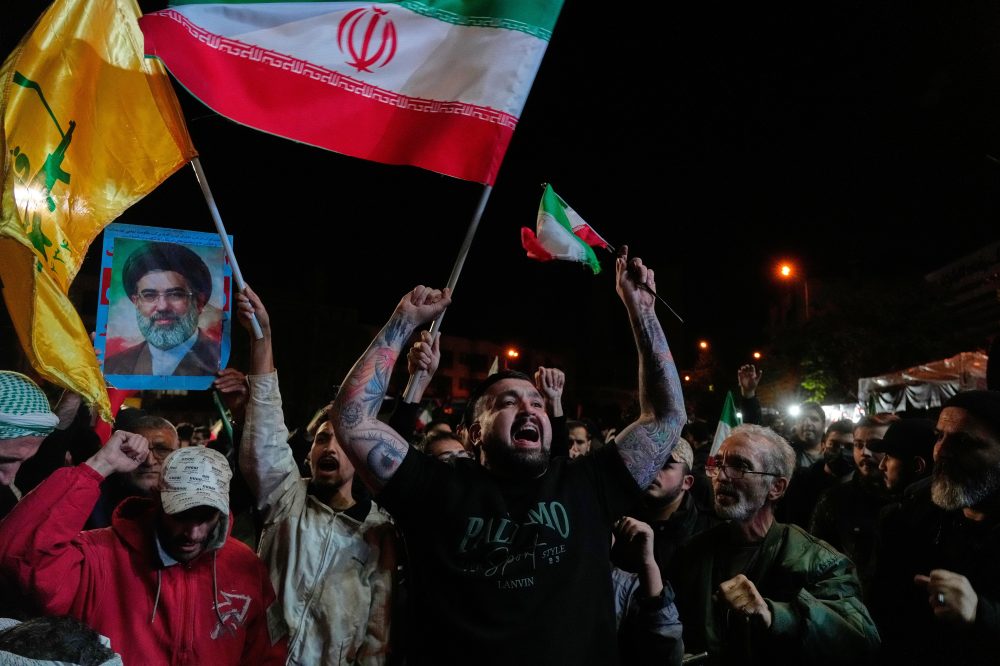
Following the ceasefire announcement, pro-government protesters in Iran’s capital chanted: “Death to America, death to Israel, death to compromisers!” while burning American and Israeli flags. The demonstrations reflected continued anger from hardline factions who had been preparing for what many expected would be catastrophic warfare with the United States.
Iranian Foreign Minister Abbas Araghchi announced that strait passage would be permitted under Iranian military oversight. It remained unclear whether this indicated Iran would fully ease its grip on the crucial waterway.
According to a regional official speaking anonymously about negotiations they participated in directly, the proposal permits both Iran and Oman to collect transit fees from ships passing through the strait. The official noted Iran would allocate collected funds toward reconstruction efforts.
Beyond strait control, Iran’s conditions for ending the conflict include removing U.S. military forces from the region, eliminating sanctions, and releasing frozen Iranian assets.
Throughout the war, Trump has consistently postponed deadlines moments before their expiration.
Continuing this pattern Tuesday, Trump announced in a social media statement that he reached his decision “based on conversations” with Pakistan Prime Minister Shehbaz Sharif and General Asim Munir, Pakistan’s influential army commander. Sharif had posted on X hours earlier, encouraging Trump to extend his deadline for diplomatic progress while requesting Iran open the strait for two weeks.
An anonymous source familiar with the situation revealed Israeli concerns about the agreement, noting that Israel hoped to accomplish more objectives.
Iran’s highly enriched uranium stockpile remains secured at enrichment facilities. This program had been among the primary justifications cited by Israel and the U.S. for launching military action.
“A whole civilization will die tonight, never to be brought back again,” Trump posted online Tuesday morning regarding potential consequences without an agreement. However, he appeared to leave room for alternatives, stating “maybe something revolutionarily wonderful can happen.”
Trump’s sweeping threat appeared to disregard potential civilian casualties, prompting Congressional Democrats, United Nations officials, and military law experts to declare such strikes would breach international law.
Iran’s U.N. representative, Amir-Saeid Iravani, characterized the threats as “constitute incitement to war crimes and potentially genocide,” warning that Iran would “take immediate and proportionate reciprocal measures” if Trump executed devastating attacks.
U.S. and Israeli forces have repeatedly struck Iran, targeting military assets, leadership, and nuclear facilities. Iran has retaliated with attacks on Israel and neighboring Gulf Arab states, creating regional instability and significant economic and political disruption.
Prior to the deadline, airstrikes damaged two bridges and a railway station, while U.S. forces targeted military infrastructure on Kharg Island, a center for Iranian oil operations.
Although Iran lacks the advanced weaponry and air superiority of U.S. and Israeli forces, its control over the strait has destabilized the global economy and increased pressure on Trump to find a resolution.
Despite the ceasefire announcement, missile warnings persisted in the United Arab Emirates, Israel, Saudi Arabia, Bahrain, and Kuwait early Wednesday. Officials reported a gas processing plant in Abu Dhabi caught fire following Iranian missile strikes.
An Israeli military official, speaking anonymously per military protocol, confirmed Israel continued attacking Iran. Iran likewise maintained its assault on Israel.
U.S. military forces have suspended all offensive actions against Iran while maintaining defensive operations, according to an official who spoke anonymously about classified military activities.
Earlier Tuesday, Israeli forces reported attacking an Iranian petrochemical facility in Shiraz, marking the second consecutive day of such strikes. The military subsequently announced hitting bridges used by Iranian forces for weapons and equipment transport.
Over 1,900 people have died in Iran during the conflict, though the government has not released updated casualty figures for several days.
In Lebanon, where Israel battles Iran-supported Hezbollah militants, more than 1,500 people have been killed and 1 million displaced. Eleven Israeli soldiers have lost their lives.
In Gulf Arab nations and the occupied West Bank, over two dozen people have died, while 23 deaths have been reported in Israel, and 13 U.S. service members have been killed.