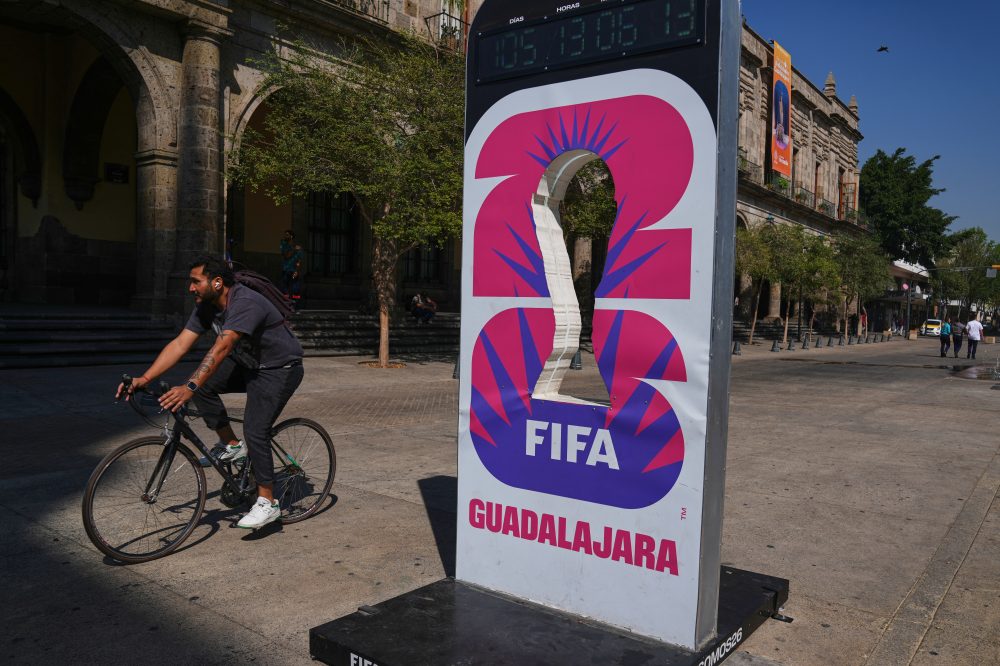

Mexican President Claudia Sheinbaum made a high-profile trip to Jalisco state Friday, working to calm safety fears before the FIFA World Cup after deadly cartel violence swept through the region.
The bloodshed began after Mexico’s military killed Nemesio Oseguera Cervantes, known as “El Mencho,” the country’s most influential drug cartel leader, last month. His death sparked violent clashes between cartel members and authorities, along with car burnings throughout Mexico, with Jalisco and its capital city Guadalajara experiencing the worst of the chaos.
The deadly confrontations claimed more than 70 lives, including 25 National Guard officers, creating serious questions both domestically and internationally about whether Guadalajara can safely welcome thousands of World Cup visitors.
Flanked by her security team and top military officials Friday, Sheinbaum conducted her daily press conference from military facilities in the same municipality where “El Mencho” was recently laid to rest under tight security and where World Cup matches will take place.
“We are here … to tell everyone in Jalisco, all the people of Jalisco, that we are together, that we are working for peace, security and the well-being of the inhabitants of this beautiful state,” Sheinbaum said.
With less than 100 days remaining before World Cup kickoff, Sheinbaum and security leaders outlined comprehensive safety measures for the international tournament, involving more than 20 federal agencies, military branches, and local law enforcement.
Security Secretary Omar García Harfuch, who spearheads Mexico’s anti-cartel operations, explained that Mexican officials have coordinated with counterparts in the United States, Canada and FIFA to enhance preparation and emergency response capabilities.
The security framework will feature specialized officer training, practice drills, alert systems, protective details around venues, airports, transportation routes and hotels, plus safety protocols for teams and spectators, García Harfuch noted.
Sheinbaum has worked to demonstrate assurance despite widespread concerns, including speaking directly with FIFA President Gianni Infantino by phone soon after the February violence outbreak, during which he voiced his “full confidence” in Mexico’s ability to co-host the tournament. Earlier this week, she publicly wore a FIFA scarf and posed alongside the World Cup trophy.
General Román Villalvazo, who oversees World Cup security coordination, announced Friday the establishment of three joint operation centers in host cities Mexico City, Guadalajara and Monterrey.
“The 2026 FIFA World Cup organized by Mexico, the United States and Canada represents an unprecedented event,” he said.
“For Mexico, it entails two challenges: to present a reliable and secure country before the international community, and to have the capacity to confront any threats that undermine national security.”