
A pre-dawn explosion at a Mexican oil refinery has claimed five lives and triggered widespread environmental damage along the Gulf coast, raising serious concerns about the impact on local communities and marine wildlife.
Guillermo Risso, who leads the community council in Puerto Ceiba, witnessed the dramatic blast at the Olmeca refinery on March 17. “It was an explosion, the entire refinery lit up,” Risso explained. “We saw flames and were alarmed,” he added, describing how the bright flash initially made him think the entire facility was burning.
According to Pemex, Mexico’s national oil company that operates the refinery, the deadly incident occurred when oil-contaminated water spilled from the facility onto a nearby roadway and ignited when a vehicle drove through it.
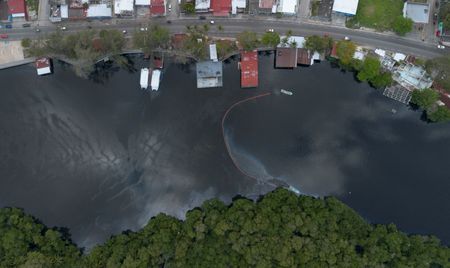
The company reported that by Sunday, cleanup crews had recovered 549 cubic meters of petroleum products from critical areas around the refinery site in Tabasco state. Workers also placed protective barriers along Rio Seco, the waterway that flows around the facility and feeds into the expansive Mecoacan lagoon where local residents harvest oysters.
Environmental scientist Alvaro Hernandez expressed concern about the spill’s potential reach. “The currents are deceptive, and it is possible that uncontrolled waste could reach the lagoon,” Hernandez warned.
Despite contamination fears, Hernandez observed that affected fishermen intend to continue selling their seafood during the approaching Easter season, as they cannot afford the financial impact of halting operations during this crisis.
This disaster represents the most severe incident yet at the troubled Olmeca facility, which has struggled with production shortfalls, cost overruns, and missed operational deadlines since opening.
The refinery incident follows another oil spill discovered earlier in March along the Tabasco and Veracruz coastlines. President Claudia Sheinbaum stated that investigators have not yet determined which company caused that earlier environmental disaster, though officials initially suspected it originated from an offshore oil tanker.
Environmental regulators have not released damage assessments for the affected coastal areas from either spill incident.
The Olmeca refinery was designed to process 340,000 barrels daily, though it has not achieved that capacity as the government continues gradually increasing production levels. The facility represents a key component of Mexico’s strategy to expand domestic oil processing and reduce dependence on imported refined products, primarily from the United States.
The Gulf of Mexico Reef Corridor Network, representing fishing organizations, indigenous communities, and environmental advocates, recently documented oil contamination along beaches near Tuxpan and Cazones in northern Veracruz.
The organization reported finding at least seven sea turtles, two dolphins, two manatees, and one pelican affected by petroleum contamination, with most of the animals found dead.
The spills have also damaged red, black, and white mangrove forests in Laguna del Ostion, Veracruz. This critical habitat supports hairy crabs and endangered blue crabs, along with migrating bird species and river otters.