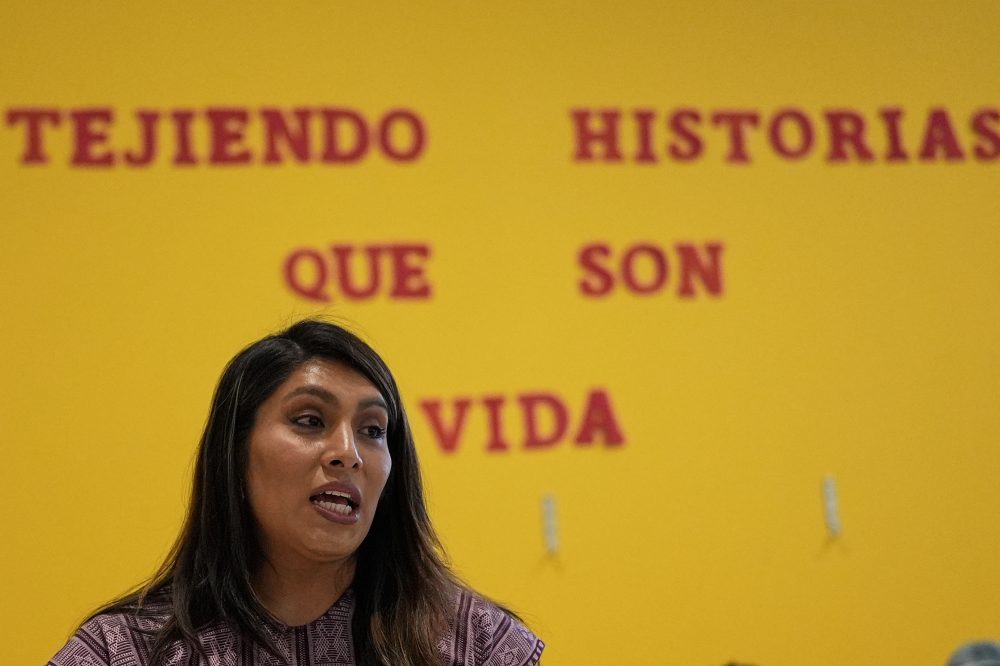

MEXICO CITY — Xaneri Merino’s journey with traditional weaving began in defiance of cultural expectations that would shape her life’s mission.
Born in San Pedro Jicayán, an Indigenous village in southern Mexico, Merino was assigned male at birth in a community where weaving traditions are typically reserved for women. Despite cultural restrictions, her grandmother secretly taught her the ancient art of backstrap loom weaving when she was just 13 years old.
“She began sharing her knowledge with me in secret,” Merino recalled about learning to weave hidden away in her grandmother’s adobe dwelling. “She taught me how to make the thread from scratch, to feel the textures and respect nature.”
Merino’s heritage combines Mixtec ancestry from her mother’s side, where creation stories connect divine origins to sacred terrain, and Zapotec roots from her father’s lineage, where spiritual practices intertwine with daily life experiences.
Her grandmother emphasized environmental stewardship as fundamental to their weaving tradition. Community weavers craft their thread-tension tools from tamarind tree branches and find methods to replenish what they harvest from nature.
“To care for nature is part of our worldview,” Merino explained. “Because it provides us with what we need to walk this world.”
Today, Merino embraces both her transgender identity and her cultural heritage as a “muxe” — a Zapotec term describing Indigenous individuals assigned male at birth who assume feminine roles, sometimes considered a third gender category.
She now earns her living conducting weaving workshops and teaching others how the backstrap loom serves both as artistic expression and resistance against oppression.
“Everyone is capable of learning how to weave, and it’s not just about creating a piece,” she told participants during a recent Mexico City workshop designed for LGBTQ+ individuals. “It’s also about weaving our own stories, as we can come to know ourselves through the loom.”
Merino’s weaving journey included a painful period of punishment and separation from her craft. At age 15, community members discovered her weaving on their way to a religious celebration.
The next morning, village loudspeakers summoned all men to address what they deemed an urgent concern: a boy who had dared to weave.
Community elders formed a circle while Merino stood in the center alongside her mother and grandmother, facing questioning about her actions.
According to Merino’s recollection, one man confronted her grandmother: “Why would you allow him to weave, if it’s not something boys are supposed to do? Do you realize what kind of example you’re setting for other children?”
Her grandmother responded straightforwardly, explaining she was simply teaching creativity and helping preserve cultural traditions through textile arts.
The community assigned Merino church-sweeping duties as punishment. Although she occasionally continued weaving secretly, the experience deeply affected her relationship with the craft, leading her to largely abandon her loom.
“I developed a deep resentment toward textiles and the customs around them,” Merino reflected. “Having the ability to create and not being allowed to use it was like having eyes and having them taken away — I could no longer see.”
Healing began when Merino relocated to Mexico City for university studies. Her communications major included coursework in cultural management, textile analysis, and postcolonial perspectives on Indigenous resistance movements.
“That made me see how I could use my reality for a greater good,” she said. “My loom became a means to healing.”
Workshop participants often discover personal connections through the weaving process. One returning student explained to her classmates that looms reflect the weaver’s emotional state, transferring both positive feelings and stress into the threads.
“I love Xan’s way of teaching because she is very human and patient,” student Emilia Freire, also a transgender woman, told The Associated Press. “She made me realize that once I had my weaving set up and began to work, everything I carried with me through the week would come out.”
First-time participant Kristhian Cravioto appreciated finding a welcoming environment for LGBTQ+ craft enthusiasts and celebrated Merino’s challenge to gender-based weaving restrictions.
“This is very important for us dissidents,” said Cravioto, who works as a designer with interest in Mexico’s Indigenous crafts. “To know that no matter whether you are a man or a woman, what you do matters.”
Traditional backstrap looms consist of cords, threads, and wooden components assembled into transportable frames. Weavers typically sit on the ground, securing one loom end to a tree or post while fastening the other around their waist. Body movements create rhythmic tension control that guides the weaving process.
Each textile piece requires substantial time investment. Merino typically spends approximately one month working eight hours daily to complete a short “huipil,” the traditional tunic worn by Indigenous Mexican women.
While many relocated weavers adapt to urban materials, Merino returns to her hometown for authentic supplies, including purple dye extracted from coastal sea snails — a resource becoming scarcer as the species population decreases.
Though homesickness persists, Merino finds encouragement in younger LGBTQ+ community members who have embraced weaving in San Pedro Jicayán following her example.
“At least five trans women and two men are weaving,” she noted. “We have gained visibility through the loom and that’s what this fight has been about.”