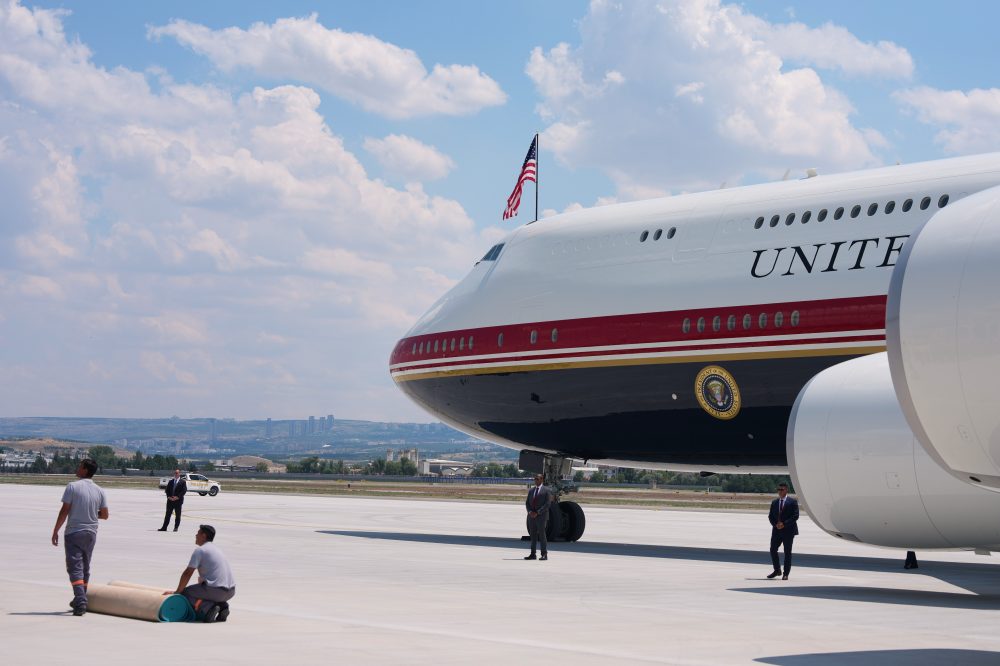

WASHINGTON — The New York Times took legal action Wednesday, filing a motion to block Justice Department subpoenas that were served on its reporters following their coverage of security concerns tied to a new Air Force One aircraft — a plane donated by Qatar and upgraded at a cost of $400 million.
David McCraw, the newspaper’s senior vice president and deputy general counsel, issued a sharp statement defending the move. “As we set out in our motion, these subpoenas are brought in bad faith to punish The Times for its coverage. They violate the constitutional rights of The Times and its journalists. We are going to court to defend our journalists’ rights to report freely on the administration and to provide the public with stories that matter,” he said.
The motion was filed under seal in the Southern District of New York. The subpoenas, which were delivered last Friday — some directly to reporters at their homes — ordered the journalists to appear before a federal grand jury in Manhattan this week.
Press freedom advocates quickly condemned the subpoenas as a government attempt to intimidate news organizations. The action follows an FBI search earlier this year of a Washington Post reporter’s home, during which her electronic devices were seized.
The Times had reported, citing unnamed sources, that the Secret Service recommended against using the newer aircraft because it lacked certain advanced security features found on the older model — including antimissile capabilities. Despite those reports, Trump denied on social media that there were any security issues. He used an older Air Force One to depart a NATO summit in Turkey last week, rather than the newer jet.
The Justice Department defended its use of the subpoenas, stating that reporters are not the intended targets. “To be clear, reporters are not the targets, those leaking classified information are,” the department said. It also acknowledged the role of a free press while asserting its responsibility to protect classified information from unauthorized disclosure.
While it is not unheard of for the government to quietly obtain journalists’ phone records during leak investigations, compelling a reporter to testify before a grand jury and identify sources is considered extremely rare and represents a significant escalation.
In April 2025, then-Attorney General Pam Bondi rolled back a Biden-era policy that had shielded journalists from having their records secretly seized in leak investigations. The new policy gives prosecutors renewed authority to use subpoenas, court orders, and search warrants to pursue officials who share classified information with reporters. A memo from Bondi stated that members of the press are “presumptively entitled to advance notice” of such actions and that subpoenas must be “narrowly drawn.”
Earlier this year, in January, FBI agents searched the home of Washington Post reporter Hannah Natanson — who has been covering changes to the federal government under the Trump administration — as part of a separate leak investigation involving a Pentagon contractor accused of taking classified materials home.