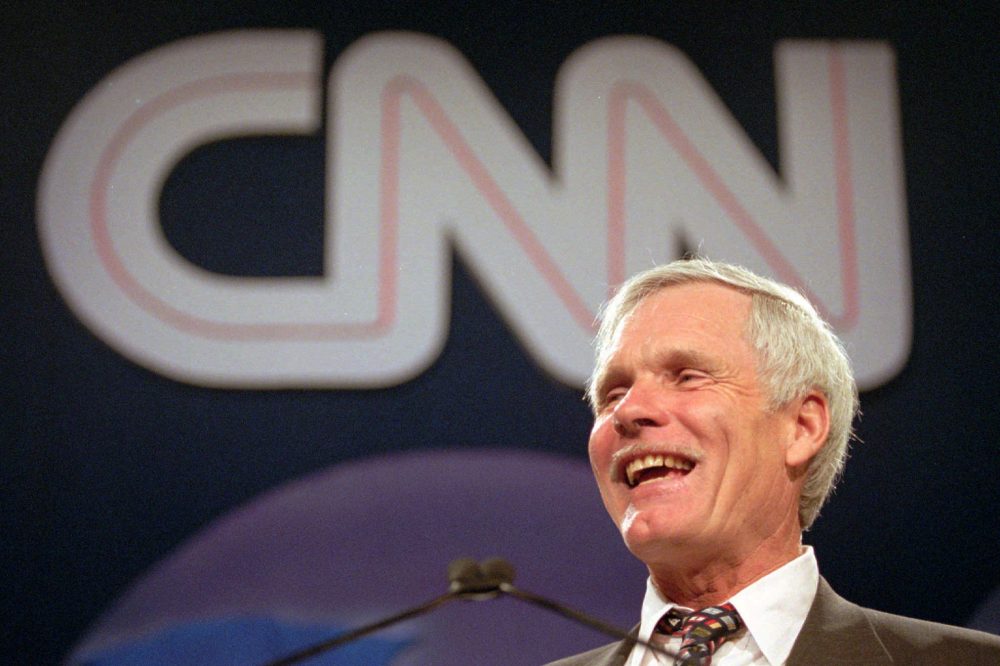

NEW YORK (AP) — Media mogul Ted Turner, the bold television innovator who created CNN and revolutionized round-the-clock news broadcasting, passed away Wednesday at his home surrounded by family members. He was 87 years old.
Turner Enterprises, which manages his extensive business holdings and investments, confirmed his death.
The Atlanta-based businessman built a media empire that included yacht racing, vast land ownership across the American West, and the launch of the first 24-hour news network that forever changed how people consume information. Turner owned multiple Atlanta sports franchises, successfully defended yachting’s America’s Cup in 1977, and made headlines with a remarkable $1 billion contribution to United Nations charitable organizations.
His personal life attracted equal attention through three marriages, most notably to actress Jane Fonda, earning him colorful monikers including “Captain Outrageous” and “The Mouth of the South.”
“If only I had a little humility, I’d be perfect,” he once boasted.
In his final years, Turner battled Lewy body dementia and stepped away from television operations to focus on charitable work and managing his extensive property holdings spanning over 2 million acres, home to the country’s largest buffalo population.
Despite his flamboyant public persona, Turner possessed sharp business instincts and an appetite for calculated risks. When he sold Turner Broadcasting System to Time Warner Inc. in 1996’s massive media merger, he had transformed his deceased father’s advertising company into an international powerhouse encompassing seven major cable channels, three professional sports organizations, and two successful film studios.
Former President Donald Trump honored Turner’s passing, describing him as “one of the Greats of All Time.”
“Whenever I needed him, he was there, always willing to fight for a good cause!” Trump wrote on social media.
Turner’s most significant contribution was establishing CNN, America’s first continuous news television channel in 1980. In today’s era of instant digital information access, it’s difficult to imagine how groundbreaking the concept of viewer-controlled news consumption once was.
Turner’s personal frustration with traditional news schedules partly inspired the venture. His work often extended beyond 8 p.m., after major network evening broadcasts concluded, and he retired before local 11 p.m. newscasts began.
He gambled on launching what critics initially mocked as the “chicken noodle network” during cable television’s infancy, even living in an apartment above CNN’s Atlanta headquarters.
“I was going to have to hit hard and move incredibly fast and that’s what we did — move so fast that the (broadcast) networks wouldn’t have the time to respond, because they should have done this, not me,” Turner explained in a 2016 Academy of Achievement interview. “But they didn’t have the imagination.”
CNN’s defining moment arrived during 1991’s Gulf War with Iraq. While most television reporters evacuated Baghdad ahead of anticipated American strikes, CNN remained, broadcasting compelling footage of warfare’s beginning, including anti-aircraft fire streaking across nighttime skies and correspondents reacting to nearby bomb explosions.
Although Turner received assurances of continued CNN involvement following his company’s $7.3 billion stock sale to Time Warner, he was eventually sidelined, causing lasting disappointment.
“I made a mistake,” he later reflected. “The mistake I made was losing control of the company.”
That same year witnessed Fox News Channel’s debut and Rupert Murdoch’s emergence as cable news’s new dominant figure. Political commentary became the primary focus for networks like Fox News and MSNBC.
Robert Edward Turner III entered the world November 19, 1938, in Cincinnati. His family relocated to Savannah, Georgia, when he was nine. After Brown University expelled him for bringing a female student to his dormitory, Turner moved to Atlanta to work as an account representative for his demanding father’s billboard business, Turner Advertising.
Following his father’s 1963 suicide, Turner assumed company leadership. In 1970, he purchased an independent UHF television station with poor signal strength that barely reached Atlanta.
On December 17, 1976, he began satellite transmission of the station to cable systems nationwide, creating the TBS SuperStation. “It was the start of something bigger than we ever imagined,” Turner said in 1996.
TBS’s eclectic programming of vintage films and “The Andy Griffith Show” reruns gained strength through Turner’s acquisition of baseball’s Atlanta Braves. The historically unsuccessful team gradually built a national following through superstation exposure and began calling themselves “America’s Team” during the 1980s.
Turner, who once wore a uniform and managed a single game, helped initiate baseball’s free-agent spending escalation by signing pitcher Andy Messersmith.
During the 1980s, Turner accumulated substantial debt purchasing MGM, another decision that faced widespread doubt.
However, the acquisition provided his company with an extensive collection of classic films that eventually became the foundation for TNT and Turner Classic Movies networks. His dedication to older cinema earned Turner a Hollywood Walk of Fame star in 2004. He faced criticism for colorizing classic films like “Casablanca,” which he defended as making them more attractive to younger viewers.
TBS also obtained the Hanna-Barbera animation collection, leading to Cartoon Network’s creation.
“He sees the obvious before most people do,” Bob Wright, former NBC president and CEO, told The New Yorker in 2001. “We all look at the same picture, but Ted sees what you don’t see. And after he sees it, it becomes obvious to everybody.”
He shared his youthful aspirations: “I used to tell people I wanted to become the world’s greatest sailor, businessman and lover all at the same time.”
When asked about his success formula, he replied: “Early to bed, early to rise, work like hell and advertise.”
Throughout much of his life a charismatic socialite who attracted beautiful women with roguish appeal, the slim, mustached sportsman married three times. His union with Fonda lasted from 1991 to 2001. She abandoned acting during their marriage but grew weary of his infidelity and divorced him, though they maintained friendship.
“He was sexy. He was brilliant. He had 2 million acres by the time I left. It would have been easy to stay,” Fonda said about her relationship with Turner.
Turner developed an unlikely friendship with Cuban leader Fidel Castro, connecting through hunting expeditions and political debates over rum and cigars. Once a fierce adversary who compared Fox’s Murdoch to Adolf Hitler, they later reconciled over shared environmental concerns.
Turner constructed a sports empire, simultaneously owning professional baseball, basketball and hockey franchises in Atlanta. He gained particular recognition leading the Atlanta Braves, transforming the struggling team into playoff contenders by the 1990s. Their stadium, constructed for the 1996 Olympics, bore the name Ted Turner Field. The Braves moved to a newer facility north of Atlanta in 2016.
Perhaps Turner’s greatest passion involved land ownership. He accumulated millions of acres in ranches populated with roaming buffalo and became Nebraska’s largest private landowner. He frequently discussed restoring the West’s bison populations, and in 2002 launched a restaurant chain featuring bison burgers, Ted’s Montana Grill. Texas A&M University researchers credited his 2005 donation of several bulls with enhancing the genetic diversity of the final southern Plains bison herd.
His net worth reached $2.5 billion in 2023, though he disappeared from Forbes magazine’s 400 wealthiest Americans list in 2021.
During a stock market collapse, Turner’s wealth plummeted from nearly $10 billion to approximately $2 billion over two-and-a-half years.
“To put this in perspective, I lost nearly $8 billion in 30 months,” he wrote in his 2008 autobiography, “Call Me Ted.” “That means that, on average, my net worth dropped by about $67 million per week, or nearly $10 million per day, every day, for two and a half years.”
He retained sufficient time and resources to pursue ambitious objectives like advancing world peace and environmental protection.
“See, my life is more an adventure than a quest to make money. Adventure is going out and doing something for the pure hell of it,” Turner once explained. “You just want to see if you can do it, period. There’s no thought of gain other than your own satisfaction.”
Over the years, Turner’s controversial behavior occasionally overshadowed his business achievements.
Following his yacht “Courageous” to America’s Cup victory in 1977, television cameras captured an extremely intoxicated Turner sprawled on the floor during celebration festivities.
Turner frequently offended people with his unfiltered speaking style. An atheist since his sister’s death from lupus at age 17, he labeled Christians “losers” and “Jesus-freaks,” later apologizing for both statements.
He once proposed during a speech that unemployed Black people transport mobile missiles with ropes “like the Egyptians building the pyramids.” Following demands for an apology from civil rights leaders, he claimed he was joking.
Other times, his wit rescued him from potentially uncomfortable situations, such as addressing a Berlin audience in 1999. “You know, you Germans had a bad century,” Turner said, according to The New Yorker. “You were on the wrong side of two wars. You were the losers. I know what that’s like. When I bought the Atlanta Braves, we couldn’t win, either. You guys can turn it around. You can start making the right choices. If the Atlanta Braves could do it, then Germany can do it.”
Turner, father of five children, assumed a leadership position in American philanthropy with his September 18, 1997, commitment to donate $1 billion, or $100 million annually for 10 years, to United Nations charities. Even as Turner’s fortune decreased following the AOL Time Warner merger, he continued supporting the U.N., describing it as humanity’s best hope for peace.
He championed various humanitarian initiatives. Turner partnered with former U.S. Senator Sam Nunn to establish the Nuclear Threat Initiative, an American nonprofit organization dedicated to reducing nuclear, biological and chemical weapon dangers. Turner publicly expressed concern about global challenges.
“If I had to predict, the way things are going, I’d say the chances are about 50-50 that humanity will be extinct in 50 years,” Turner said in 2003. “Weapons of mass destruction, disease, I mean this global warming is scaring the living daylights out of me.”
While investing millions in international nonprofits, Turner also enjoyed sharing his wealth through smaller gestures. He once contributed $500 to a volunteer fire department that helped extinguish a blaze on one of his ranches. Another time he loaned personal artwork for a Bozeman, Montana, museum exhibition.