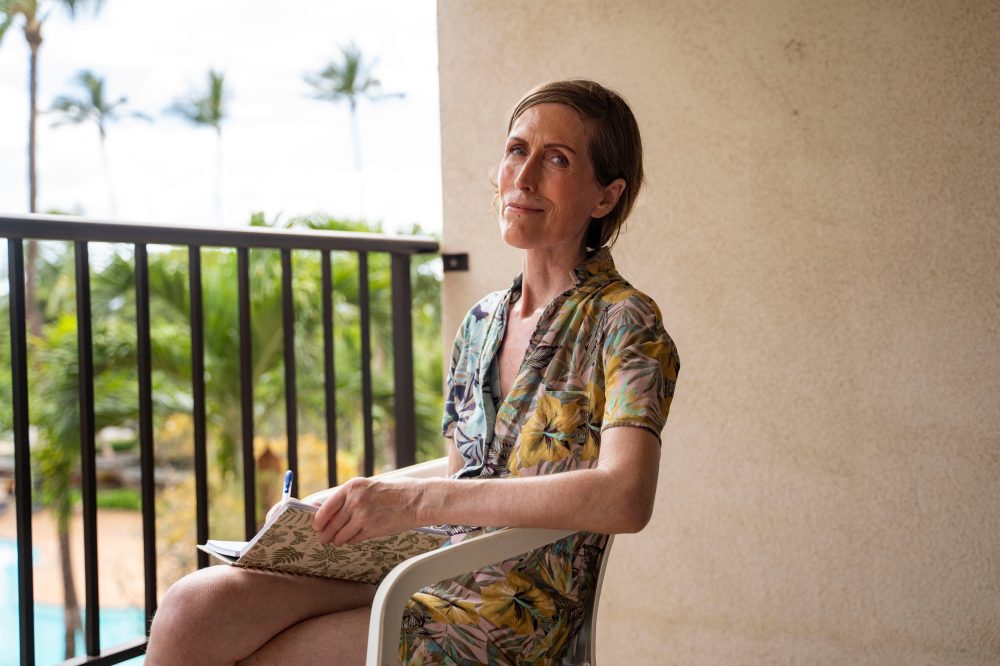

Mari Younger treasured her West Maui lifestyle. The restaurant industry professional had built an independent life over 11 years in the same condominium, caring for her beloved cat Stella.
Everything changed when a medical crisis ended her physically demanding career. Soon after, devastating fires swept through Lahaina, destroying the community she called home.
Now, two years since the disaster, Younger lives 30 miles from her former home in a converted hotel room, struggling to afford basic groceries. The 49-year-old woman’s weight dropped to just 89 pounds following the fires due to mounting stress, declining health, and limited access to proper nutrition.
Her disability benefits weren’t enough to cover health insurance, vehicle payments, and the nutritious food she desperately needed to regain her strength.
“I really needed help,” said Younger, 49. She wasn’t sure how she’d support herself and Stella, adding, “I’d rather starve and have her eat.”
A case manager then recommended Younger for an innovative cash assistance initiative designed for Maui fire victims. She started receiving $700 each month through a specialized Mastercard in December.
The financial support has made an enormous difference, according to Younger. “It’s like the calvary has shown up. The war is not over, but at least there’s more help coming.”
Younger represents one of 69 families participating in a groundbreaking initiative that provides Lahaina fire survivors with direct cash payments for 12 months, designed to help stabilize the most vulnerable residents during the island’s lengthy recovery process.
Advocates for disaster cash assistance argue it empowers survivors to control their own recovery while providing flexibility to address individual circumstances. “When we let them choose, it unwinds the trauma and gets them out of survival mode faster,” said Nicole Huguenin, executive director of Maui Rapid Response, the mutual aid nonprofit behind the program.
Younger participates in the program’s second phase of three enrollment groups. Strong interest in the program highlights a persistent issue in disaster recovery: some survivors continue facing critical unmet needs years after public attention and funding have diminished.
“The need for longterm recovery is there in every disaster, but very seldom is that funded,” said Kirsten Trusko, co-founder of Payments as a Lifeline, a financial technology nonprofit that promotes disaster cash assistance.
Recovery support becomes even more crucial as increasingly frequent severe weather events mean multiple emergencies can affect survivors simultaneously. This week alone, Hawaii faced significant flooding from a subtropical cyclone that left thousands without power on Maui and caused widespread property damage.
“It’s creating even greater need,” said Huguenin.
Maui Rapid Response introduced the Kahua Card initiative last year as a six-month trial to determine whether direct cash payments could help those still struggling to recover from the August 2023 catastrophe that claimed at least 102 lives, destroyed 2,200 buildings, and forced 12,000 residents from their homes.
Although Lahaina reconstruction efforts are gaining momentum, Maui’s recovery faces significant obstacles including a pre-existing housing crisis, damage to the tourism-dependent economy, and the island’s isolated location that makes construction projects slower and more costly.
At the same time, survivors who were experiencing homelessness, lacked bank accounts, or faced overwhelming challenges such as disabilities or caregiving responsibilities struggled to navigate multiple assistance programs, according to Huguenin.
Younger faced this exact situation when she didn’t meet requirements for certain grants because her residence hadn’t burned, yet she still lost her home when the destruction prompted her landlords to sell the condominium she rented near Lahaina. Post-fire rent increases forced her to relocate to a state-purchased hotel housing survivors.
Using donations collected from thousands of contributors following the fires, Maui Rapid Response provided 18 pilot families with up to $1,100 monthly, based on household size.
Transaction records revealed participants primarily spent funds on food, transportation, utilities, and personal necessities.
When the pilot concluded, 80% of recipients reported reduced anxiety and stress levels, crediting their improvement to increased personal control, ability to help others, or more family time. One-third used the financial relief to pursue better employment opportunities.
“The agency provided a level of mental health that none of us expected,” said Huguenin, adding it enabled survivors to then address other recovery essentials, like moving or finding work.
However, cash payments weren’t a complete solution — more than half of participants reported continued housing challenges when the program ended, and fewer than 20% could apply the additional income toward rent. One-third expressed worry about the payments stopping.
These outcomes mirror broader research on hundreds of non-disaster cash assistance initiatives nationwide, according to Dr. Stacia West, co-founder and director of the University of Pennsylvania’s Center for Guaranteed Income Research and an associate professor at the University of Tennessee.
“Largely, what you’re going to see are reductions in food insecurity, and that people are shoring up their finances,” said West. “They’re making sure that they have a little bit to fall back on.”
Broader research shows less definitive mental health improvements, West noted, possibly because participants worry about program endings combined with increasing living costs. Cash assistance also hasn’t demonstrated strong effectiveness in addressing rent burdens due to rising housing expenses.
Younger has regained 10 pounds since receiving the Kahua card. She primarily purchases food and supplements, along with Stella’s cat supplies, and attempts to buy extra food for others in need. The cash allows her to allocate other income toward health insurance and reducing debt accumulated before finding assistance.
Finances remain challenging, but nothing compared to when she could barely afford to eat. “It brings down the pressure,” she said. It also reduced her stress about potentially replacing spoiled groceries following this week’s power outage.
Long-term cash assistance following disasters remains uncommon. Dolly Parton’s foundation provided $1,000 payments for six months in 2016 to Tennessee fire survivors. Oprah Winfrey and Dwayne Johnson led an effort in 2023 that paid 8,100 Maui survivors $1,200 for six months.
Huguenin hopes this program can serve as a model for larger organizations. “We want to show it can be done, so those who have more resources than us can take it and really run with it,” she said.
Last year, the Maui County Council approved a $12 million cash assistance program for working families earning above poverty levels but still unable to meet basic expenses.
The target population differs, but shares similar goals, said Jeeyun Lee, CEO of United Way Maui, which will oversee that program.
“If we’re able to alleviate that stress for a year, and provide some space for breathing and strategizing, what are the longterm possibilities of benefits?” asked Lee.
Coordinating these programs to work together and establishing systems before disasters occur will help prepare for future emergencies, Lee explained. “We’re working toward creating a really extensive safety net, that we can toggle on and off.”
Meanwhile, Younger may need to find new housing for herself and Stella by August. However, she says she now has more mental capacity to plan the transition. “I feel like I’m able to get a little more traction.”