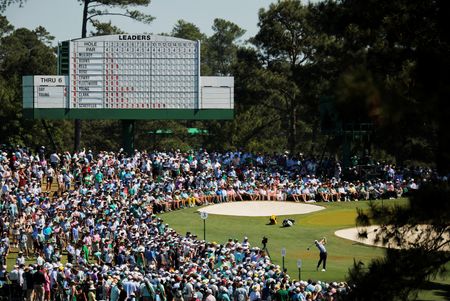

AUGUSTA, Ga. — Golf professionals competing in this year’s Masters tournament expressed surprise at how manageable Augusta National’s course conditions were during Saturday’s third round, with many describing the legendary course as unusually accessible.
A record-setting 19 competitors among the 54 who survived the cut managed to score in the 60s during Saturday’s play, with both Scottie Scheffler and Cameron Young leading the charge with impressive 65s. The day saw 35 golfers finish below par, contributing to a field average of 70.63 strokes — marking the lowest third-round scoring average in the tournament’s storied history.
Following Thursday’s challenging start where players averaged 74.65 strokes, Ireland’s Shane Lowry had anticipated this tournament would be among the most difficult in recent memory due to dry, firm playing conditions. However, Lowry managed an ace on Saturday that helped propel him to a 4-under 68 and positioned him at 9-under for the competition.
Friday’s scoring improved to an average of 72.85, prompting many competitors to expect tournament organizers would increase the difficulty level for the weekend. Instead, most found the greens remained receptive with pin placements that invited aggressive play.
“Pretty easy,” commented Max Homa when describing the course conditions following his round of 71, which he considered disappointing. “The front nine is pretty — I mean, very gettable. I didn’t feel like it was too fast, too firm. Obviously the weather is amazing, so it helps.”
Co-leader Rory McIlroy, despite carding a 1-over 73 on Saturday, recognized that opportunities for low scoring were abundant.
“The course was obviously gettable,” McIlroy observed. “There was a lot of good scores out there, and the quality of the chasing pack is obvious. There was a lot of guys that shot good scores.”
Earlier in the week, Patrick Reed had expressed hopes that officials would increase the challenge level. Adam Scott shared similar sentiments, particularly noting the absence of traditional winds that typically add complexity to Augusta National.
“I think the firmer and faster they can get it, the better,” Scott explained. “I mean, there’s no wind. The greens are still very, very friendly.”
“I don’t think it’s the scariest I’ve ever seen it here, but I love seeing the fairways play firmer. On some of these holes that turn, having the ball run and you’re having to be more precise with your line off the tee is an important defense of the golf course.”
Jason Day expressed satisfaction after recording a 4-under 68 that placed him in a fifth-place tie, trailing the leaders by just three strokes at 8-under overall.
“I expected to see it a little bit different than what I saw today. I mean, you were hitting shots in there that were spinning,” Day noted. “Typically sometimes you get to Saturday at Augusta and they’re bouncing. It’s really difficult to hold some shots.”
“So, I thought the green speeds were lovely. I thought the green firmness was great. It was very fair, and I think that’s why you’re seeing a lot of, like, decent scores out there, which brings in a lot of the crowd, which is great.”
Scheffler capitalized on an early starting time, making the turn at 5-under 31 en route to his personal-best Masters round of 65, though he felt it could have been even better. He’ll tee off in Sunday’s fourth-to-last pairing, when course conditions are expected to be at their most challenging.
“It depends on what the leadership here wants to do,” Scheffler said. “If they want to see some lower scores, they can make them softer if they want. They’re already pretty firm, so they can just go full Bay Hill (at the Arnold Palmer Invitational) and just let them die.”
“It’s Augusta. They’ll figure it out after that.”