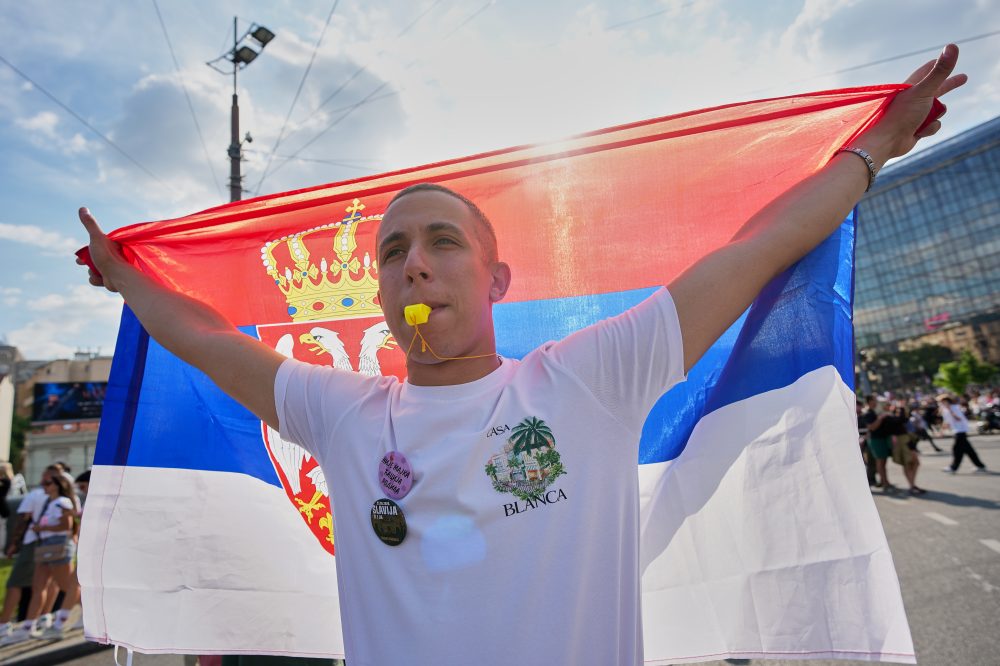

BELGRADE, Serbia — Massive crowds converged on Serbia’s capital Saturday for a demonstration organized by protesting university students, despite the authoritarian government’s attempts to prevent large-scale gatherings that have challenged President Aleksandar Vucic’s strongman leadership over the past year.
Demonstrators flooded into Belgrade’s central square from multiple routes, with many displaying banners and wearing shirts bearing the youth movement’s “Students win” slogan. Earlier that day, vehicle convoys had arrived in Belgrade from towns across Serbia.
“Students managed to gather us here with their youth and wonderful energy; I really believe that we have right to live normally,” said demonstrator Maja Milas Markovic.
The student movement sparked a countrywide surge of anti-corruption street demonstrations seeking justice for a November 2024 railway station disaster in northern Serbia that claimed 16 lives. The protests resulted in the resignation of then-Prime Minister Milos Vucevic, though Vucic later launched a harsh crackdown on demonstrators.
In an apparent effort to limit attendance from other regions of the Balkan nation, Serbia’s state railway company suspended all train service to and from Belgrade on Saturday.
Vucic supporters, meanwhile, assembled at a park encampment outside the Serbian presidency building — a setup he established before a major anti-government demonstration last March to serve as a barrier against protesters. Loud folk music played from the fenced compound, which was surrounded by fully equipped riot police.
Student organizers emphasized their rally would remain peaceful. However, concerns about potential violence persist given Vucic’s supporters — who often wear hoods and masks — have previously assaulted student demonstrators.
The Serbian president has drawn international criticism for his harsh response to the protest movement. Michael O’Flaherty, the Council of Europe Commissioner for Human Rights, condemned Serbia’s government in a report this week and stated he “will monitor the situation closely” on Saturday.
While Serbia officially pursues European Union membership, it has maintained strong relationships with Russia and China. The EU’s chief enlargement official warned last month that the democratic deterioration under Vucic could result in Serbia losing approximately 1.5 billion euros ($1.8 billion) in European Union funding.
Saturday’s demonstration took place at Belgrade’s Slavija Square, which hosted a massive anti-government protest in March 2025. That gathering ended abruptly amid what experts later claimed — though the government disputed — was the deployment of a sonic weapon against peaceful protesters.
Student leaders now indicate they intend to challenge Vucic in upcoming elections this year or next, hoping to remove the right-wing populist administration from power. Vucic announced this week that voting could occur between September and November this year.
Vucic, his administration, and pro-government media outlets have labeled opposition figures as terrorists and foreign operatives seeking to harm the nation — language that has intensified political divisions.