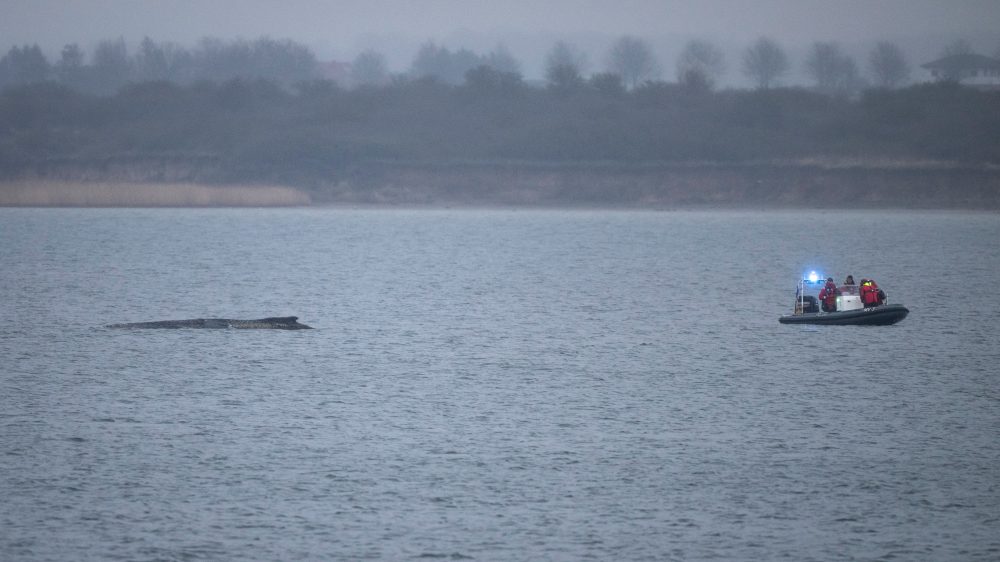

A massive humpback whale measuring between 39 and 49 feet has successfully escaped from shallow waters where it had been trapped along Germany’s Baltic Sea coast since the weekend.
The marine mammal broke free Monday evening from waters near Wismar, a German port city, according to regional authorities. Initially swimming toward the harbor, the whale changed course and headed for open waters. Marine experts reported no additional whale sightings Tuesday morning.
Rescue teams had previously worked to free the enormous creature from an underwater sandbank at Timmendorfer Strand, a resort community in the area, using heavy excavation equipment. Despite the successful initial rescue, the apparently weakened whale soon found itself in difficulty again, though in slightly deeper waters. Officials decided to give the animal space and time to regain strength naturally.
The whale’s plight captured widespread attention across Germany, drawing large crowds to shorelines while news outlets provided continuous coverage and live video streams of the rescue efforts.
However, the whale remains far from where it belongs and must navigate an enormous distance to reach the Atlantic Ocean via the North Sea.
“The whale swimming free yesterday is a first very good sign, but the way to the North Sea is still long and we can only keep our fingers crossed that it makes it there,” Burkard Baschek, the scientific director of the Ocean Museum Germany and the scientific coordinator of the rescue effort, told ZDF television.
Baschek explained that guiding the whale on its journey spanning several hundred miles would not be feasible, citing whales’ diving capabilities. “That means that in principle we can only hope that it will make it under its own steam,” he added.
Marine biologists have not placed a tracking device on the whale due to its deteriorated skin condition, caused by extended exposure to the Baltic Sea’s lower salt levels compared to ocean waters.
The whale was initially observed in the area on March 3.
Experts remain uncertain about what caused the whale to enter Baltic waters. Some marine biologists suggest the animal may have become disoriented while pursuing a school of herring or during its migration route.