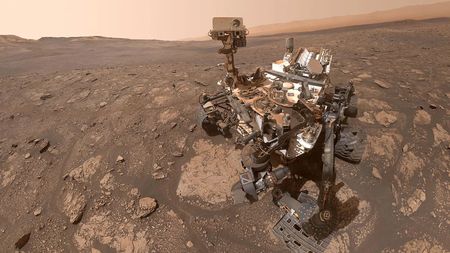

NASA’s Curiosity rover has made another significant discovery on Mars, uncovering additional organic compounds that could provide clues about whether the Red Planet ever supported life.
The six-wheeled explorer confirmed seven different organic compounds in ancient rock formations near Mars’ equator, with five of these compounds never before detected on the planet, according to researchers. The groundbreaking experiment also suggested the possible presence of another compound with similarities to DNA building blocks – the genetic material that carries life’s instructions on Earth.
These organic compounds, which are primarily carbon-based molecules linked to other elements, serve as the foundation for all Earth-based life forms. Scientists have now catalogued dozens of such compounds on Mars, though researchers emphasize these could have originated from non-living processes.
Mars took shape approximately 4.5 billion years ago, similar to Earth and other planets in our solar system. During its early period, the planet experienced much warmer and wetter conditions compared to today’s frigid, dry environment. Scientists believe the rock samples analyzed by the rover – formed from ancient water-deposited sediments – date back at least 3.5 billion years.
“We cannot yet say that Mars ever harbored life, but our findings further support the evidence that Mars was a habitable world around the time that life on Earth originated,” said astrobiologist and planetary scientist Amy Williams of the University of Florida, a member of the Curiosity scientific team and lead author of the study published on Tuesday in the journal Nature Communications.
Conclusive proof of ancient life would require returning Martian rock samples to Earth for detailed laboratory analysis.
“To be clear, we have not found evidence for life with this study, but we’re further refining the building-block molecules that were present on Mars,” Williams said.
The rover touched down in Gale crater – created by an ancient asteroid impact – back in 2012. The recent experiment took place in 2020 within a crater section called Glen Torridon, where abundant clay minerals indicate water once flowed. Such water bodies would have provided ideal conditions for any potential microbial life on Mars.
According to Williams, clay minerals excel at preserving organic molecules compared to other mineral types, making them prime targets for compound detection.
The rover’s Sample Analysis at Mars (SAM) instrument carried out the experiment by drilling into bedrock at a site named “Mary Anning” after a famous 19th-century English fossil hunter. The pulverized rock sample was then mixed with a chemical agent that breaks down complex organic material into smaller, detectable fragments.
“This study confirms that larger and more complex organic matter, called macromolecular carbon, is present and preserved in the near surface of Mars bedrock despite the planet’s harsh radiation conditions. The experiment also yielded smaller organic molecules from that breakdown process that have not been seen on Mars before,” Williams said.
“The Curiosity rover was built to search for habitable environments, places where life would want to live if it ever arose on Mars. This study contributes to that story, that Mars environments were habitable in the ancient past and had the ingredients for life as we know it,” Williams said.
Last year, scientists revealed that another NASA rover, Perseverance, collected a rock sample from a separate crater containing features that might have formed through microbial chemical reactions during the rock’s formation.
NASA’s rovers continue leading efforts to understand whether Mars could have supported life, including these ongoing organic compound discoveries.
“Although we cannot tell if this organic matter came from geologic processes, infall from meteorites, or life, our work suggests that if complex organic matter from life were preserved on Mars, we should be able to detect it with current and upcoming rover instruments,” Williams said.