
Global financial markets responded positively Tuesday to renewed diplomatic signals between the United States and Iran, with stock indices climbing while oil prices and the dollar weakened on hopes for peaceful resolution.
Despite the breakdown of weekend peace negotiations, sources indicate both Washington and Tehran remain open to continued diplomatic discussions. A U.S. official reported progress in efforts to reach an agreement.
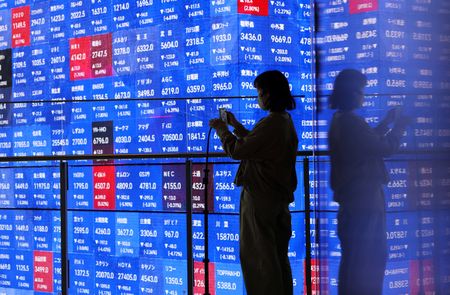
Asian markets led the rally, with the MSCI Asia-Pacific index excluding Japan climbing 1% during early trading sessions. Japan’s Nikkei and South Korea’s KOSPI each surged more than 2%.
U.S. market futures showed modest gains, with Nasdaq futures up 0.13% and S&P 500 futures remaining flat following Monday’s Wall Street rally. European markets also showed strength, with EUROSTOXX 50 futures gaining 0.63% and DAX futures adding 0.77%.
“Markets are trading hope, not resolution,” explained Charu Chanana, chief investment strategist at Saxo.
“The failed weekend talks did not produce a deal, but they also did not close the door on diplomacy, and that is enough for equities to keep pushing higher for now.”
President Donald Trump announced Monday that Iran had “called this morning” and “they’d like to work a deal,” though Reuters was unable to independently confirm this claim.
Simultaneously, U.S. military forces initiated a blockade of Iranian ports as a pressure tactic against Tehran. Trump has warned that Washington would intercept Iranian vessels and any ships paying related fees, threatening to destroy Iranian “fast-attack” ships approaching the blockade zone.
“The U.S. has actually played that trump card. To me it’s important because they forced the onus back on Iran to open the Strait without the need to put those boots on the ground,” noted Tony Sycamore, a market analyst at IG.
“It’s now forced the Iranians back to the drawing board.”
Energy markets reflected the diplomatic optimism, with oil prices declining as resolution hopes overshadowed supply disruption concerns. Brent crude futures dropped 2.7% to $96.66 per barrel, while U.S. crude futures fell 3% to $96.13 per barrel.
Currency markets saw the dollar weaken to a six-week low of 98.328 against a basket of major currencies as improved risk sentiment reduced demand for the safe-haven currency. The euro gained 0.05% to $1.1764, while the British pound reached a six-week high of $1.3514.
“The U.S. and Iran have started to walk down the path of coming up to an agreement,” said Joseph Capurso, a strategist at Commonwealth Bank of Australia.
However, he cautioned that “the markets are still facing a global economic outlook that is deteriorating, and I think the risks are high that you get equity markets and credit markets and the like fall again, and that would push up the U.S. dollar against probably all currencies.”
U.S. Treasury yields showed little movement, with two-year yields at 3.7722% and benchmark 10-year yields at 4.2854%.
The recent surge in energy prices has led investors to anticipate potential interest rate increases from major central banks, representing a significant shift from pre-conflict expectations of rate cuts or extended pauses.
Precious metals benefited from the risk-on sentiment, with spot gold rising 0.7% to $4,771.81 per ounce. Cryptocurrency bitcoin also gained 1.5% to approximately $74,312.