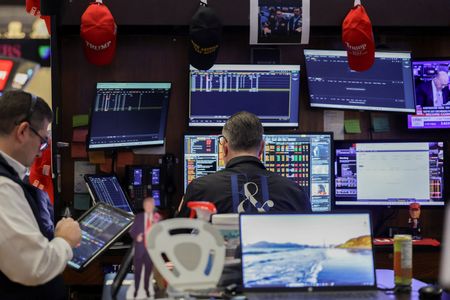

NEW YORK, April 3 – Wall Street investors are preparing for crucial inflation data and early corporate earnings reports next week that may reveal how the ongoing Middle East conflict is impacting America’s economy and businesses, as financial markets seek clarity amid war-related uncertainty.
Market participants have been grappling with mixed messages regarding the potential conclusion of the conflict that started more than a month ago with U.S.-Israeli military operations against Iran.
The S&P 500 managed to climb during the abbreviated trading week, breaking a five-week losing streak. However, the key index recently completed its worst quarterly performance since 2022, declining steadily since late February due to war concerns and the accompanying spike in energy costs.
“It’s going to be hard to get the market’s attention off the Middle East, oil prices and the risks that have emerged,” said Matthew Miskin, co-chief investment strategist at Manulife John Hancock Investments. “The markets have been so myopically focused on geopolitical risk and … how all this is going to shake out.”
Equity markets have struggled throughout the year, with worries about artificial intelligence disruption and private credit vulnerabilities adding to Middle East conflict uncertainties. The S&P 500 currently sits nearly 6% below its late-January record peak.
Energy supply disruptions and price volatility from the war continue to dominate investor concerns, particularly regarding the Strait of Hormuz, a vital Middle Eastern oil transport route where shipping has been disrupted. U.S. crude oil surged past $110 per barrel Thursday after crossing the $100 mark earlier in the week for the first time since 2022.
“The market is pricing off oil,” said Doug Huber, deputy chief investment officer at Wealth Enhancement Group. “Inflation expectations, bond markets — everything is stuck to this concept of what oil is doing.”
The upcoming consumer price index report, a key inflation indicator, will serve as an initial measure of the war’s energy-related economic impact. With U.S. crude prices surging approximately 90% year-to-date, national average gasoline prices exceeded $4 per gallon this week for the first time in over three years.
“We think the first stage of oil price pass-through will have arrived in March via motor fuel,” BNP Paribas noted in their CPI preview analysis.
The March CPI data, scheduled for release April 10, is projected to show a 0.9% monthly increase, based on Reuters polling through Thursday. The “core” CPI measure, which excludes volatile energy and food costs, is anticipated to rise 0.3%.
Miskin indicated he’ll be monitoring “ripple effects” throughout other sectors resulting from the conflict and energy price increases, though he noted the March data may be premature to capture broader inflationary consequences.
“You’re just trying to get as much real-time data as you can to formulate where the inflation and economic growth trends are going,” Miskin explained.
Inflation concerns driven by the war have caused markets to essentially eliminate expectations for interest rate reductions this year, after such cuts had been central to many optimistic stock predictions.
“The market already has inflation on the brain,” said Patrick Ryan, chief investment strategist at Madison Investments. If CPI were to “surprise with a much higher print, that could also be something that the market would take negatively.”
Next week will also feature another inflation metric, the personal consumption expenditures price index, though that PCE information covers February, largely preceding the current conflict. Updated fourth-quarter U.S. economic growth data is also expected, while investors will examine Wednesday’s Federal Reserve March meeting minutes for rate policy insights.
Earnings season will begin capturing Wall Street’s focus, with investors depending on strong corporate profit projections to bolster U.S. stock performance this year. Delta Air Lines and beverage company Constellation Brands are among companies reporting next week.
These initial reports will preview the first-quarter earnings period, which begins in earnest the following week. S&P 500 companies collectively are forecast to deliver a 14.4% first-quarter earnings increase compared to the previous year, according to LSEG IBES data.
“The Q1 earnings season beginning in mid-April should show that underlying earnings growth is still strengthening and broadening,” Deutsche Bank equity strategists wrote in their analysis.