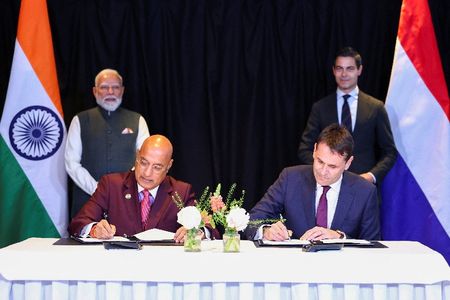

Two major technology companies announced Saturday they will collaborate to establish India’s first front-end semiconductor manufacturing facility, marking a significant milestone in the country’s push to build its domestic chip production capabilities.
Tata Electronics and the Dutch chipmaking equipment manufacturer ASML revealed their partnership through a joint announcement, stating that ASML’s technology will enable Tata Electronics’ planned 300-millimeter semiconductor manufacturing plant in Gujarat state.
“India’s rapidly expanding semiconductor sector represents many compelling opportunities, and we are committed to establishing long-term partnerships in the region,” ASML CEO Christophe Fouquet said.
The manufacturing facility is being developed by Tata Electronics in Dholera, Gujarat, requiring an $11 billion investment. According to the joint announcement, the plant will manufacture chips for various uses including automotive systems, mobile devices, and artificial intelligence applications.
The partnership agreement was formalized with Indian Prime Minister Narendra Modi and Dutch Prime Minister Rob Jetten in attendance, according to India’s Ministry of External Affairs. The ministry noted that both leaders also conducted meetings with executives from prominent Dutch corporations spanning energy, ports, and technology sectors.
During the discussions, Modi encouraged Dutch businesses to pursue investments in semiconductors, renewable energy, digital technologies, and healthcare sectors. Both prime ministers also advocated for swift progress on implementing a free trade agreement between India and the European Union.
India has committed billions in government subsidies to draw semiconductor manufacturing plants and associated production facilities to the country, with eight projects currently in development, including a separate $14 billion Tata Electronics operation in Gujarat.
At the same time, Dutch semiconductor companies are exploring new markets and expanding their geographic presence as they navigate export restrictions and trade limitations stemming from technology competition between the United States and China.