
The nation’s two largest oil corporations experienced significant earnings drops during the first three months of the year, even as crude oil and gasoline costs soared to new heights. However, industry analysts say the reduced profits are merely accounting setbacks caused by hedging strategies that went wrong following military strikes by the United States and Israel against Iran in late February.
Both Exxon Mobil and Chevron released their quarterly financial reports on Friday, with both companies exceeding Wall Street’s adjusted earnings forecasts. Stock prices for both firms rose in pre-market trading, building on gains made earlier this week.
At the beginning of the year when energy costs were lower, both Exxon Mobil and Chevron had established hedging arrangements to protect against price swings, which is common practice throughout the oil industry.
However, after the U.S. and Israeli strikes on Iran, oil shipments became nearly impossible as the Strait of Hormuz was effectively blocked. Both companies cannot record profits from their hedging positions until they can physically receive the crude oil deliveries.
The virtual shutdown of the Strait of Hormuz near Iran’s coastline has become a major conflict zone and is causing widespread economic disruption worldwide. Approximately 20% of global oil shipments typically move through this waterway daily, but the passage has been severely restricted since hostilities began in late February.
Exxon’s earnings reached $4.18 billion, equivalent to $1 per share, for the quarter ending March 31. This compares to $7.7 billion, or $1.76 per share, during the same period last year. The company suffered nearly $4 billion in losses during the quarter due to what it described as “unfavorable estimated timing effects” from its hedging activities.
When excluding these one-time impacts, Exxon’s earnings came to $1.16 per share, significantly surpassing the $1.07 per share forecast by analysts polled by Zacks Investment Research. The company does not modify its official earnings reports to account for one-time events like asset transactions.
Total revenue reached $85.14 billion, substantially exceeding Wall Street’s projected $81.49 billion.
During the first quarter, net production averaged 4.6 million oil-equivalent barrels daily, representing a decrease from the 5 million oil-equivalent barrels per day produced in the preceding quarter.
Chevron announced first-quarter earnings of $2.21 billion, or $1.11 per share, down from $3.5 billion, or $2 per share, in the previous year’s first quarter.
The company noted that its quarterly results included a $360 million net loss tied to a legal reserve, while foreign exchange rate fluctuations reduced earnings by $223 million.
Chevron’s adjusted earnings totaled $1.41 per share, significantly outperforming Wall Street’s expectation of 92 cents per share. Similar to Exxon, Chevron does not modify its official earnings reports for one-time events such as asset transactions.
The company generated $48.61 billion in revenue, which also exceeded expectations.
Both Exxon and Chevron join other major oil producers releasing earnings this week. BP announced on Tuesday that its first-quarter profits more than doubled compared to the previous year.
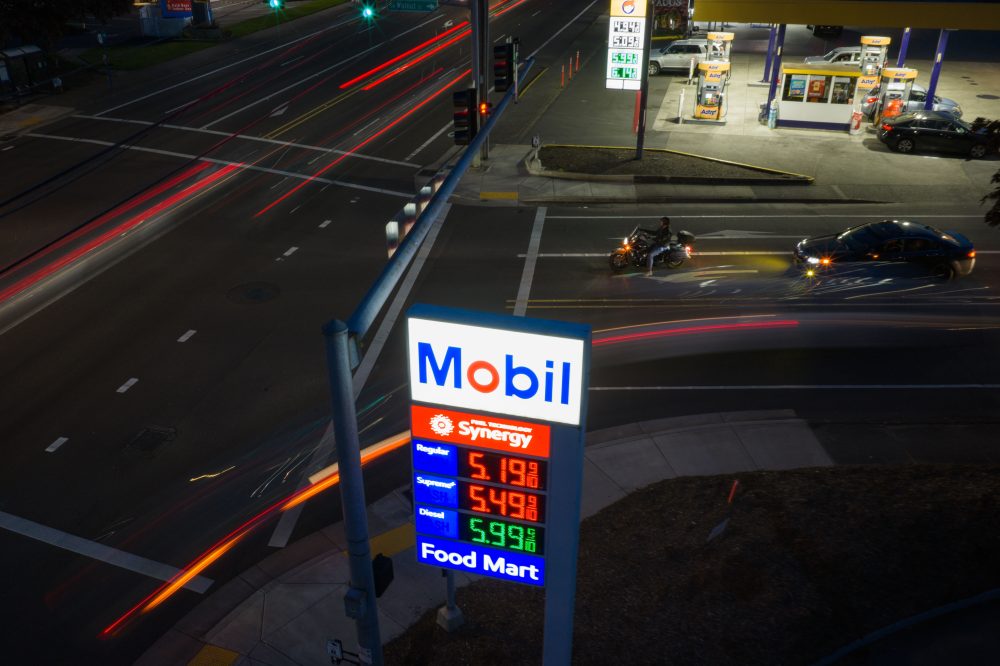
These oil company results emerge as U.S. gasoline prices reach their highest levels in several years, creating growing frustration among travelers, families, and businesses that are especially vulnerable to rising energy costs.
According to AAA, the national average gasoline price reached $4.39 on Friday, marking an increase of more than 8% for the week.
U.S. inflation accelerated significantly last month amid the largest monthly gasoline price surge in six decades, based on Labor Department statistics. The dramatic rise in fuel costs has strained household budgets for lower- and middle-income families, making it harder to afford basic necessities.
The situation is also affecting business operations, especially for companies sensitive to fuel cost increases. Airlines across the globe have started canceling flights as Middle East conflicts disrupt jet fuel availability and drive up airfare prices.