
NAIROBI, Kenya (AP) — In the early morning hours within the cramped pathways of Mathare, a sprawling settlement in Kenya’s capital city, Agnes Mbesa switches on a lone light bulb suspended from her metal ceiling. The mother of three previously depended on smoky kerosene lamps for years. Today, electrical power illuminates her dwelling and operates the modest retail business she operates from her front porch.
“Before the power came, we closed early because it was too dark,” Mbesa said. “Now people come even at night, and I can earn something.”
Several hundred kilometers away in the western Kenyan village of Sori, fisherman Samuel Oketch shares a comparable account. When a solar mini-grid system arrived in his community, he purchased a freezer to preserve his daily catch. Fish that previously required immediate sale at reduced prices can now be kept fresh and transported to neighboring markets.
“These small changes mean a lot,” Oketch said. “Electricity gives us options. My wife can now sell (fish) without being taken advantage of by brokers who had the freezers.”
These stories of electrification supported by charitable organizations and government funding demonstrate how expanding energy access can revolutionize daily life and enhance economic opportunities. Over 730 million individuals globally remain without electrical power, with approximately 600 million residing in Africa. Insufficient access limits healthcare delivery, educational advancement, digital connections and employment opportunities.
Fresh financial commitments seek to speed up advancement. In March, the European Investment Bank committed over $1.15 billion toward renewable energy developments throughout sub-Saharan Africa, encompassing hydroelectric, solar, wind and electrical grid expansion projects.
“This funding is Europe’s commitment to provide cleaner, more affordable, and reliable energy for hundreds of millions of people in Africa,” said European Investment Bank President Nadia Calviño.
The Rockefeller Foundation also revealed in March during the Africa Energy Indaba conference in Cape Town, South Africa, its plan to contribute an additional $10 million supporting electrification efforts in no fewer than 15 African nations. These funds will be distributed through the Global Energy Alliance for People and Planet to bolster national programs and assist government policy changes.
“African governments are choosing to transform their energy sectors by committing to national energy compacts and investing in African-led solutions,” said William Asiko, senior vice president at the Rockefeller Foundation.
These investments back the Mission 300 program spearheaded by the World Bank and African Development Bank, targeting electrical connections for 300 million sub-Saharan African residents by 2030 using grid extensions and decentralized approaches like mini-grids and independent solar systems. Throughout much of Africa, where national power grids frequently prove unreliable, mini-grids have become a crucial alternative. These compact, community-based networks, usually solar or hybrid-powered, produce and deliver electricity within local areas.
Independent systems, in contrast, function autonomously at individual household levels. These encompass standalone solar packages that supply direct power access, helping close electricity shortfalls in distant and underserved regions.
The program provides governments in Malawi and Liberia with technical guidance to advance national energy strategies, extend transmission infrastructure and enhance distribution system reliability and effectiveness. Work in Côte d’Ivoire, Nigeria, and Senegal incorporates local currency funding and collective purchasing assistance.
Andrew Herscowitz, CEO of the Mission 300 Accelerator at RF Catalytic Capital, emphasized that expanding access requires ongoing funding and enhanced implementation capabilities, including better monitoring and more coordinated support to speed connections.
“Energy access is key to unlocking human potential and economic development,” Herscowitz said.
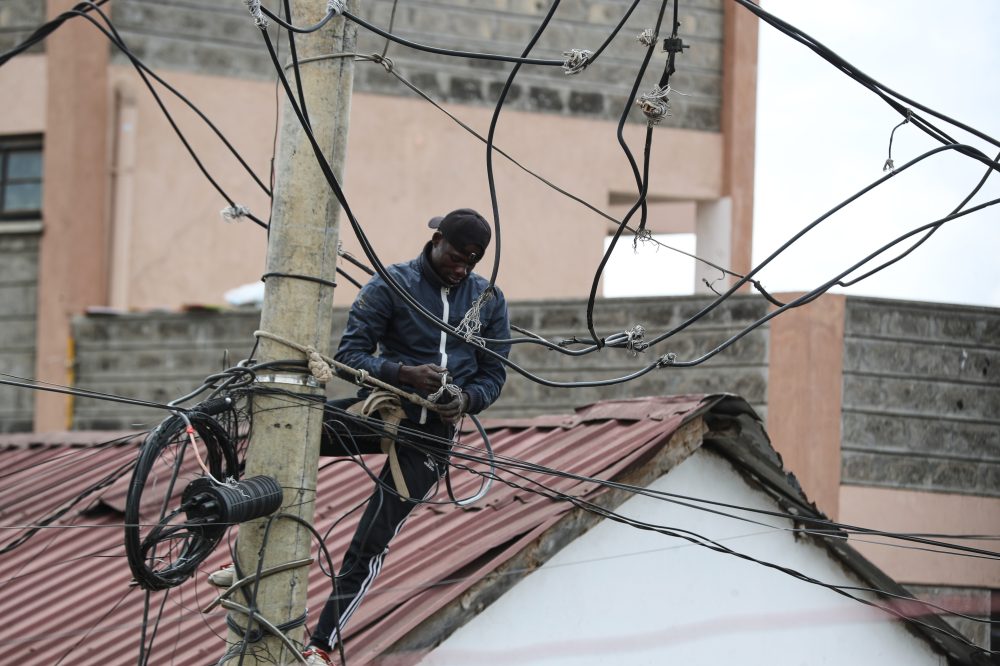
Kenya has obtained funding since 2017 from the World Bank, African Development Bank and partners through Mission 300 to advance its Last Mile Connectivity initiative, which focuses on households near existing electrical equipment, especially in countryside areas and informal communities, while working toward complete electricity coverage by 2030. Countryside access increased to roughly 68% in 2023 from slightly under 7% in 2010.
Throughout eastern and southern Africa, where only approximately 48% of residents and 26% in rural regions have electrical access, World Bank initiatives plan to expand coverage in up to 20 nations over the coming seven years through renewable energy developments.
Mbesa, the Mathare shop owner, received electrical service in 2021 through the Last Mile Connectivity Project. The program offered no-cost connections to households and small enterprises situated near transformers, with sponsors covering the typical $115 connection charge. In more isolated locations like Oketch’s village, the project included independent solutions, such as mini-grids and solar installations, to serve communities outside the national grid.
For Mbesa, the transformation is unmistakable. The single light fixture over her shop has lengthened her business day and enabled her children to complete homework after dark.
“Electricity changes everything,” she said. “Once you have it, life starts moving forward.”