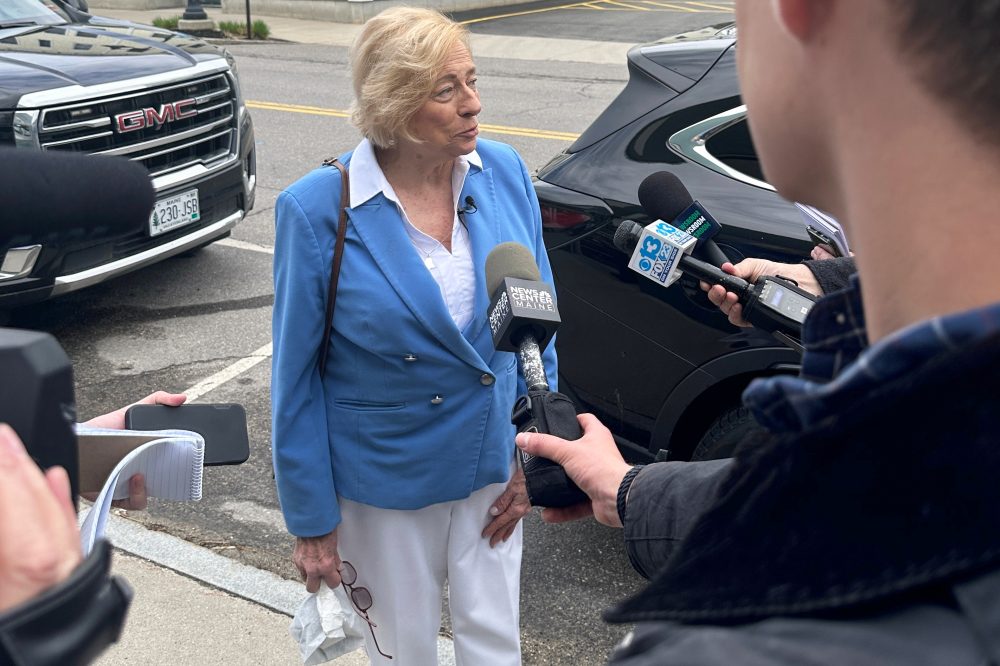

CAPE ELIZABETH, Maine (AP) — When Maine Governor Janet Mills wants to illustrate why others shouldn’t count her out politically, she recalls an incident from her early career involving a powder blue outfit she once donned in court.
More than 40 years ago, Mills made history as the state’s first female prosecutor in the attorney general’s criminal division when she won a murder case. However, the newspaper coverage the next day highlighted something entirely different: “The prosecutor wore pale powder blue.”
“That wasn’t the first time someone underestimated me. And it certainly wasn’t the last,” Mills, who is now seeking a U.S. Senate seat, stated in a recent message to her campaign supporters.
This theme has become central to the two-term governor’s messaging as she campaigns for the Democratic nomination to challenge veteran Republican Senator Susan Collins. Although Mills brings decades of government experience and has earned backing from Washington’s Democratic leadership, she finds herself trailing in the race leading up to next week’s initial primary debate.
Her primary challenger, Graham Platner, a former military member turned oyster farmer, has been attracting larger and more energetic audiences. Platner has also outpaced Mills in fundraising and has saturated television and radio with advertisements since launching his campaign last summer.
Mills contends she represents the Democrats’ best option against Collins in what could be a pivotal Senate contest. She believes her smaller, more personal campaign events allow for deeper voter connections. With their first debate set for May 7 — the opening round of five planned debates — Mills expects Platner’s previous controversial statements to become a major talking point. She emphasizes her extensive governmental background, contrasting it with Platner’s limited experience serving only on a small town’s planning committee.
Following a Portland demonstration supporting Planned Parenthood, Mills highlighted her role in establishing the Maine Women’s Lobby, an organization advocating for gender equality since the 1970s, and her long-standing commitment to reproductive rights. The Planned Parenthood Action Fund recently endorsed her candidacy.
“He’s been nowhere on these issues,” Mills said of Platner. “He’s never walked the walk.”
Mills boasts an impressive list of firsts in Maine politics. She broke barriers as the state’s inaugural female district attorney, attorney general, and governor. For this Senate campaign, she has secured endorsements from Senate Minority Leader Chuck Schumer and the Democratic Senatorial Campaign Committee.
However, her past successes may not guarantee victory in this year’s Democratic primary, as party members debate whether seasoned politicians or fresh candidates offer the better path forward. Platner has won support from Vermont Senator Bernie Sanders and other progressive figures who argue that Democrats’ 2024 electoral setbacks demonstrate the need for new leadership.
Age has emerged as another campaign issue. At 78, Mills has committed to serving just one term if elected. Platner, who is 41, argues that voters should choose a senator willing to build long-term influence in Washington, where gaining seniority and policy influence typically requires years. This age difference presents both opportunities and challenges, given Maine’s older population but Democrats’ growing concerns about elderly candidates following Joe Biden’s decision to abandon his reelection bid at age 81.
“I’m really torn, I want the person who can win,” said Karen Tilbor, 79, who supports Mills as governor but remains undecided about the primary. She believes “many more young people” will support Platner.
While Platner organizes large rallies across the state, Mills’ supporters argue the governor doesn’t need massive events because she already enjoys broad name recognition and voter familiarity with her positions and character.
Denham Ward, 79, finds this approach appealing.
“She has got supporters who have known her for a long time, who know what she can do,” Ward explained. “She’s a known commodity for the state and has an organization that I think can take on Susan Collins.”
Emily Cain, a former Maine legislator and past executive director of EMILY’s List, which supports female Democratic candidates and has endorsed Mills, believes the fundamental question for primary voters is: “Who do you think has the best chance of beating Sen. Collins?”
Although Maine voters chose Democrat Kamala Harris over Donald Trump in 2024, Collins has maintained her Senate seat for decades by positioning herself as a moderate in a predominantly Democratic state.
“If it’s just about who you like better, or who makes you feel better, then that is different than who you think can win in the fall,” Cain observed.
Even Mills’ supporters like Cain avoid claiming she has a clear advantage in the Democratic primary.
“I think the governor has a path to victory,” Cain said. “I think it’s going to be up to her, her team and her supporters to get across that finish line.”
Mills maintains that Platner’s controversial background makes him a riskier choice for the general election.
Questions persist about inflammatory statements Platner posted online previously, which he has since renounced but which Mills featured in an attack advertisement where women called his remarks “disgusting.” He has also faced scrutiny over a skull-and-crossbones tattoo associated with Nazi imagery that he received while drinking during military leave in Croatia. Platner has since had the tattoo covered.
Mills also confronts some challenges. Liberal voters have criticized her opposition to a ballot measure creating a red flag gun law in the state, though the measure ultimately passed.
Additionally, Mills has positioned herself as a Trump opponent, which may help in much of Maine but could alienate voters in rural areas. Trump has won the presidential vote in the Republican-leaning 2nd Congressional District in three consecutive elections.
Platner has built his campaign around economic concerns like housing and healthcare costs while targeting billionaires and what he terms “oligarchy.”
During a recent Saturday rally, he appeared alongside Massachusetts Senator Elizabeth Warren, who told the crowd of hundreds that the nation requires significant change.
Meanwhile, Mills recently spent a Friday meeting with small business owners in Cape Elizabeth and South Portland, coastal communities near the state’s largest city.
These events weren’t intended to draw massive crowds, and they didn’t. One involved casual conversations with restaurant patrons during lunch, while another featured discussions with a flower shop owner and employees. Each event attracted approximately five to 10 attendees.
Some voters present believed Mills’ governmental experience would benefit the state.
“Janet Mills has a ton more experience at many levels of government and I think has the best chance to hopefully give Maine a little bit of a leg up in terms of getting federal funding for us, and some federal recognition,” said Shelley Stevens, 51, who owns Fiddleheads florist in Cape Elizabeth. “It’s just very pragmatic for me.”