
A threat by Yemen’s Houthi rebels to impose a naval blockade against Saudi Arabia in the Red Sea could dramatically expand the ongoing war with Iran and push an already overstretched U.S. military to its limits, according to current and former American officials.
On Monday, the Iran-aligned Houthis announced they would prevent ships from loading or unloading at Saudi ports. The move could block Saudi oil exports and cut off roughly 7% of the world’s oil supply from global markets.
Saudi Arabia, which is home to U.S. military forces, has not asked Washington for help. Still, Trump signaled Tuesday that any effort by the group to choke off shipping through the Red Sea — a critical artery for international trade — could bring the United States into the fight.
“If something like that happens, we’ll take care of it. We’ve done that with the Houthis before,” Trump told reporters Tuesday.
But military analysts say it won’t be that straightforward.
The Houthis have built a reputation as tough, adaptable fighters who have withstood previous Saudi and U.S. bombing campaigns. Engaging them now would mean pulling American resources away from the current fight against Iran and from the U.S.-imposed blockade of Iranian ports in the Gulf.
“You’re bifurcating your admittedly fairly robust resources in the region between two active fronts,” said Jason Campbell, a former senior Pentagon official now with the Middle East Institute.
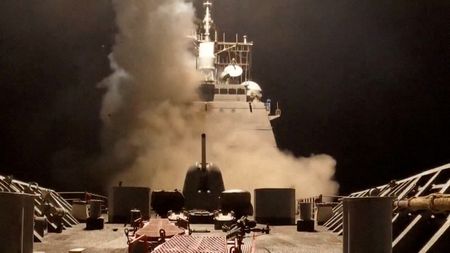
Campbell added that dealing with the Red Sea threat could require repositioning U.S. warships from the Gulf toward Yemen to conduct operations against the militants and intercept Houthi missiles.
The potential involvement of the Houthis is yet another sign of how the conflict — originally framed by Trump as a targeted bombing campaign that would force Iran to back down — continues to grow more complicated, adding to political pressure on the president.
If U.S. Navy ships and aircraft are pulled into shooting down Houthi drones and missiles, experts warn it could further deplete already diminished stockpiles of American munitions and air defense interceptors.
The Pentagon did not respond to a request for comment.
The Houthis have shown remarkable staying power over years of bombardment by a Saudi-led Arab coalition that failed to defeat the mountain fighters, who effectively control large portions of Yemen. More recent intensive U.S. bombing campaigns have also failed to neutralize them.
“The Houthis have proven many times in the past that they have the ability and willingness to obstruct maritime traffic in the Red Sea and the Bab el-Mandeb strait,” said Michael Mulroy, who served as deputy assistant secretary of defense for the Middle East during Trump’s first term.
During the Biden administration, the U.S. launched airstrikes on Houthi positions to protect the Red Sea trade route. Trump escalated those efforts last year, striking Houthi targets after the group fired on U.S. warships and commercial ships off Yemen’s coast.
Experts say neither campaign fully eliminated the group’s ability to threaten maritime traffic.
Last year’s two-month military operation required considerable American firepower — two aircraft carriers, additional warships, fighter jets, and strategic bombers including B-2s.
While the U.S. military remains the most well-funded in the world, officials acknowledge it still faces real limits, with many of the systems that would be needed for a Yemen campaign currently deployed in the war against Iran.
“We’re pretty busy already,” one official said, noting that some warships have been at sea longer than usual due to the high pace of operations — first in the Caribbean and now in the Middle East.
Extended deployments take a toll on service members, and ships must eventually return to port for upkeep and repairs.
More than 20 U.S. Navy warships and hundreds of military aircraft are currently operating in the Middle East. A second U.S. official said additional forces are being sent to the region to support the Iran conflict.
That could limit what is available for a potential Red Sea campaign near Yemen, which officials say would require significant naval and air power — and would also divert intelligence resources needed to assess Houthi capabilities that may have shifted since last year.
Mark Cancian, a retired U.S. Marine officer at the Center for Strategic and International Studies, agreed that a second front in the Red Sea would put added pressure on U.S. naval forces.
However, he noted that the Houthis would face their own supply challenges, given that Iran — their primary backer — is currently under a U.S. blockade.
“The U.S. blockade is not 100% effective but it is highly effective. As a result, the Houthis may be hard pressed to continue a campaign for long,” Cancian said.