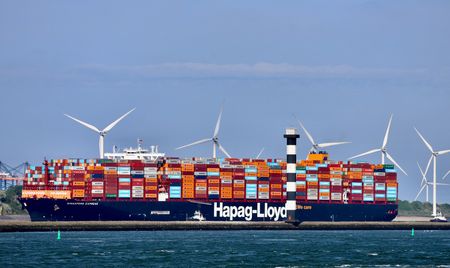

COPENHAGEN — Two major global shipping companies are taking their first steps back toward the Suez Canal trade route, more than a year after militant attacks in the Red Sea pushed them off course.
Maersk announced Monday that it and fellow shipping group Hapag-Lloyd will restart some voyages through the Suez Canal as part of their shared Gemini network. The news sent shares of both companies lower, as investors worried about the potential downward pressure on freight rates.
Most major shippers abandoned the Asia-Europe corridor through the Suez Canal after Yemen’s Houthis began attacking vessels in the Red Sea. Companies were forced to reroute ships around Africa’s Cape of Good Hope — a significantly longer journey that drove up shipping costs and made freight more expensive worldwide.
“This joint decision with Hapag-Lloyd comes after thorough assessments of the security situation in the Red Sea area and marks a step towards a gradual return to the trans-Suez corridor,” Maersk said in a statement.
The change involves the AE15 service, which links Asia, the Mediterranean, and Europe. A Hapag-Lloyd spokesperson said the shift will cut the length of the journey by four weeks.
Before the Houthi attacks began, the Suez Canal and Red Sea route was the fastest connection between Europe and Asia and handled roughly 10% of all global ocean trade, according to data from Clarksons Research.
Maersk said the two companies have no plans to adjust any other Gemini services at this time and will continue watching developments in the Middle East closely. “Any alteration to services within the Gemini Cooperation will remain dependent on the ongoing stability in the Red Sea area and absence of any escalation in conflicts in the region,” the company stated.
Maersk shares fell 5.8% and Hapag-Lloyd dropped 2.7% as of 1251 GMT Monday.
Jyske Bank analyst Haider Anjum described the move as a significant signal of what may come next. “We view this as the first step that will pave the way for a full return to the Red Sea by the end of this year,” Anjum wrote in a note to clients. “A full return, and thus more efficient capacity management, combined with the prospect of new ships being delivered in 2027 and 2028, should put pressure on freight rates and, consequently, on shipping companies’ earnings.”
The two companies had previously resumed their joint ME11 service — which connects India and the Middle East with the Mediterranean via the Suez Canal — back in mid-February, with ships traveling under naval escort. However, those Red Sea transits were suspended again in late February following the outbreak of the Iran war, Maersk said in a separate statement Monday.