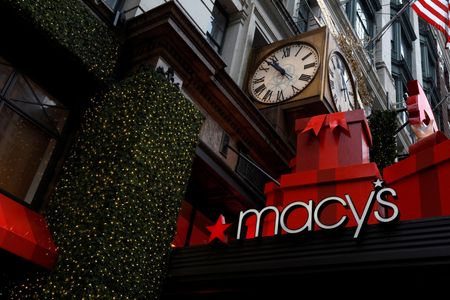

Department store chain Macy’s announced Wednesday that it expects lower annual profits than previously anticipated as consumers continue to tighten their spending habits amid ongoing economic pressures.
The retail giant joins other major chains including Walmart and Kohl’s in adopting a conservative outlook for the coming year, reflecting concerns about American consumers’ financial strain.
Company executives said they are taking a “prudent approach” when planning for the future, pointing to economic and international political factors that could further impact how much customers are willing to spend.
Following the announcement, Macy’s stock dropped 2% during pre-market trading hours.
Under CEO Tony Spring’s leadership, the company has been working to attract higher-income customers as a strategy to boost sales, while budget-conscious shoppers continue to feel the squeeze from rising prices and economic instability.
The retailer projects annual adjusted earnings will fall between $1.90 and $2.10 per share, a decrease from last year’s $2.15 and below Wall Street analysts’ predictions of $2.17 per share, based on LSEG data.
Import tariff costs are expected to squeeze profit margins during the first six months of the year, with the heaviest impact anticipated in the opening quarter.
Because Macy’s depends heavily on Chinese manufacturing, the company faces significant exposure to import taxes. Although Washington has implemented a standard 10% tariff rate following a Supreme Court decision that eliminated broader U.S. duties, retailers may still experience short-term financial pressure from inventory purchased at previously higher tariff rates.
Looking ahead to 2026, the company anticipates net sales between $21.4 billion and $21.7 billion, representing a decline from 2025’s $21.8 billion. This projection aligns closely with analysts’ expectations of $21.42 billion.
During the fourth quarter, Macy’s total sales decreased 1.7% to $7.64 billion compared to the same period last year, though this figure exceeded analysts’ projected $7.62 billion, boosted by strong holiday shopping activity.
The main Macy’s brand experienced a 3.2% sales decline, partially due to store closures, while comparable store sales managed a 0.4% increase. The company’s premium divisions showed stronger performance, with Bloomingdale’s achieving 8.5% sales growth and Bluemercury rising 2.5%.