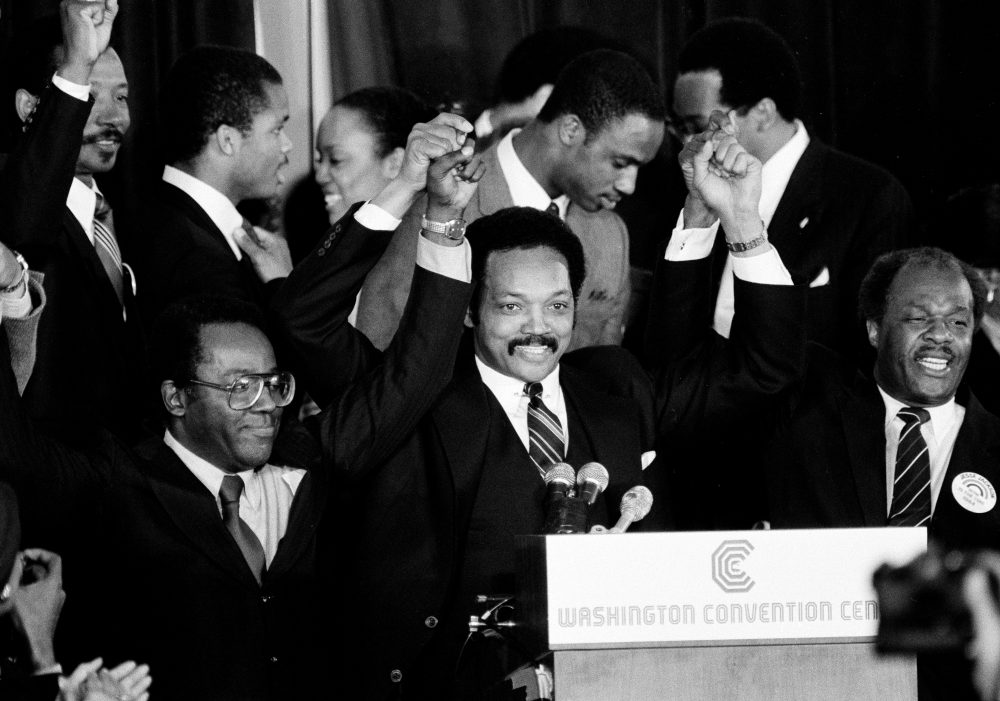

CHICAGO (AP) — Rev. Jesse Jackson received coverage from The Associated Press during his preparation for a groundbreaking 1984 presidential bid when he was 41 years old and actively involved in civil rights work. The AP is sharing that original story again, written by the late AP journalist Sharon Cohen, exactly as it ran on Aug. 7, 1983.
___
Jackson envisions himself walking the isolated, challenging path of religious prophets — someone called by divine purpose and sent forward like Jesus, Gandhi or Rev. Martin Luther King Jr. to guide others from difficult times.
“I’m very much driven by my religion to rise,” he says. “There’s a push that comes from religious duty. Gandhi couldn’t stop. Martin couldn’t stop. Jesus couldn’t stop.”
And according to his own words, Rev. Jesse L. Jackson cannot stop either.
“I’m in the prophetic ministry,” he says. “It’s the kind of ministry ancient prophets engaged in when they challenged the conduct of kings and queens.”
Jesse Louis Jackson — the 41-year-old Southern native, product of the civil rights era and potential 1984 black presidential contender — represents someone consumed, nearly fixated with his chosen calling.
Jackson carries a message of hope wherever he travels. His approach involves rhythm and rhyme. He excels at creating memorable phrases.
“If you are behind in a race, you CAN’T run equally,” he tells church audiences. “The race does not go to the fast or to the strong but to those who hold out.”
“If you pickle your brains with liquor, you CAN’T hold out. If you shoot cocaine in your membrane, you CAN’T hold out. If you put dope in your veins, rather than hope in your brains, you CAN’T hold out.”
His presentations captivate listeners. Before long the crowd responds with chants of “Preach, brother. Preach it.” And he continues.
“We’re not the result of accidents, we’re the result of providence. We’re not here because we’re lucky. We’re here because we’re blessed.”
Following his presentations, people surround him, taking photographs, requesting autographs and asking him to kiss their children. He accommodates everyone.
“My gift is a gift of the spirit,” he says.
This spiritual gift appears in various ways throughout the development of this multifaceted individual from an eager, impulsive aide to King into a charismatic — though sometimes disputed — political presence in his own capacity.
During the 1960s, he fought for civil rights, organizing restaurant protests and participating in open housing demonstrations.
The 1970s brought emphasis on dignity and economic fairness. Push-Excel emerged as a self-improvement initiative encouraging academic commitment. Corporate partnerships began ensuring equitable black participation.
Currently, his focus centers on leadership. He promotes voter registration throughout the South. He advocates for increased black representation in government. His ultimate goal involves electing a black president, potentially Jesse Jackson himself.
“It’s not enough to get in the mainstream and swim,” Jackson says. “You must get in the mainstream and redirect its course.”
Jackson has attempted to make his contribution for years through highly public methods, sometimes causing frustration and annoyance among others.
He has criticized inappropriate content in disco songs, intervened in local employment conflicts and organized boycotts against major corporations.
He has supported the rights of Haitians, Palestinians and Polish people.
He traveled to Panama to evaluate the canal agreement and addressed 20,000 South African blacks about apartheid.
Jewish Americans were disturbed when he embraced Yasser Arafat, the Palestine Liberation Organization leader. Alabama legislators welcomed his historic address as the first black speaker before their body this century.
Recently, Jackson has been considering a Democratic primary presidential campaign and increasingly sounds like someone seeking office, generating mixed responses from fellow black leaders who question the political wisdom of a black candidacy currently.
Polling data shows him performing better than some declared candidates. “God did not limit genius to white males,” says Jackson. “He distributed it all over town.”
Jackson has never sought elected office. His formal base remains Chicago’s Operation PUSH (People United to Serve Humanity), though he essentially embodies the organization. Jackson established the group in 1971, initially calling it the more ambitious People United to Save Humanity, after leaving the Southern Christian Leadership Conference. He has served as president continuously, currently earning $40,000 annually.
When supporters and critics discuss Jackson, they consistently mention identical characteristics — his self-regard, his ambition, his grand concepts, his organizational limitations, and his skillful media cultivation.
“He seems himself on a messianic mission,” says half-brother Noah Robinson. “What is it that motivates a person to grow? For Jesse, it’s his ego. God bless him for having that ego.”
“I always describe a visionary as someone who looks at cloudy skies and does not see the clouds, but sees the sun,” says Gary, Ind., Mayor Richard Hatcher, a friend and PUSH chairman of the board. “He’s able to do that.”
Mary Frances Berry, a member of the U.S. Civil Rights Commission, added though that “Jesse’s not really an organization man. His strong suit is not really running an organization.”
“The most pungent criticism is that he is constantly announcing campaigns and crusades that evaporate after the TV set is turned off,” says Don Rose, a political strategist who worked with Jackson in the 1960s civil rights movement.
Jackson, says Hatcher, “seems to have the ability to elicit from people either a very strong feeling of support … or a very strong feeling of dislike, and sometimes a feeling that borders almost on hatred.”
Several prominent black leaders indeed accuse Jackson of opportunism, claiming he exploits situations and takes credit for others’ achievements. However, virtually none have publicly opposed him.
Nobody questions Jackson’s commanding presence. Standing 6-foot-2 with an athletic build, he wears carefully fitted conservative suits that long ago replaced the flashy dashikis he favored in the 1960s, along with his prominent Afro hairstyle.
He maintains his Baptist minister’s speaking ability, avoids smoking and drinking, yet displays humor that leads friends to believe Jackson could have succeeded as an entertainer.
Constantly traveling, he still makes time to check with teachers about his son’s academic progress. Jesse Jr., 18, his oldest of five children, attends a private Episcopal school in Washington, D.C. “He wants us to be an example of what he preaches,” says Jesse Jr.
Though Jackson addresses many topics, one message remains constant throughout his words and life: an unwavering determination to achieve success.
“When you do less than your best, it’s a SIN,” he tells audiences. “To be black in America, you have to be superior to be equal.”
Jackson was born Oct. 8, 1941, in Greenville, S.C., and completed his education at North Carolina A&T, earning degrees in sociology and economics, and meeting Jacqueline Davis, his 1962 bride.
Following college, Jackson attended Chicago Theological Seminary and participated in King’s civil rights demonstrations.
King named him Operation Breadbasket director, the SCLC’s economic division, in 1967. Following King’s 1968 assassination, he created Operation PUSH four years later.
Jackson accompanied King on that fatal day in 1968 when he was killed in Memphis, Tenn. He appeared at a Chicago City Council session the next day wearing a shirt reportedly stained with the murdered civil rights leader’s blood.
Leading PUSH, Jackson has functioned as an urban motivational figure, encouraging and praising, persuading and challenging blacks to work diligently, succeed academically, and claim their rightful share of influence.
Jackson’s Operation PUSH reports securing over $1 billion in business agreements with Burger King, Coca-Cola, Heublein, and Seven-Up that establish additional distributorships and increased advertising in black-oriented publications.
Not every initiative has generated support.
When PUSH declared an Anheuser-Busch beer boycott last year, some St. Louis blacks, where the company operates, criticized him for targeting the wrong business.
Others claim Jackson’s programs benefit too few people.
Another Jackson creation, PUSH-EXCEL — Push for Excellence, a 1976 program promoting daily study time, teacher commitment and student discipline — has encountered additional challenges.
Seven Department of Education audit reports completed this year seek to disallow PUSH-EXCEL’s use of $736,000. They indicated the funds apparently supported items not covered under the organization’s federal grants and contracts.
Additionally, officials noted that approximately $1 million in expenditures has been questioned due to insufficient documentation. This money represents part of roughly $6 million granted to PUSH-EXCEL over three or four years.
The audits do not suggest criminal wrongdoing. Jackson states PUSH representatives are collaborating with auditors to address the issues.
As Jackson began discussing presidential matters like American re-industrialization, employment, or military spending, some critics challenged his credentials for addressing such national topics.
Jackson rejects this criticism.
“I wasn’t trained in auto mechanics and brick masonry,” he says. “I had a liberal arts education … So if on a given day Mr. Reagan can speak about agricultural policy and trade policy and international affairs and art and culture and science, who’s to suggest I should be less able to speak to a broad range of issues?”
Jackson indicates his Southern registration drive’s success, funding and organization will influence his decision about seeking the Democratic nomination. If he declines, he believes another black candidate should run.
The Democrats, he argues, “have in many ways made us like the Harlem Globetrotters. We can provide the thrills and excitement, but not participate in the other room where policy decisions are made.”
While supporters and black leaders remain split on a Jackson candidacy, some recognize advantages from considering the possibility.
“He’s made the party more cognizant of black voters,” says Georgia state Sen. Julian Bond. “It has made race — in a positive way — an agenda item in the campaign for the Democratic nomination.”