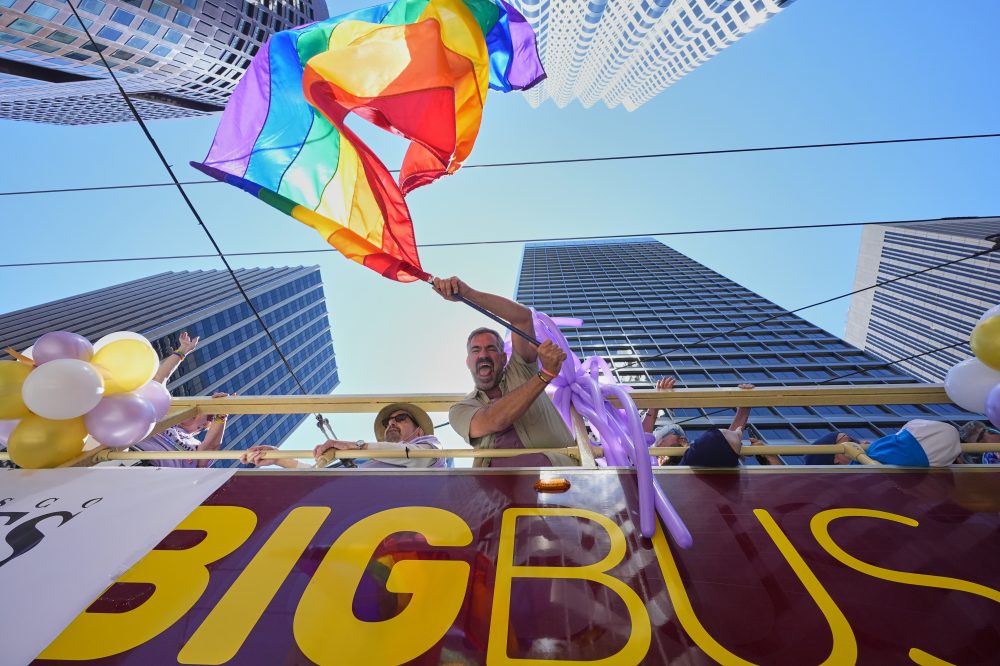

LGBTQ+ celebrations have kicked off nationwide this month, with colorful parades and community gatherings taking place from major metropolitan areas to smaller communities.
This year’s rainbow-themed events unfold while President Donald Trump’s administration implements measures aimed at reducing transgender rights and limiting diversity, equity and inclusion programs.
According to Jordan Braxton, co-president of USA Prides, an organization representing Pride groups nationwide, these celebrations have always maintained their activist origins.
“A festival is a time to celebrate,” she said. “Those are acts of resistance, too.”
These commemorations trace back to a brutal police assault on the Stonewall Inn, a New York gay establishment, which occurred on June 28, 1969.
That incident triggered widespread public demonstrations and launched the modern gay rights movement during an era when most LGBTQ+ individuals concealed their sexual orientation and gender identity.
Commemorative marches took place one year later in June 1970 across Chicago, Los Angeles, New York and San Francisco to honor that milestone.
Today, similar events occur in major metropolitan areas, suburban communities and rural towns globally.
In 1999, President Bill Clinton designated June as Gay and Lesbian Pride Month through an executive proclamation. Democratic presidents have continued this tradition annually during their terms, while Republican presidents, including Trump, have declined to issue such declarations.
While parades and street festivals serve as the main attractions for Pride observances, many communities offer additional programming.
San Francisco Pride incorporates a golf tournament and human rights conference. Twin Cities Pride in Minneapolis organizes a bar crawl, while Central Alabama Pride in Birmingham hosts a vocal competition.
Major celebrations this year include Los Angeles on June 14, Chicago on June 20 and 21, San Francisco on June 27 and New York on June 28. International observances are planned this month in Paris, Rome, Sao Paulo and Tokyo.
While these established events span more than five decades, Haddon Township, New Jersey, a Philadelphia suburb, will host only its sixth official Pride celebration. A parade is planned for Thursday, followed by a community gathering on Friday.
Isis Petrie Williams, president of Haddon Township Pride, expects 2,000 to 3,000 parade participants, including area high school marching bands, youth athletic teams and many volunteers distributing candy.
“We decided to have a radical expression of joy, acceptance and love, centered on exposure and community connection,” she said.
For many years, government policies nationwide generally became more inclusive toward LGBTQ+ individuals, culminating in the June 2015 U.S. Supreme Court decision that established marriage equality nationwide.
Recently, however, multiple policies have shifted in the opposite direction.
In March, the Supreme Court struck down Colorado’s prohibition on “conversion therapy” for LGBTQ+ minors, determining it infringed upon free speech rights.
Last year during Pride Month, the U.S. Supreme Court upheld Tennessee’s prohibition on gender-affirming medical care for transgender youth.
Throughout this decade, most Republican-led state legislatures have enacted comparable limitations on gender-affirming treatment, prohibited transgender women and girls from participating in female athletic competitions, and regulated restroom access for transgender individuals in educational settings and sometimes other public facilities.
Trump has issued executive directives pursuing similar policies at the federal level.
On Monday, one such policy faced a setback when a court determined that the military’s transgender service member prohibition was unlawful.
Corporate support for Pride events declined last year among some major companies.
Braxton observed that investment companies are reducing their involvement this year, following the lead of corporations like Anheuser-Busch and Walmart in the previous year.
“It’s all because of Trump’s DEI policies. Corporations are afraid that if they sponsor a Pride event, they are going to get scrutinized from this administration, which is completely sad,” she said.
However, she noted that smaller celebrations have experienced increased support from local business sponsors.
This trend holds true for Haddon Township Pride in New Jersey. Williams reported that the Coast Guard represents the only major national sponsor to withdraw support in recent years.
In contrast, area hospitals, dining establishments, legal practices, coffee houses and other local enterprises are providing financial backing.