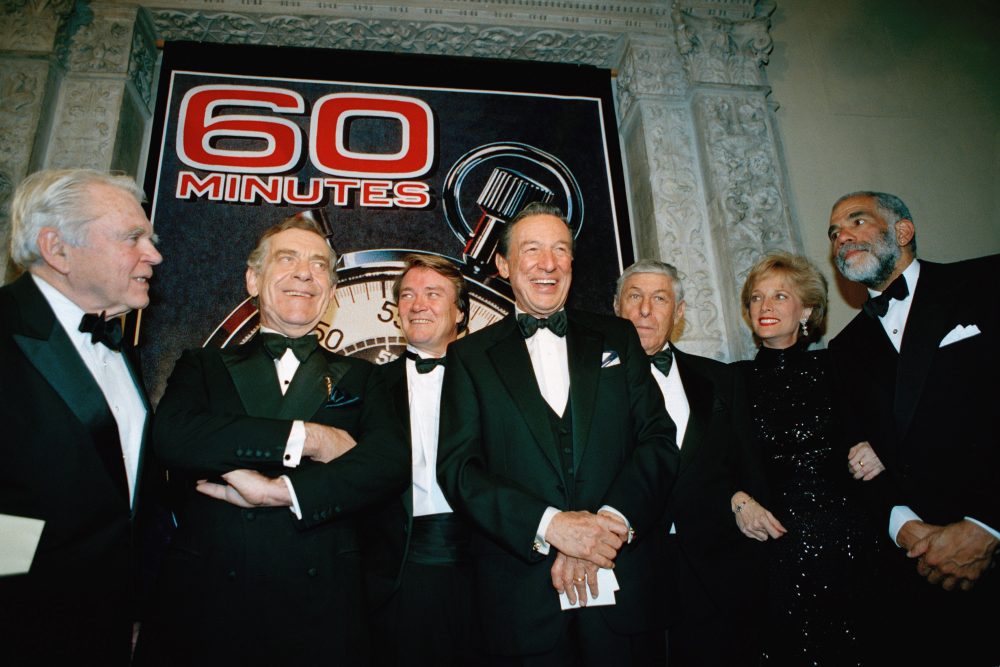

NEW YORK (AP) — When Harry Reasoner launched CBS News’ “60 Minutes” on September 24, 1968, alongside correspondent Mike Wallace, he described the program as “kind of a magazine for television.”
“We do think this is sort of a new approach,” he declared.
Over five decades and 58 seasons later, CBS News leader Bari Weiss is using that identical phrase — “new approach” — to justify dramatic overhauls at television’s most celebrated news program. Her changes include dismissing the executive producer and two correspondents, while bringing in a new leader without television broadcast background. Most recently, one of the program’s most recognizable personalities, Scott Pelley, was terminated following a heated clash with executives.
“We realize, of course, that new approaches are not always instantly accepted,” Reasoner observed during that 1968 debut. Weiss’ transformation has sparked sharp criticism from various quarters. The internal chaos has itself become a major news story, with conflicting accounts emerging — all unfavorable to CBS News.
The crucial question emerging Wednesday: What direction will “60 Minutes” take moving forward? Can the program cease being the subject of headlines, return to its core mission, and preserve its reputation for investigative journalism and legendary dominance in television news? Or is its iconic ticking clock, as some worry, actually counting down to its end?
According to one respected television news expert, something fundamental appeared to have already disappeared Wednesday — perhaps the long-standing belief that “60 Minutes,” which combines traditional values with aggressive reporting, was essentially immune to such upheaval.
“My first response is, it started in 1968 — not a bad run,” said Robert Thompson, director of Syracuse University’s Bleier Center for Television and Popular Culture. “Because it really does look like this is systematically deconstructing what (the show) was.”
However, he immediately clarified: “I don’t think we’re writing the obituary of ’60 Minutes.’ I think there’s just too much value and voltage built into that brand.”
Nevertheless, he identified troubling indicators. The program has suddenly lost four correspondents. Three received terminations, including Pelley, while Anderson Cooper departed voluntarily. Additionally, disturbing allegations have emerged from Pelley. “New management has instructed me to inject falsehoods and bias into a politically sensitive story,” the correspondent and former evening news anchor claimed in a Tuesday statement. “I’ve been told to include assertions that are unverified.”
According to Jeff Fager, former executive producer of “60 Minutes” and author of a book about the show, losing Pelley represents a significant blow.
“I can’t imagine running ’60 Minutes’ without Scott,” said Fager, author of “Fifty Years of 60 Minutes: The Inside Story of Television’s Most Influential News Broadcast.”
“His is the most remarkable body of work in the history of the broadcast,” Fager stated. “It’s hobbled without him.”
A chaotic week of public exposure of internal conflicts continued Wednesday with Weiss addressing staff about Pelley’s termination — followed by Pelley’s response to her comments. In a transcript obtained by The Associated Press, Weiss opened a morning editorial call by stating she was “only interested in working in a newsroom that is built on trust and mutual respect.”
“That foundation was broken on Monday, and despite our attempts to engage with Scott Pelley and to find a way back, unfortunately we weren’t able to do so, and so we had to part ways,” Weiss explained during the call. “We did not want that to happen, but that’s the path that he chose.”
Pelley quickly responded with his own detailed account of their meeting. “Bari Weiss knows what she said is not true,” he stated in a response published by New York Times media reporter Ben Mullin. “In the meeting on Tuesday, in which I was effectively fired, there was no effort to ‘find a way back.’”
Unrest at “60 Minutes” had been apparent for over a year, following President Donald Trump’s lawsuit against the show regarding its editing of a 2024 interview with then-Democratic presidential candidate Kamala Harris. This became part of broader changes at CBS News after Weiss received the new position of editor-in-chief from parent company Paramount late last year, following David Ellison’s appointment as the network’s corporate leader.
Ellison’s company, Skydance, merged with CBS parent company Paramount, which subsequently settled the Trump lawsuit for $16 million, frustrating some at “60 Minutes” — and indirectly causing the departure last month of popular CBS late-night host Stephen Colbert, who had characterized the settlement as “a big fat bribe.”
Internal disagreements at the show became public last Thursday, when Weiss and CBS News President Tom Cibrowski announced their modifications intended for “building a show that thrives in the 21st century.”
They appointed Nick Bilton, a former technology columnist and documentarian, as executive producer, replacing Tanya Simon, a 30-year veteran of the show who had held the top position for approximately one year. Also dismissed were correspondents Sharyn Alfonsi, whose segment about Trump administration deportees in a Salvadoran prison had been suddenly withdrawn by Weiss before airing a month later, and Cecilia Vega.
Four days afterward, a Monday morning staff meeting erupted into hostility when Pelley challenged Bilton, arguing he lacked relevant experience for the role. When Bilton told the meeting that “Bari loves this institution,” Pelley responded, according to accounts of recordings: “She’s murdering ’60 Minutes.’ She does not love this place. She was brought in to kill it and she’s doing exactly that.”
This prompted Weiss, Bilton and others to summon Pelley for the Tuesday meeting, which resulted in his termination. Weiss and Bilton did not respond to interview requests Wednesday.
However, reactions spread throughout the media industry. “This is David Ellison’s ’60 Minutes’ now,” CNN media critic Brian Stelter wrote in his newsletter Wednesday.
What does the program’s future hold? During her staff call Wednesday, Weiss commended some of Pelley’s work on recent “unforgettable stories” and promised Bilton would deliver similar work “in season 59 with the amazing team that’s still there and hopefully from some new people that are going to be joining us.”
No information was provided about those additions. A much broader question concerned whether the confusion at “60 Minutes” would ultimately prove more political in nature — Pelley and others have accused the new leadership of attempting to curry favor with the Trump administration — or represent more of a generational disagreement. Weiss and Bilton have characterized the changes as essential for evolving with contemporary times.
Fager, among others, expresses concern about that explanation. The show, he argued, has successfully adapted over time.
“It hasn’t been running in place — that’s such a misunderstanding of the broadcast,” he explained. “We adapted on a regular basis. Every time there’s been a new leader, there has been significant evolution.”
He recognized that some modification and growth remains always necessary. But observing the past week’s “new approach” develop, he continues worrying about the show’s overall prospects.
“I worry about it,” he said. “I’ve always thought it’s fragile, and I don’t take it for granted.”