
BEIRUT/JERUSALEM – An intensifying unmanned aircraft conflict between Hezbollah and Israeli military forces in southern Lebanon is threatening to derail ongoing diplomatic efforts aimed at establishing regional peace, as Washington and Tehran continue negotiations over broader Middle East stability.
The Iranian-supported militant organization has dramatically escalated its use of inexpensive First Person View kamikaze drones in recent weeks, fundamentally altering the nature of hostilities that commenced when Hezbollah began launching attacks against Israel on March 2, following the start of U.S.-Israeli military operations against Iran.
These fiber-optic cable-controlled unmanned vehicles can bypass Israel’s sophisticated electronic jamming systems, allowing them to strike Israeli forces positioned throughout southern Lebanon during an unstable ceasefire that took effect April 16, one week after the broader regional conflict paused.
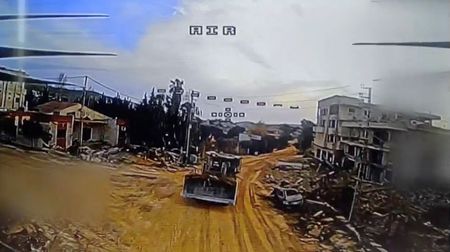
Hezbollah has released video documentation of more than 45 FPV drone strikes, with 28 occurring during the nearly four-week period since the ceasefire halted Israeli bombardments of Lebanon’s capital, though Israel reported targeting a Hezbollah leader there Thursday.
The temporary peace agreement has resulted in Israeli ground troops maintaining control over a buffer zone extending up to six miles from the border, creating concentrated targets in territory familiar to Hezbollah operatives and leaving forces exposed to such precision attacks.
Video evidence from before the ceasefire showed unmanned aircraft striking stationary targets and military vehicles including tanks and construction equipment, with Israel reporting no fatalities. However, since the truce began, Hezbollah has shifted focus toward targeting soldier groups, conducting five documented attacks that resulted in three Israeli military deaths and one contractor fatality according to Israeli reports.
Israel has responded with at least two lethal FPV drone operations against Hezbollah personnel in April, releasing their own aerial footage allegedly showing militant fighters at close range.
The tactical deployment of FPV attack drones originated years ago thousands of miles away in Ukraine, where battlefield positions are protected with defensive netting against Russian drone assaults, and Ukrainian operators are monitoring Hezbollah’s techniques.
“They are amateurs, but they are learning,” stated Dmytro Putiata, a drone warfare specialist with Ukraine’s Unmanned Systems Brigades.
REGIONAL IMPLICATIONS
Iranian officials and Pakistani mediators maintain that any U.S.-Iranian peace framework must include cessation of Israeli military operations in Lebanon to prevent escalation that could restart the broader regional conflict.
U.S.-facilitated direct negotiations between Lebanon’s government and Israel are scheduled to resume Thursday and Friday, though advancement has been limited. Israel demands Lebanon disarm Hezbollah, a requirement that risks renewed violence in a nation that endured civil war from 1975 to 1990.
Youssef el-Zein, Hezbollah’s media relations chief, indicated the organization believes continued Israeli military losses from FPV drone operations could compel an Israeli withdrawal more effectively than diplomatic talks, which Hezbollah rejects.
Israeli forces currently operating in southern Lebanon represent “an opportunity, and not a threat,” as they become easier targets, el-Zein explained.
“We know the enemy’s supremacy, but we also know their points of weakness. We are taking advantage of the points of weakness to create that balance,” el-Zein told journalists.
A Hezbollah military commander revealed that a dedicated drone unit collaborates with the group’s acquisition team to obtain components from multiple markets. These parts undergo inspection for potential Israeli tampering, according to a Lebanese military source familiar with Hezbollah’s drone operations. The organization has maintained heightened vigilance since Israel sabotaged and detonated thousands of their communication devices in 2024.
Hezbollah’s initial FPV video documents an attack from March 22, three weeks into the conflict. The first footage revealing drone components, including explosive warheads, dates to April 11.
“The drones shown in the imagery all show systems assembled from parts commonly made by Chinese enterprises and sold freely on the online marketplaces,” explained Konrad Iturbe, a Spanish-based drone specialist with experience operating and modifying commercial quadcopters.
TECHNICAL CAPABILITIES
A standard drone costs under $400, according to both the Hezbollah commander and an Israeli drone expert. Reuters confirmed attack locations across Lebanon’s entire border region, demonstrating widespread deployment capabilities.
The April 11 footage showed a Russian PG-7L high-explosive anti-tank warhead mounted on the aircraft, according to an unnamed Ukrainian drone operator and a foreign security official monitoring Hezbollah’s unmanned systems. While Hezbollah already possessed these warheads, adapting them for drone use created extended-range precision weapons, the foreign official noted.
When questioned about potential Russian drone expertise assistance, el-Zein stated the group relies on internal specialists.
Established in 1982 with Iranian Revolutionary Guards Corps support, Hezbollah possesses tens of thousands of rockets and precision missiles. The organization began developing drone capabilities in 2004 and deployed them during conflicts in 2006 and 2024.
The Ukrainian drone operator assessed that Hezbollah pilots appeared to have received several weeks of training. The April 11 footage’s spool was consistent with containers holding approximately six miles of fiber-optic cable connecting aircraft and operator – a connection the Hezbollah commander described as crucial.
“The objective is that Israeli radar systems cannot detect them, effectively blinding the enemy,” the commander stated.
ISRAELI COUNTERMEASURES
Israeli Prime Minister Benjamin Netanyahu has acknowledged the drone threat as problematic. “A few weeks ago, I ordered the establishment of a special project to thwart the drone threat… It will take time, but we are on it,” Netanyahu said May 3.
Israeli military forces report nearly daily explosive drone launches against their positions in southern Lebanon. Israel’s Army Radio indicates up to 40 troops have been injured in these attacks.
An Israeli defense official explained that the aircraft are difficult to detect and neutralize due to their small size and “low and slow” flight patterns executed by Hezbollah crews with intimate terrain knowledge.
ALMA, an Israeli research organization, noted that Hezbollah’s ceasefire-period attacks predominantly utilized drones, with video distribution creating “significant psychological impact.”
Israeli critics argue solutions should already exist. The defense official, speaking anonymously about sensitive matters, said no immediate fix was available.
Israel’s defense establishment has studied the Ukrainian drone threat for over a year, the official said. New defensive measures could be implemented within weeks to months.
While advanced technological solutions undergo development, low-tech approaches like protective netting will be deployed, and rifle enhancements are expected to improve drone neutralization capabilities, the defense official indicated.
Israeli forces have also utilized their Iron Dome missile interception system and enhanced radar detection, according to a senior military official. A newly developed drone interception system tested by the Air Force in April failed, the official reported.
Both officials agreed that targeting Hezbollah drone crews represents the most effective defense. Israel published video April 13 showing a target covering his face as a drone approached, and another April 29 targeting a fighter on a motorcycle. Israel has not released images of its own drone operations.
Iturbe observed that some Hezbollah pilots have progressed from simpler fixed-angle flying to diving, accelerating and striking vehicles from above.
“Lesson clearly learned here,” he noted.
However, Hezbollah videos show drones primarily targeting armored vehicles rather than personnel, with limited consecutive strikes on single targets or secondary drone or surveillance footage.
“Individual clips of vehicles being struck are great for political videos, but do not necessarily translate into military effect,” forensic imagery analyst William Goodhind observed.