
The Lebanese militant organization Hezbollah has suffered devastating losses since it launched attacks against Israel on March 2, according to internal casualty estimates from the group itself.
Israeli forces have seized portions of southern Lebanon, forcing hundreds of thousands of Shiite Muslims to flee their homes, while killing what sources describe as several thousand Hezbollah fighters – far more than previously known.
The renewed fighting has also created serious political problems for the Iran-backed organization. Lebanese opposition groups have grown more critical of Hezbollah’s armed status, arguing it repeatedly drags the country into wars with Israel.
For the first time in decades, Lebanon’s government engaged in direct negotiations with Israel last April – a move Hezbollah strongly opposed.
Despite these setbacks, more than a dozen Hezbollah officials told Reuters they believe joining Tehran’s broader conflict with Israel and the United States could ultimately benefit them. The organization, established by Iran’s Revolutionary Guard in 1982, began attacking Israel just two days after the conflict started with American and Israeli strikes on Iran on February 28.
Hezbollah leaders calculate that their involvement will ensure Lebanon becomes part of any future U.S.-Iranian peace talks, potentially securing a stronger ceasefire agreement than the one implemented in November 2024 after the Gaza-related fighting.
The group was severely damaged in the previous war, which resulted in the death of leader Hassan Nasrallah and approximately 5,000 fighters, significantly weakening its control over Lebanon’s government.
With Iranian assistance, Hezbollah has rearmed and adopted new strategies, including drone warfare, demonstrating surprising capabilities after maintaining a fragile 15-month truce during which Israel continued targeting its members.
Hezbollah legislator Ibrahim al-Moussawi rejected claims that the group was following Iran’s orders when it resumed hostilities. He explained to Reuters that Hezbollah saw an opportunity to “break this vicious cycle … where the Israelis can target, assassinate, bombard, kill, without any revenge.”
Al-Moussawi admitted to losses and destruction in southern Lebanon but stated that “you don’t go into making calculations of how many are going to be killed” when “pride and sovereignty and independence” are threatened.
Although a U.S.-brokered ceasefire that began April 16 has reduced fighting significantly, Israel and Hezbollah continue exchanging attacks in the south, where Israeli forces maintain what they call a “buffer zone.”
Yezid Sayigh, a senior fellow at the Carnegie Middle East Center in Beirut, noted that Hezbollah had “shown more resilience than many thought possible, but that was not a strategic gain in itself.”
“The only thing that will contain Israel is a comprehensive U.S.-Iran deal,” Sayigh said. “Without a deal, there’s going to be a lot of pain for everyone. At best, a hurting stalemate.”
Heavy Casualties Mount
Lebanon’s health ministry reports that over 2,600 people have died since March 2, with approximately one-fifth being women, children, and medical workers. The ministry’s count does not separate civilians from combatants.
Three sources, including two Hezbollah officials, revealed that the ministry’s numbers exclude many of the group’s casualties. They confirmed several thousand Hezbollah fighters have been killed, though the organization lacks complete casualty figures.
Hezbollah’s media office disputed the several-thousand figure as inaccurate while acknowledging they don’t have final totals. The group directed Reuters to the health ministry’s statistics.
A Hezbollah commander described how dozens of fighters went to frontline towns like Bint Jbeil and Khiyam prepared to fight to the death. Their remains have not been recovered.
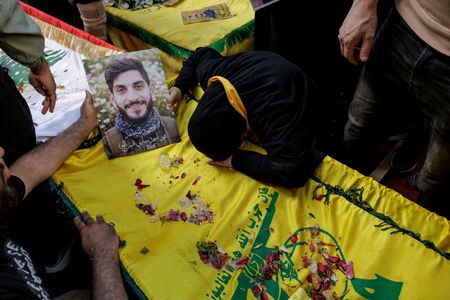
In Hezbollah-controlled southern Beirut neighborhoods, more than two dozen newly excavated graves were rapidly filled with fighters’ bodies in the days following the ceasefire. Simple marble headstones mark some as commanders, others as regular fighters.
The village of Yater alone recorded 34 Hezbollah fighter deaths, according to local council records.
Lebanon’s Shiite Muslim population has suffered the most from Israeli attacks, fleeing to Christian, Druze, and other areas where many residents blame Hezbollah for initiating the war.
Israel has been consolidating control over a security zone extending up to 10 kilometers into Lebanon and destroying villages, claiming the goal is protecting northern Israel from Hezbollah militants operating in civilian areas.
An Israeli government official stated that Hezbollah violated the November 2024 ceasefire by attacking Israeli civilians on March 2. The official said the threat to northern Israel would be eliminated, adding that thousands of Hezbollah militants had been killed and Israel was systematically destroying the group’s infrastructure.
Israeli military reports indicate Hezbollah has launched hundreds of rockets and drones at Israel since March 2. Israel has announced 17 soldier deaths in southern Lebanon and two civilian deaths in northern Israel.
Citing continued Israeli strikes, Hezbollah has dismissed the April ceasefire as meaningless and maintained its attacks.
High-Stakes Gamble
A diplomat with Hezbollah contacts described the group’s war decision as both a major gamble and survival strategy, explaining that it needed to become part of the problem to be included in any eventual regional solution.
Whether this gamble succeeds remains unclear.
Tehran has insisted that Israel’s campaign against Hezbollah be included in any broader war agreement. However, President Trump stated last month that any Washington-Tehran deal “is in no way subject to Lebanon.”
Pakistani Foreign Ministry spokesperson Tahir Andrabi referenced an April 16 statement emphasizing that Lebanese peace was essential to the U.S.-Iran talks Pakistan is mediating.
A Western official suggested the possibility that the U.S. and Iran might eventually reach an agreement that excludes the Lebanese conflict.
The U.S. State Department, Iran’s U.N. mission in Geneva, and Lebanon’s government did not immediately respond to requests for comment.
Hezbollah’s al-Moussawi said a Lebanese ceasefire remains Iran’s top priority, noting that Tehran shares Lebanon’s goals, including stopping Israeli attacks and securing Israeli withdrawal. Hezbollah has “full trust in Iran – that the Iranians will not sell their own friends,” he stated.
The State Department referenced an April 27 Fox News interview where Secretary of State Marco Rubio said Israel had the right to defend itself against Hezbollah attacks and that he didn’t believe Israel wanted to maintain its Lebanese buffer zone permanently.
The United States has urged Israel “to make sure their responses are proportional and targeted,” Rubio said.
When the April 16 ceasefire was announced, Israeli Prime Minister Benjamin Netanyahu declared that Hezbollah’s disarmament would be a fundamental requirement in Lebanese peace negotiations.
Hezbollah has rejected disarmament, stating that its weapons are a matter for national dialogue. Any Lebanese attempt to forcibly disarm the group could spark conflict in a country devastated by civil war from 1975 to 1990.
Lebanese President Joseph Aoun and Prime Minister Nawaf Salam have pursued Hezbollah’s peaceful disarmament since last year. On March 2, the government prohibited the group’s military operations.
Hezbollah has demanded the government reverse that decision and end direct Israeli talks.
Lebanese officials told Reuters they believe direct Israeli negotiations under U.S. supervision offer the best path to securing a lasting ceasefire and Israeli troop withdrawal, as only Washington has sufficient influence with Israel to achieve these objectives.